It’ll be alright on the night (Peter Oswald’s “The Golden Ass”)
After four months in rehearsal, you’d think a play would have a fairly smooth set of dress rehearsals. But with a cast of twenty-something, several score of freshly-made costumes, and only having access to our outdoors venue (a college garden) two days in advance of the play – and being told we could not make noise until the day of the first performance – there was plenty of scope for scares.
Especially given my propensity for forgetting half my lines in Act Two (strange the psychological difference actually having to deliver the lines in a taffeta ball-gown made to my ability to remember them).
We finished the dress rehearsal an hour before we let the audience in, and were still finding scenes we could not get through without corpsing (actors laughing at each other on stage) or things that needed to be re-staged for props to work.
And then suddenly, there they were.
The audience, on their picnic blankets. But from the opening cabaret number, they were entirely on board. There was the odd moment when an item of costume went missing and someone had to grab whatever was to hand, I inserted an extra line in a speech, slightly throwing someone else’s cue, but it all went off brilliantly.
Even the lines I deliver in the ball-gown before waltzing backwards with someone in a wedding dress.
Which was the perfect reason to be drinking until three in the director’s flat on the opening night. One shudders to think what the closing night party will be like – especially given that I and the producer have to go to telephone fundraising training the next day (possibly straight from a cooked breakfast at the director’s).
After a little rain this morning, the sun is out. I hope that holds for tonight’s show.
Tuesday, June 8, 2004
Rough as guts, but finally up
I apologise that it's been a month (blame exams), but new installment Naylor's Canberra is finally up.
For those unfamiliar with the concept once a week (in theory) I publish 1,000 words of a crime novel in draft that starts over here.
Elliot Naylor, a semi-employed law librarian, refused admission as a solicitor following a culpable driving charge, has been hired to find his ex-girlfriend Marina by her father (David Carmichael, a prominent barrister).
Marina works for the Minister for Justice and Customs, a high-profile crusader against the trafficking of women into Australia for sexual slavery. Her father is keen to avoid any embarassment to himself or the Minister, and hope Elliot can find her quickly and quietly.
Elliot's research suggests more is at stake. Carmichael seems to have lied to his wife and daughter about his dealings with a corrupt local businessman (Bob Mitchell). Carmichael, Mitchell and a third man, Ryder, are involved in a property development of dubious environmental impact.
Elliot suspects Marina of absconding with documents. Meanwhile, he discovers the death of Marina's colleague Jenny and Ryder's connections to pornography and prostitution.
A naive attempt to ascertain whether Carmichael was a known face at one of Ryder's brothels earned him bruised ribs (and possibly worse). Frighteningly, the flat next door to Elliot's - mistaken for his - has been trashed.
It is possible the Minister is influencing the police investigation into both Marina's disappearance and Jenny's murder, and that a leak from his office is somehow responsible for Jenny's death.
Leads on Marina's whereabout remaining scant, Elliot (with new girlfriend Danielle and flatmate Eva) returns to Marina's house to interview her flatmate Ted. He suspects Ted of having slept with Marina recently, despite both of them sharing a roof with Trish, Ted's girlfriend.
With that recap in mind, read on ...
Sunday, June 6, 2004
A personal boast (or, “First lines”)
The play opens next week. After rehearsals today we went for drinks, then to “Gala Bingo, Cambridge” (a blog in itself) and then wound up back at the director’s to play “Ex Libris”.
“Ex Libris” is a game where you’re given the title of a novel, a summary of its plot and the name (and dates of birth and death) of the author and then have to write a plausible first line to the novel.
Then you vote on the most convincing opening line submitted (and get double points if you pick the real one). I won the game on the strength of my proposed opening line for Mervyn Peake’s “Gormenghast” (which snagged six votes).
My thinking went like this: British modernist/surrealist, known for long, tortuous gothic passages of description, a man who will set the scene for pages before introducing action.
My first line: “On the north wall of the hall hung a helmet rusted scarlet and dun, presiding over cobwebs and abandoned silence.”
Peake’s Line: “Titus was seven.”
I refused to vote for Peake’s line on the basis that he would never have written a sentence that short …
I also came up, during rehearsal, with a fairly melodramatic opening line for what could be the third Naylor novel, if I ever get that far:
“The English Spring had unfurled around us, but for the body in herringbone tweed nudging against our prow it would have been a fine morning for punting: horse-chestnut blossoms standing like candles against the leaves, gently stirring wires of willow falling in cages across the sluggish green water, the college backs along the Cam stained bloody with poppies”.
There will be more Naylor soon, for its few (and deeply appreciated) readers.
Saturday, June 5, 2004

A plague of angels best avoided
Please, please, please do not waste your life on “Angels in America” on the ABC next week. It will bring you no rewards, no profundity, it may even trash your opinion of the excellent HBO (“The Sopranos”, “Six Feet Under” and “Sex and the City”).
Emma Thompson should be amazing as the archangel with personal oversight of the American dream, but she’s just kinda shouty. Which sums up the package: so self-consciously over-the-top it hurts.
It should be so much better. With its themes of AIDS, gay identity/solidarity, religion and corruption it could be “Six Feet Under” as a contemporary Biblical allegory. The concept of a HIV positive gay man in New York as the Lord’s prophet is brilliant.
A shame the dialogue is so melodramatic you spend the entire experience flinching.
The best line is: “Her? She’s my ex-lover’s new boyfriend’s Mormon mother.”
Thomson (as a hospital nurse with a Brooklyn accent): “Even for New York in the 1980s, that’s weird.”
Despite the huge billing given Thompson (frankly, disappointing), Al Pacino and Meryl Streep the production stands or falls on the performances of Patrick Wilson (a right wing Mormon judicial associate who drafted critical anti-gay rights judgements who’s in the process of coming out of the closet), Justin Kirk (drag queen and prophet) and Ben Shenkman (fairly unlikeable character who runs out on dying lover and spends a lot of time whining about how awful he is for doing so). And they don’t have it, at least not with the lines they’ve been given.
But maybe the unconvincing over-emoting (you can almost here the director yelling “Don’t hold back, emote some more – except you Meryl, just try and look stunned and vacant darling, there’s a dear”) has to do with the script's origins on Broadway where it was originally entitled: “Angels in America: A Gay Fantasia on National Themes”.
I suspect Alan Ball should have been hauled in to handle the TV movie adaptation.
High points? Pacino as a compellingly corrupt lawyer – not that we’ve seen him in that role before – delivers brilliantly the exchange: “I may have sex with men, but I’m not a homosexual, homosexuals are powerless. I pick up that phone and dial sixteen digits, you know who I got on the line?”
“The President.”
“Better, his wife.”
But these moments do not relieve an otherwise unengaging failure of a production with special effects that don’t live up to the average episode of Buffy (you can almost see the wires holding Thompson up).
Okay, it’s amusing to have a travel agent hiding in your fridge.
Still, shame on The Age for just recycling The Washington Post’s delusional ramblings.
Friday, June 4, 2004
Only in Cambridge ...
Could it be said that on the one day I was drinking since noon (LLM farewell drinks at the faculty) and wound up crashing a Law Lord's garden party before going punting.
I can now honestly say I have been off ferretting for a lost croquet ball in Lord Mustill's undergrowth.
I am also in the peculiar position of still not having a confirmed PhD place, but having both funding and someone who is not yet my supervisor advising me to change my topic.
(It seems that Big Names are muscling in on the ole WMD proliferation territory and there may be nothing original left to say in 3 years. Am not yet convinced personally, but will need to do some reading over summer.
It also turns out my LLM dissertation supervisor was on the committee that put my name forward to the scholarship organisation that accepted me. It's who you know, kids ... )
It's a little scary two weeks ahead of results to have people treating me like a sure thing.
Thursday, June 3, 2004

A new set of photos are up

Soon, but not now ...
Went to see an astonishing play in London on Tuesday. (God bless ten pound tickets.) Will need to write soon, reflecting on Shakespeare and the ideas of law, justice, tyranny and abuse of public power.
Listened to jazz (Miles Davis, "Kind of Blue") discreetly on the iPod while visiting these old friends I'd not seen since 1998 in the US, where I had to chase them down across Washington DC, Chicago and New York. Convenient to be able to catch up with them in one place.
My punting is improving.
I had recent good fortune announced to a college bar after closing-time by a friend from Queensland.
Faintly heartbreaking farwell drinks with Professor Allott at "The Lawyer" yesterday. We gave him a globe and I was asked to "say a few words". He described us (essentially a collection of Australians plus a South African, a New Zealander and a Jordanian), kindly, as the most memorable History and Theory class he taught. It was a privelege to be in his last class, and possibly the last History and Theory class ever as no-one is taking over the subject after his retirement.
(PS surely this is too ridiculous for words: outrage over "Play School" featuring a story about Brenna and her two mums going to the amusement park?)
Tuesday, June 1, 2004
Playing devil’s advocate
There’s something in the air again about the academic and young professional “brain drain” and the “unpatriotic” expat intelligentsia. Beth’s had some great posts on the debate, and I basically agree with everything Beth’s had to say.
But the more I think about it, as young professional expat hopefully about to start a PhD in the UK, the more I think the debate risks being fundamentally misconceived and – in a word – parochial.
First off, from where I sit, I do not see people leaving Australia forever. Sure, some do. More, I suspect, gain skills and experience overseas and return with them to Australia – surely a plus.
I also don’t understand why we now have a reverse cultural cringe about expat intellectuals and feel compelled to denigrate any efforts by the likes of Greer, Hughes or Carey to contribute to Australian debates as “out of touch” or as having let the side down by working overseas (especially when like most people working in foreign countries, they probably repatriate a chunk of their income).
Okay, a blogosphere example. Beth, Lyn and I all went to uni and lived most/all of our childhoods or high-school days in the Canberra region. I am now in the UK, Beth is in Melbourne (as I was happily for some time), Lyn is in Sydney.
Is moving inter-state a betrayal of “local” roots in Canberra? No-one would make that argument. But the nation is a “natural” community, isn’t it?
I seriously hope not. The vibrancy of Australian culture comes in large part from a rich migrant tradition. We embrace multiculturalism (and skilled migration) but still see “leaving” as some sort of personal failing. Again, there could be a parochialism at the root of this: “Well, of course people want to come here, but why would they want to leave?”
Also the debate is essentialist. It treats people as having only their national identity and ignores other aspects of the importance of location: moving to a city (wherever in the world) and falling in love with it, or someone in it, or simply reaching a point in your career where (in the small-to-mid sized Australian market) there is nowhere left to go but overseas.
We also undervalue these people as ambassadors for the vibrancy of Australian business, culture and academia.
The real question is not why do people leave, the real question is whether they return – and whether we are doing enough to attract movement in the other direction. Where are the voices we have lured to Australia to enrich our debates, and if there aren’t any, what are we doing wrong?
If Melbourne is the best city in the world for expats to live in, where are the professionals and intelligentsia we’ve lured from overseas? I suspect they’re already there, though we could do more to pull them in – starting with ditching the chip on our shoulder.
(PS The comments on this post have moved over here. My apologies.)
A place called home
Last week Beth wrote on the Australian intelligentsia and those who’ve left home to pursue careers overseas, especially in the 1970s. I found this post quite provocative, not least through being mentioned by name as part of the large Australian professional diaspora. Another reason was that I had something kind of extraordinary happen on Saturday.
I stumbled in from a day’s play rehearsal, punting and drinking to find a letter from this organisation waiting for me. I’ve been offered three years PhD funding. It's an incredibly generous offer.
I have to stress that my Masters marks are not out and the Law School has not accepted me yet (significant unhatched chickens) – but funding is usually the hard bit, so it looks like I have the option of staying on 3 years for my doctorate.
And I’ll take it.
But why? Couldn’t I do a PhD at home?
I’d love to do a PhD in Melbourne, I love the city and it has some great international law research centres. So why will I stay on in the UK if I’m given a chance?
I’ve been unpacking my responses cautiously. The prospect of four years in a foreign country (even speaking the language) scares me. I am a long way from old friends (with a few noble exceptions) and family. If I went home to corporate law or government service I’d be earning and could get a foot on the property ladder. As it is, I may return at 31, broke and with four degrees in tow.
Why stay then?
The biggest draw-card is, to be entirely frank, something my Australian undergraduate supervisor (now head of a major UK law school) said to me over lunch recently: “It’s sad, and it shouldn’t be the case, but you’ll find having a Masters from Cambridge opens doors for you nothing else would.”
The same goes for a PhD. If I want to go into the underpaid, Alice-in-Wonderland world of academic teaching and research (which I do) a PhD is more-or-less vital, and doing a PhD here is potentially career-making.
Is that a sell-out? Well, no. As I commented at Beth’s site – I don’t think the present Australian young-professional-expat community sees itself as turning its back on home, and it comes abroad with a fairly assertive national identity.
In my field, international law, it is hard to imagine being taken seriously If you had not spent some time studying overseas. Further, being based at a European institution, you get to see guest-lecturers and speakers who just don’t get to Australia.
Personally, I also distrust the “easy” option – the thing I would find easiest to do. And, in the lead-up to exams, I would have liked nothing more than to just pack up and come home for good. (As I still intend to do eventually.)
As a small, proud country do we risk missing something? Surely we should be over by now thinking that leaving home is an act of betrayal (not that Beth’s post in anyway suggested this). It’s just as bad as treating those who “made it” overseas as inherently superior (though in some industries, there may only be so far you can go in Australia given our limited population).
Where does the individual fit in this debate? Is Peter Carey less Australian for writing novels with inherently Australian concerns, but while he is living in New York? Or is it the case that “exile” is sometimes the thing that reveals our national identity to us? (It's easy to think of a long list of historical celebrities who did their best work in exile: Ovid, Locke, Grotius, Einstein, Mary and Percy Shelley, Byron, etc.)
I find it amazing how fiercely (almost pardoically) Australian the Australians abroad can become, and anytime I go drinking with Queenslanders, I’m no exception …
(PS due to the joys of technology half the comments on this post are over here.)
Sunday, May 30, 2004
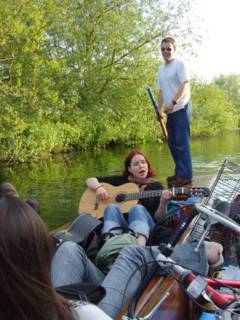
Friday, May 28, 2004
“The Silence of the Cam”
I am now well inside the zone of behaviour marked “Grade A Smug Bastard”.
When your response at 4.30 in the afternoon to the question, “How are you?” is “Rather the worse for cheap champagne” - and minutes later a woman you’ve met once before is stuffing toilet paper down the front of the embarrassingly large deficit in the bodice of your sequined gown – you can be fairly confident that your exams are over.
Wednesday, my exams finished. Yesterday my only commitments were champagne punting and picnicking, and a costume fitting for the play. (In one of my roles, I play an aristocrat, pretending to be a mountain bandit, pretending to be a female dancer. We have decided to pad the dress, rather than have me wear one of the director’s bras.)
Yesterday was possibly one of the most perfect days I’ve had in Cambridge. Sunlight is never quite so cheerful, fresh air quite so refreshing, pretty passers-by quite so pretty, as the day after exams.
And if this city is beautiful in Spring, it is astonishing from the water.
So there we were, two punts full of champagne and strawberry fuelled chaos, me, another early finishing Australian LLM mate, a batch of her college friends and one of the college friends’ assorted Canadian cousins.
“Grantchester or death!” was our watchword, as we steered away from the St John’s punt moorings out into the green, viscous mass of the Cam.
The women were reduced to goo-ing at the sight of what we first took to be ducklings.
“Don’t their parents look rather like geese?” I asked.
“Canadian geese,” a Canadian suggested.
“So,” some random punter asked, “what does that make the babies?”
The answer evaporated into air like a champagne bubble from a cheap plastic cup: “Goose- kittens?”
“Goslings?” I hazarded.
“Why not goose-puppies, huh, huh?”
We were soon debating, as only international lawyers could, whether one could commit piracy on the Cam and what our pirate names should be. Somehow, all the men wound up as “Uncle Boat” – except for Captain Forceps, who explained that prosthetics had come a long way since hooks.
We weren’t exactly rushing. True, it was after two by the time we got the punts unmoored, but by three-ish we’d only just made it under all the college bridges to the landings at The Anchor – and it was already time to send a party out for more champagne before we faced the challenge of “The Rollers”.
I had presumed, idly, that where the Cam rushes down a concrete canal and pours out by Darwin college, there would be a lock.
Instead there’s a 45 degree concrete ramp set with a series of steel rollers. You get out, try and pull/run the punt up it, topple it onto a set of planks embedded in the tow path, shunt it across, and then down a smaller set of rollers on the other side.
Not as easy as it sounds. Still, amidst the mayhem no accidental dunkings.
I had to zip off on my bike (a leisurely ten minute walk away for all our time on the river) to the costume fitting, but then afterwards cycled Grantchester-wards to catch up the crew for the picnic. People were prepared to risk death, apparently, having stopped part way.
Rejoining the party, I was warned to avoid the couple shagging in the undergrowth while stowing my bike (the quaint Spring fertility rites of the British) and was soon drinking, debating, and listening to Newfoundland folk songs with guitar accompaniment.
When it came time to set off home, I volunteered to have a crack at doing some of the standing and pole-pushing, which raised the awkward question of what to do with the bike.
“Just put it in one of the punts!” came the tipsy reply. The chorus rapidly took up the suggestion and we were sailing merrily down the Cam, with a bicycle on board.
I’m not sure that the speeding kayakers knew what to make of us.
“Okay, you though going up the rollers was tough, going back can be scary. Especially if you sit in the punt. It’s white-water punting.”
“White water punting?” I countered. “As an adventure sport that sounds about as scary as extreme fine dining.”
"Well, the only risk is that you sink the punt."
"Ah."
"Ooh, look at the goose-kittens," someone coo-ed.
Someone did sit in the punt going down the rollers: water broke over the bows like a themed movie-park ride (“Brideshead Unlimited II”).
Punting back towards the mathematics bridge we passed a puntful of PhD friends from college.
“That’s some terribly poor punting technique there, man!” taunted the captain of the cricket team.
True, I could make it go forward, or steer, but not both. But I thought my principle achievement was not falling in.
I am going to have to spend more time this Spring messing about in punts.
Sunday, May 23, 2004

Saturday, May 22, 2004
Possibly the worst metaphor in legal history
When is “alcohol” not alcohol? When is a “car” not a car?
Put another way, when is one apple not like another?
No this is not a Sesame Street song, this is actually a critical issue in world trade.
Let’s start on the ground floor. The WTO exists to promote more liberal trade (not so much free trade, as freer trade). One of its most basic rules is that you do not treat imported products that are “like” your domestic products differently from your domestic products.
So if I have an apple tax of 5% on local apples, I can’t slap an extra 10% tax on imported French apples.
(Note, you can still tax nasty foreign apples at the border with a tariff, we’re only talking about not cheating on your tariff promises by whacking on an extra charge on them behind your trading buddies backs once their apples are off the wharf.)
Still awake? Cool.
So, when am I allowed to treat apples differently? The answer is, if they’re different from each other – ie if they’re not actually “like” one another.
So when is an apple not like an apple?
Let’s try an easier one: insulation materials. Is asbestos sheeting “like” fibreglass batts for insulation? No, one is a major carcinogen and risk to health, the other is not. Is a heavily petrol consuming car not “like” a low fuel consuming car? Mmm … maybe not.
See what’s happening here? The test begins to slide from whether things are physically identical (a bit of a philosophical paradox anyway) to taking a peek at whether the government regulation is aimed at protectionism or some legitimate regulatory purpose: health in the case of asbestos, the environment (clean air and preserving fossil fuels) in the case of cars.
The conclusion in WTO law? The meaning of “like” and “like products” is a slippery beast that changes its colour and stripes according to the exact Article of the General Agreement on Tariffs and Trade 1994 in which you find it.
This lead in the “famous” Japan – Alcohol case to what I would argue is the worst literary image ever unleashed on an unsuspecting world in the course of legal reasoning. I give you the words of the World Trade Organisation Appellate Body:
I just have this vision of the Chair of the panel in the middle of submissions whipping out his accordion of likeness for a rousing chorus of the protectionist polka.
Maybe a nice bit of square dance calling: “Take your trade partner by the hand, now do-cee-do and ain’t it grand! Woo hoo!”
My WTO exam is on Monday. Excuse the madness.
PS this just in (via Aileen at wuyuetian) the latest in reality TV: "The Partner" - the legal profession just got scarier ...
When is “alcohol” not alcohol? When is a “car” not a car?
Put another way, when is one apple not like another?
No this is not a Sesame Street song, this is actually a critical issue in world trade.
Let’s start on the ground floor. The WTO exists to promote more liberal trade (not so much free trade, as freer trade). One of its most basic rules is that you do not treat imported products that are “like” your domestic products differently from your domestic products.
So if I have an apple tax of 5% on local apples, I can’t slap an extra 10% tax on imported French apples.
(Note, you can still tax nasty foreign apples at the border with a tariff, we’re only talking about not cheating on your tariff promises by whacking on an extra charge on them behind your trading buddies backs once their apples are off the wharf.)
Still awake? Cool.
So, when am I allowed to treat apples differently? The answer is, if they’re different from each other – ie if they’re not actually “like” one another.
So when is an apple not like an apple?
Let’s try an easier one: insulation materials. Is asbestos sheeting “like” fibreglass batts for insulation? No, one is a major carcinogen and risk to health, the other is not. Is a heavily petrol consuming car not “like” a low fuel consuming car? Mmm … maybe not.
See what’s happening here? The test begins to slide from whether things are physically identical (a bit of a philosophical paradox anyway) to taking a peek at whether the government regulation is aimed at protectionism or some legitimate regulatory purpose: health in the case of asbestos, the environment (clean air and preserving fossil fuels) in the case of cars.
The conclusion in WTO law? The meaning of “like” and “like products” is a slippery beast that changes its colour and stripes according to the exact Article of the General Agreement on Tariffs and Trade 1994 in which you find it.
This lead in the “famous” Japan – Alcohol case to what I would argue is the worst literary image ever unleashed on an unsuspecting world in the course of legal reasoning. I give you the words of the World Trade Organisation Appellate Body:
”The concept of “likeness” is a relative one that evokes the image of an accordion. The accordion of “likeness” stretches and squeezes in different places as different provisions of the WTO agreement are applied. The width of the accordion in any one of those places must be determined by the particular … context … in any given case …”
I just have this vision of the Chair of the panel in the middle of submissions whipping out his accordion of likeness for a rousing chorus of the protectionist polka.
Maybe a nice bit of square dance calling: “Take your trade partner by the hand, now do-cee-do and ain’t it grand! Woo hoo!”
My WTO exam is on Monday. Excuse the madness.
PS this just in (via Aileen at wuyuetian) the latest in reality TV: "The Partner" - the legal profession just got scarier ...
Thursday, May 20, 2004
George Dubyah, John, Tony and Ozymandius
Even the extreme American “legal realists” who pinned the legitimacy of ousting Saddam Hussein on the success of the subsequent nation building must have a feeling of the sand slipping out from their feet about now.
While I have posted comments on those torture photos at other peoples’ blogs, I’ve not blogged on the issue yet myself (I blame the exams that start tomorrow).
But this astonishes me. They let a General who believes Hussein and Bin Laden are the direct tools of Satan (and are waging war on the US on behalf of said anti-Christ), implement the Guantanamo-isation of the Abu Ghraib prison system.
Is it any wonder people under his command treated detainees as sub-human?
Is it any wonder the coalition has been demonised as a “new Crusade”?
This on top of a White House where a lawyer produced a memo (which admittedly sent Powell through the roof) that described the Geneva Conventions as “quaint”.
The imposition of democracy is beginning to look a lot like the imposition of the law of God, which I for one find rather disturbing.
(I had the impression God had left the day to day administration of law up to humanity about the time Moses came down from the mountain. Less flippantly, I though Christian philosophy since Aquinas had been fairly clear that while God may grant the ability to distinguish good and evil, the detail of law was up to us.)
I may have history and theory tomorrow, and maybe that’s why it comes to mind but dear old John Locke (Considerations on Representative Government, 1861) said some time ago:
In other words, if the majority aren’t behind them: “representative institutions are of little value, and may be a mere instrument for tyranny …”
Welcome to western, liberal democracy Iraq. Whether you like it or not.
For lighter fare, with equal rantage, read on ...
Even the extreme American “legal realists” who pinned the legitimacy of ousting Saddam Hussein on the success of the subsequent nation building must have a feeling of the sand slipping out from their feet about now.
While I have posted comments on those torture photos at other peoples’ blogs, I’ve not blogged on the issue yet myself (I blame the exams that start tomorrow).
But this astonishes me. They let a General who believes Hussein and Bin Laden are the direct tools of Satan (and are waging war on the US on behalf of said anti-Christ), implement the Guantanamo-isation of the Abu Ghraib prison system.
Is it any wonder people under his command treated detainees as sub-human?
Is it any wonder the coalition has been demonised as a “new Crusade”?
This on top of a White House where a lawyer produced a memo (which admittedly sent Powell through the roof) that described the Geneva Conventions as “quaint”.
The imposition of democracy is beginning to look a lot like the imposition of the law of God, which I for one find rather disturbing.
(I had the impression God had left the day to day administration of law up to humanity about the time Moses came down from the mountain. Less flippantly, I though Christian philosophy since Aquinas had been fairly clear that while God may grant the ability to distinguish good and evil, the detail of law was up to us.)
I may have history and theory tomorrow, and maybe that’s why it comes to mind but dear old John Locke (Considerations on Representative Government, 1861) said some time ago:
“When … a set of institutions, has the way prepared for it by the opinions, tastes and habits of the people, they are not only more easily inclined to accept it, but will … be … better disposed, to do what is required of them both for the preservation of the institutions, and for bringing them into such action as enables them to produce the best results.”
In other words, if the majority aren’t behind them: “representative institutions are of little value, and may be a mere instrument for tyranny …”
Welcome to western, liberal democracy Iraq. Whether you like it or not.
For lighter fare, with equal rantage, read on ...
Home is where you hang your heart

I’ve had a great time in UK, an amazing time in Cambridge - love the place, lucky to be here – but there should be at immigration, Heathrow terminal 4, a neat little sign “abandon all hope of administrative efficiency all ye who enter here.”
You think Australian banks are bad?
Well, they are.
But they’re burning beacons of dynamic efficiency and customer service than their ole blighty brethren. But if it were only banks, it'd be fine.
Early on, during induction at the Law Faculty, it was declared that the Cambridge system was “You appoint the best people, and the rest sorts itself out.” This accounts, in a nutshell, for the best of the institution (the academic faculty) and its worst (how they run it).
I sometimes wonder if the left hand has even been introduced to the right. Y’know, in passing, at a cocktail function.
I know people who've started referring to this general malaise either as "the new world expectation of efficiency" or just by the simpler "Welcome to England".
All a long winded way of saying you don’t realise what you love about a place until you leave. The reason that Australians are seen in the UK as breezy, cheerful, can-do types who work hard is because – well, we are and we do. (Despite seeing ourselves as laid back, un-entrepreneurial slackers.)
On leaving Australia I have realised I took the following things for granted:
Of course having racked up four cities in as many years, I’ve left a number of other places. So here’s a quick best and worst on each.
Still, I’ve found a community here, and I may yet be around for longer.
Me: “The British couldn’t organise their way out of a damp paper bag. Actually, they’d just sit there and complain about the damp. How did these people run an Empire?”
The Swiss Historian: “They had guns, the natives didn’t.”
I’ve had a great time in UK, an amazing time in Cambridge - love the place, lucky to be here – but there should be at immigration, Heathrow terminal 4, a neat little sign “abandon all hope of administrative efficiency all ye who enter here.”
You think Australian banks are bad?
Well, they are.
But they’re burning beacons of dynamic efficiency and customer service than their ole blighty brethren. But if it were only banks, it'd be fine.
Early on, during induction at the Law Faculty, it was declared that the Cambridge system was “You appoint the best people, and the rest sorts itself out.” This accounts, in a nutshell, for the best of the institution (the academic faculty) and its worst (how they run it).
I sometimes wonder if the left hand has even been introduced to the right. Y’know, in passing, at a cocktail function.
I know people who've started referring to this general malaise either as "the new world expectation of efficiency" or just by the simpler "Welcome to England".
All a long winded way of saying you don’t realise what you love about a place until you leave. The reason that Australians are seen in the UK as breezy, cheerful, can-do types who work hard is because – well, we are and we do. (Despite seeing ourselves as laid back, un-entrepreneurial slackers.)
On leaving Australia I have realised I took the following things for granted:
A bright, sunny winter is not a contradiction in terms, or necessarily a bad thing.
Our grass is different: clumpier, tougher, knottier and needs watering.
We really do have trouble with authority (most Aussies I know have had a run-in with college bursars, porters, manciples or senior tutors over something, even I – who never even got a detention in high-school – have been fined for a smoke-detector violation).
Australian beer has a smoother, more kinda summer-drinking consistency. English ales have a lot of flavour, but sit pretty heavy. (The recent taste-test comparison: a party with a rare six pack of Coopers Green Label. Manna, I tell you, manna.)
Vegemite.
Of course having racked up four cities in as many years, I’ve left a number of other places. So here’s a quick best and worst on each.
Canberra’s best: the guys. The Thursday night gang of red wine and pizza who indulged my weird imaginings. The Sunday brunch crew who were my local community. The Tuesday night dinner party in Yarralumla while it lasted. Ultimate Frisbee. You know who you are, don't believe I don't miss you all.
Proximity to the New South Wales south coast.
Canberra’s worst: Summer and Winter I could both do without. But the nightlife has improved leaps and bounds while I’ve been away, it seems.
Sydney’s worst: my first job. No, I am not a corporate lawyer, nor was meant to be. My first flat and the Worst. Flatmate. Ever.
Sydney’s best: The colleagues who’s cynicism made life bearable. The irreplaceable Mad Rob. (Dude, you’re a legend. Shibby!)
And Balmain, Sunday night jazz, the harbour at night, the ferry trip to work.
Melbourne’s best: my job (working for a judge rocks), my colleagues (other associates, who basically rocked), my bosses PA (who was like an adoptive new age auntie), my lifestyle (reasonable hours, pay, travel time to work and cocktail prices), and the blogger community, which was astonishingly welcoming (thanks Beth!)
Melbourne’s worst: Those summer nights in a house without air conditioning. Winter nights in a house without insulation …
Cambridge’s best: my deranged, dysfunctional, soon-to-disband, international household of madness – my very own family away from family (I came home at lunchtime to discover a water-fight in progress in the kitchen); formal hall in college (it’s wearing the bat-gown with a suit to dinner, I tells ya); having the doors of my legal mind blown wide open by Phillip Allott.
Oh, and central heating. Damn but they can keep winter out in this country.
Cambridge’s worst: Michaelmas Term (rapid descent into winter, freshers from all over the globe bearing exotic flu strains); Lent Term (more winter); the East Anglia wind; and that efficiency thing.
Still, I’ve found a community here, and I may yet be around for longer.
Monday, May 17, 2004
Dammit, now that’s what I call study
Yesterday, I sat in gorgeous spring weather and twenty degree weather, on a picnic rug in the Queen’s college backs, by the Cam.
We observed croquet and punts, I squeaked excitedly about ducks, an acappella group rehearsed nearby (I lost it completely during the “Can you feel the love tonight?” number from the Lion King).
We flopped and lolled and debated the theory of international law.
“I like Kelsen’s reasoning, but he just won’t show you the grundnorm.”
“Can governments have a subjective intent? Or is opinion juris simply speech-act state practice?”
“I like it when Hart calls that idea a meaningless anthropomorphism hiding an empty tautology. It makes me laugh.”
“Can you have two contradictory legal norms that are valid in the same space at the same time?”
“What’s the difference between constutionalism and constitutionalisation?”
We bantered, we debated. I observed, in fine egalitarian style, a punt full of beer-swilling lads float by – a mate running along the tow path, shooting down the bank, using a punt full of tourists as a stepping stone, and leaping in among them.
“You know,” I said, “the rumour is if you fall in the Cam in Trinity Hall’s backs, they have to send you to the nurse. A few years ago a porter’s dog fell in. Died two days later.”
“It does look rather algal.”
We got back to the nature of international society, customary law and the international constitution (we’re confident there is one, really) and reflected that it would have been fabulous if we could have had champagne, strawberries and that amazing professor in a deckchair just giving us a grade for the course based on our conversation.
Best study-group meeting of my life. It even beat revising international criminal law and debating whether universal jurisdiction and state immunity are contradictory concepts over a cooked brunch.
T-minus 10 and counting
In exactly nine days from now, I will be staggering from a grad hall dinner in search of after-dinner drinks, my last ever law exam having been over by that point some five hours.
I do not intend to be sober.
Back here in the present, I think I’ve hit the eye of the storm. I’m tense, but it’s a low background hum. I think I’m working efficiently and methodically. I’m sleeping reasonably well.
Hatches are battened, the wheel house in order, what’s not vital has gone overboard. Maps are out, course plotted; though I know I'll just have to react to what's thrown at me.
Now let’s see how we come through this.
Friday, May 14, 2004
An unusual request
Rather alarmingly, there's been a spate of recent attacks by a knife-weilding cyclist at night out on Jesus Green.
Quite a few warnings have gone round about not walking across poorly lit parks at night, even, it would seem, in company.
It was nonetheless a bit of a surprise to get an e-mail (through a list) today from another international student, a rather muscularly ethical and community-spirited chap it would seem.
I thought about it, and then bit. After all, he's a great guy, very sincere and a keen cricketer. The consequences of him being injured in any altercation would be awful.
He's the only member of the college team who can bowl.
Or bat.
Indeed, he's generally our only hope in the grudge-match against Jesus (the college, not the son of good, prophet or nice chap in sandals depending on your views). Jesus notoriously beat the Hall in a graduate cricket game when they showed up drunk last year.
And continued drinking, throughout the game.
Our team was, rather awfully, sober, trying to the best of their ability and - in the event - soundly thrashed.
Anyway, this was my reply:
He's since told me: "thanks, that's helpful."
Glad my skills could be of use ...
Rather alarmingly, there's been a spate of recent attacks by a knife-weilding cyclist at night out on Jesus Green.
Quite a few warnings have gone round about not walking across poorly lit parks at night, even, it would seem, in company.
It was nonetheless a bit of a surprise to get an e-mail (through a list) today from another international student, a rather muscularly ethical and community-spirited chap it would seem.
I was wondering if any one would be able to enligten me about what laws here say about knocking out/down the attacker (such as the man-on-little-bike) if (1) i see him attacking other people (2) when i am certain that he is the bad guy and he is going to attack me, but before he has actually attacked me (which would mean it won't YET be a self defence)
I thought about it, and then bit. After all, he's a great guy, very sincere and a keen cricketer. The consequences of him being injured in any altercation would be awful.
He's the only member of the college team who can bowl.
Or bat.
Indeed, he's generally our only hope in the grudge-match against Jesus (the college, not the son of good, prophet or nice chap in sandals depending on your views). Jesus notoriously beat the Hall in a graduate cricket game when they showed up drunk last year.
And continued drinking, throughout the game.
Our team was, rather awfully, sober, trying to the best of their ability and - in the event - soundly thrashed.
Anyway, this was my reply:
I'm not a UK lawyer, but from my undergraduate criminal law classes I suspect:
(1) if you see him actually attacking other people, you could step in "in defence of others" - hitting him would be no problem.
(2) if you are certain it's the bad guy (he's cycling towards you, acting threatening and waving a knife) punching him should be fine in self-defence.
The law is usually that you may use "reasonable" force in self-defence (or defence of others), and that's why no-one could give you 100% water-tight legal advice in advance.
If he comes at you with a knife, using your fists (lesser force) is reasonable.
If he is only standing there, yelling, making threats, but not actually doing anything - then attacking with fists (even if he has a knife) is not reasonable.
I have no idea whether the law would think striking back with a cricket bat against a knife-weilder was reasonable, but as this is England it could well be OK.
In the end police take a common-sense approach, and this cyclist is not very popular.
Again, this is only a rough outline to the law, not legal advice.
He's since told me: "thanks, that's helpful."
Glad my skills could be of use ...
Thursday, May 13, 2004
Ch-ch-changes ...
So, I should be studying for my WTO exam.
But last night was the annual dinner at college, with a "Great Gatsby" theme and both "serious" (colour) and "humorous" (costume, sepia) photos.
My three-pound costume consisted of a fake monocle on a ribbon - and shaving my head again. It took a truly evil grin to scrunch up my face muscles enough to keep the monocle in place.
Just call me "the mad baron". (No, do, the photos are here. Yes, I did spend my evening hugging people. That kind of night.)
Anyway, after drinking industrial-strength after-dinner cocktails in the common room until the wee-small hours and walking home with the Italian Sociologist (and near-neighbours the Californian Archaeologist and the Canadian Criminologist) at two this morning I have felt a Gatsby-esque lethargy about work.
The kind accompanied by a sense of fatigue and dehydration.
And euphamisms.
The result has been that rather than study, I've found a new template and tinkered it into what you see before you. It should fix any problems people were having reading the far right hand of the page in some browsers (I hope).
I like it, clap hands and comment if you do to.
Lines from a recent graduate hall dinner
Doug sits down to dine with three people studying international relations (Irish, Russian, and English). A discussion of the appropriate yardstick to judge a government's international action ensues.
Doug: “Don’t give any of this European proportionality, give me a good common law standard of reasonableness.”
Russian guest: “Is that a law joke, or are you flirting?”
Doug: “Can’t I be both?”
Tuesday, May 11, 2004
International law: the law of a half-built international society
(A nutty, utopian vision, complete with leaps of logic)
French Declaration of the Rights of Man: “A society in which the observance of the law is not assured, nor the separation of powers defined, has no constitution at all.”
International law can seem like a mug’s game. It has great promise, but often seems short on real world effects and enforcement. The UN is easily criticised for having realised it has no chance of producing world peace and instead producing endless reports and a rather tedious document numbering system.
But these are cheap shots. One only has to look at the World Bank, IMF or World Trade Organisation to see that international legal structures can have real world effects. One only has to look at refugee law to see international law having a direct affect on individual lives.
Enforcement of every law in society isn’t needed before we say we live under the rule of law. Nor does the fact the law is broken prove it useless or non-existent (that murder still occurs does not invalidate criminal law). A functioning society relies mostly on people having internalised the rules and following them voluntarily or out of a sense of obligation.
States comply with WTO rulings voluntarily for the much the same reason most corporations comply immediately with court orders. States can no more be sent to jail than companies and both could fight off “enforcement” action for some time (economic sanctions or winding-up and deregistration), but both realise they are better off in the long-term with stable rules-based system, even if sometimes it means accepting results against their short-term interests. (This is “regime theory”: the idea that the benefit of a rules-based system in itself can encourage cooperative behaviour out of pure self-interest.)
The problem complicating international law is simple. Law and society are inextricably interlinked. Once people organise into a society, there will be a “legal” dimension to their social system – however unsophisticated or customary.
You cannot have a society without it beginning to generate law, and you cannot have law without a society. International law, the law of the international community, is the law of a society that refuses to see itself as a community.
It is a society that admits its interdependence, but refuses to admit it has any social contract, that in fact sees “social contract” as an oxymoron. It will accept social but unenforceable aspirations (the Universal Declaration of Human Rights) or contractual relations (WTO trade regimes) but remains wedded to the supposedly total freedom of “state sovereignty”.
It’s a society that refuses to see itself (despite the UN Charter) as having a constitution or separation of powers (the International Court of Justice having basically held that it cannot review decisions of the Security Council to establish whether or not they are legal.)
Here’s a simple, old idea. A true society aims at the good of all its members (Aristotle). If all states really were equal in resources, state sovereignty might be an efficient way of aiming at the common good: states are manageable units that might sensibly look after their local people. Letting such equals contract among each other might bring about a civilised and balanced world.
However, to treat as equal that which is not is a form of injustice. As states are not equal, state sovereignty (as a theory upon which to base a society), therefore, promotes injustice.
The only just form of international society would have to start from the premise of a universal society of mankind, and assume that the underlying principles of international law were its unwritten constitution. (To some extent Kant's cosmopolitanism might back this, but you really need to look to early international lawyers like Suarez and Wolff.)
On such a view, states would be holding delegated power from universal society to govern individual countries on trust for all mankind.
If people actually believed this, it would be an interesting world.
Monday, May 10, 2004
Using humour to make your point
This has to be one of the funniest cases I've read for legal equality in a while ...
This has to be one of the funniest cases I've read for legal equality in a while ...
Saturday, May 8, 2004
Heading for hell in a nice multinational handbasket? (Inspiring teachers 2)
Why do big players in international relations get to act like bullies in the playground? Why are important international institutions criticised as remote and imposing developed nation economic and governmental structures on the developing world?
Allott argues with breathtaking clarity that international law has adopted some of the ideology of nineteenth century liberalism, without any of its “constitutional principles”. That is, international law believes in:
However, this has been achieved without any implementation of substantive representative democracy or accountable and transparent government.
Executive governments run international agencies basically free from the constraints of domestic politics, legislation and judicial review. (Governments can sign treaties and vote on policy in the World Bank without media scrutiny, enabling legislation or administrative law challenge.)
International law thus risks becoming a fairly un- or anti-democratic preserve, the domain of unelected bureaucrats, where virtually unaccountable government appointees can re-make world law which they can then “helplessly” take back to national parliaments and say, “Well, we have to pass this into domestic law, the WTO/World Bank/IMF/International Telecommunications Union technical standards committee has told us to and we’ll lose the benefits of membership if we don’t.”
It risks being an unaccountable squeeze by the powerful over the powerless, without any democratic controls.
Allott puts it this way (in “State Responsibility and the unmaking of international law” 29 Harvard ILJ (1988) 1):
Whether you think his point is overblown or not … oh, sod it, it’s plain inspiring. Just point me to the barricades and pass me a tricolore.
Why do big players in international relations get to act like bullies in the playground? Why are important international institutions criticised as remote and imposing developed nation economic and governmental structures on the developing world?
Allott argues with breathtaking clarity that international law has adopted some of the ideology of nineteenth century liberalism, without any of its “constitutional principles”. That is, international law believes in:
a domestic sphere free from legal regulation (state sovereignty); and
a laissez-faire approach to the public sphere (international free trade).
However, this has been achieved without any implementation of substantive representative democracy or accountable and transparent government.
Executive governments run international agencies basically free from the constraints of domestic politics, legislation and judicial review. (Governments can sign treaties and vote on policy in the World Bank without media scrutiny, enabling legislation or administrative law challenge.)
International law thus risks becoming a fairly un- or anti-democratic preserve, the domain of unelected bureaucrats, where virtually unaccountable government appointees can re-make world law which they can then “helplessly” take back to national parliaments and say, “Well, we have to pass this into domestic law, the WTO/World Bank/IMF/International Telecommunications Union technical standards committee has told us to and we’ll lose the benefits of membership if we don’t.”
It risks being an unaccountable squeeze by the powerful over the powerless, without any democratic controls.
Allott puts it this way (in “State Responsibility and the unmaking of international law” 29 Harvard ILJ (1988) 1):
“International law is trapped in the pre-Revolutionary world of the eighteenth century, the world made by Vattel, the world before the American and French Revolutions, before Rousseau and Marx. The international law of the old regime is preventing the emergence of the new international society. As governments further extend their Faustian ambitions into international society and international society becomes the main arena for the human struggle to survive and progress, the highest professional duty now rests on international lawyers to exert eternal vigilance on behalf of the people, because lawyers have power over the law, the only thing which can have power over the government. The task of the contemporary international lawyer is to redeem governments in the name of justice, which is a sort of love, and in the name of humanity, whose interests transcend the interests of states and governments.”
Whether you think his point is overblown or not … oh, sod it, it’s plain inspiring. Just point me to the barricades and pass me a tricolore.
Friday, May 7, 2004
Thursday, May 6, 2004
Procrastination and insomnia
It has set it in. The Fear. I am not studying harder, but sleeping less.
So what better time to not study, and not even make an effort to finish Naylor, but to start new ramblings.
The "Insomulin" (a neologism stolen from Dean Motter) series is now up to three parts.
But the latest one is too long and embarassing to post here, so I've moved the whole set of surreal/baroque little stories (all set in the same world, incidentally) over here, where I hope they'll be happy.
If you like sci-fi or fantasy sort of stuff, you may like these. I may make something more of them once the crime novel is done.
And once the exams are over. Oh, the exams.
Hurm, had not quite counted on that ...
When beginning to lay plans to stay on the UK until Christmas to "wait and see" what might happen with the PhD application, I should perhaps have checked my return air ticket terms and conditions.
The kinda sorta plan was that I'd start a job in London in August and then fly home at Christmas regardless of whether I was going to be working in London or studying Cambridge as of October this year.
Except my return journey expires in September.
Yes, yes, dear reader. I knew this when I left: return tickets are only good for a year. I just mislaid that fact along the way.
So, unless I find something really worth staying for, looks like I'm home in September.
Home and unemployed.
Of course, if I get into the PhD and get funding, I'll have to be back here by October.
Confused yet? I am. And I'd better start applying seriously for jobs in Australia, too, by the look of things ...
Tuesday, May 4, 2004
Teachers who change your world
It was the last ever History and Theory seminar today. The last class Prof. Allott will ever teach before retiring. I don’t think any of the seven of us wanted it to end.
I cannot overstate the impact of this course on my thinking about my professional discipline, public international law. There was no grand final revelation today, thought the entire course is really an explanation of his view of the world, leading up to a final point where (agree with it or not) you’re in a position to get his point.
His aim is to equip you to argue for or against (broadly) all current interpretations of international law and pick your own (though he would obviously be happy if it were his). Extraordinarily ambitious.
When the dust settles, I might try to explain my reaction better. His view of international society and order (and the role of law within it) is commonly dismissed as Utopian, but … well, it demands that you think, engage and not just constrain yourself to the hideous view that international law is a useless Lilliputian effort to restrain the Gulliver of state power with a thousand legal threads (to steal a metaphor from Krauthammer whose view of international law is that negative).
Anyway, this small, dry-witted, modest, Cambridge don with his deliberate enunciation and watery blue-grey eyes has had us dizzy and spellbound since October. Even those convinced they’ll fail the exam rave about him down the pub.
It’s like waking up as a character in Donna Tartt’s “Secret History” – a small, possibly deluded, group of idealists overwhelmed by the intellectual charisma of an unashamed classicist.
But, y’know, without the murder and unhappy endings … so far at least.
Regardless of what happens, this course alone will have been worth the year. It is the one class here that I feel has been an actual education, not just a chance to extend existing knowledge and skills.
It is simply appalling that numbers in this subject at Cambridge have been dropping because it is “too hard”; and worse that this kind of intellectual challenge is slipping out of the education system in general in the face of “commercial reality”, “profit centres” and “relevance” and probably more so because students see it as a luxury than because Law Faculties are not prepared to support them.
That said, I just can’t imagine anyone else teaching this particular course. On the other hand, it’s been one of those experiences that restores your faith in the inestimable value (at any level) of being a teacher.
Life-changing teachers, anyone? I know I can’t be alone here …
Sunday, May 2, 2004
My rapidly diminishing stockpile of rationality
It is now fairly obviously May.
Which deprives me of the slender shield to my sanity of being able to claim my exams start next month. They now start this month. A much scarier prospect.
Indeed, after three years away from full-time study I’d kind of forgotten how one enters the twilight of one’s sanity in an exam period.
The colleges are hushed and closed to visitors. The libraries are full of pale, serious people and piles of undergraduates’ folders and notes. (My favourite so far, three cheerfully gift-wrapping covered binders marked “Culture Wars”). Punting is done elsewhere, in a sun that shines not on us, by tourists.
My moods are up and down, my body clock – with the slightest application of exam pressure – has magically shed its Cambridge conditioning (waking as late as 10.30) to return to my office slave settings (awake by 7.30, but possibly as early as 5.45).
People are going out less, but partying harder it seems when they do.
I am trying with various degrees of willpower and success to prune my social life, fun levels and intake from within the Beer vitamin group.
I oscillate between a confident sense that I am in a good position, and a certain dread that I’ve not really been working hard enough to get the results I need if I want to carry on into the PhD program.
I over-react to some things (finding utterly hysterical the “Sex and Cycling” article in the free local magazine “Cambridge Agenda”), and disregard others with cavalier bravado (the requirement that my committee minutes be a rational and unbiased record of proceedings).
I have sudden surges of energy and productivity, or lethargy and napping.
I am thus the model of a perfectly normal student whose exams start within three weeks and finish within four.
On the upside, today is a good mood day and while I appear to have lost the power of rational conversation with flatmates, I am churning out model essays on the theory of customary international law and global society.
I am also realising that perhaps one of the greatest privileges of my education has been taking Professor Phillip Allott’s history and theory course, which I think has changed me as a lawyer.
I also had a friendly neighbourhood physicist ask if I’d like to share a house with him and some other grads next year, if should I get to stay on.
And as far as non-Cambridge options go, a recruitment agency finally called me back last week, so the plan B of working in London after graduating and some travel may yet come to pass.
Anyway, over soon one way or another, if I can just keep the pace and my sanity.
Strike that. If I can just keep the pace.
Thursday, April 29, 2004
Heart Palpitations
An e-mail exchange between a lawyer writing a thesis on containing weapons of mass destruction by interdicting ships in international waters and his supervisor:
The instantaneous reply:
Thank the sweet merciful gods of international law is all I can say.
An e-mail exchange between a lawyer writing a thesis on containing weapons of mass destruction by interdicting ships in international waters and his supervisor:
Dear Supervisor
I submitted my thesis on Tuesday, and of course by Thursday morning the Security Council has passed a new resolution on domestic measures to contain the proliferation of WMD.
I don't see that anything in the resolution touches directly on interdiction in international waters, and I imagine it would have been a one-sentence issue. (Unless I'm deluding myself.)
Am just faintly worried that my examiners might expect a reference to it, given its appearence before the final submission deadline.
Is it best not to worry - or should I see if it is possible to retrieve a submitted thesis?
Regards
Douglas
The instantaneous reply:
don't worry - the examiners certainly won't think that you should have
added new material at this stage! No need to retrieve the thesis!
Thank the sweet merciful gods of international law is all I can say.
Tuesday, April 27, 2004
When you try to exercise and the universe answers “Boy, who you tryin’ to kid?”
So I turned in my thesis today. Three days early, even after having had the ring-binding prised open by the lovely people at Ryman’s stationers to change the bibliography for something … more consistent.
Perhaps unsurprisingly, this felt a bit anticlimactic.
Perhaps surprisingly I decided the answer was exercise.
Especially as I’d already cycled from “the wrong side of the tracks” to the Law School and back again.
It being close to the end of the calendar month, my reserves of local currency are running a little low. Going to yoga was going to involve: finding a “cash point” (ATM) that dispenses five pound notes; going to my bank and making a manual withdrawal; or going to a supermarket and buying items up to the value of 2.45 and getting five pounds “cash back” (EFTPOS).
Given that British Banks should just have done with it and take down their individual logos and post a nice, accurate “abandon all hope ye who enter here and despair” sign, I was kind of hoping for the cash-point solution to come up trumps. No such luck.
As I didn’t feel like going through the farce of buying something I only just needed at the supermarket, and really didn’t have the kind of camping gear and gritty determination needed for a bank queue, I did what any lateral thinker would do.
I counted my change and decided to go to the pool instead.
Invariably my mid-afternoon plans of swimming (on no less than four occasions now) have been greeted with “I’m sorry sir, we’re closed, but if you consult your almanac, the position of the stars and the speaking clock you’d discover its really much better to come back some other time.”
As a rule, they’re open ‘till seven at night. It’s just that I always arrive during an exception, it seems. And today was no exception to the rule that a Doug who tries to hit the pool at five will meet not water, but polite English indifference.
So I cycled back home again, went to the supermarket, bought 1.25 of sandwich ham and drew out my five pounds.
It takes at least twenty minutes to cycle through peak-hour traffic to Wolfson College for yoga at 6 pm on a Tuesday. After the supermarket stop-off I was close for time.
I struggled with might and main, I veered around roundabouts signalling with gay abandon and laughing devil-may-care into the grills of Range Rovers. I cackled with the superiority of a cyclist skirting the stationary lines of cars backed up twenty deep at lights. I nodded sagely to the cows by the cycle path.
I arrived, panting, to find myself on time and my yoga venue full of “Open University” exam equipment. To wit, desks and papers and “Silence! And Begone! Exams Progresseth!” kind of signs.
Consulting the Porters (as is done in times of crisis) I found yoga had been set back an hour. What does one do to kill such an hour?
One goes and watches “Friends” at the flat of … um … mates … who live in Grange Road. One has tea and Easter eggs and chats and stays to watch the news, slowly abandoning all thought of exercise.
Other than cycling home through the gathering mists.
Damn the locals. They were right. It has got cold and windy again.
Sunday, April 25, 2004

(Punts at the Anchor, click for more riverside frolics.)
Running barefoot over the grass ...
Yesterday was simply too lovely to stay indoors and study.
Fortunately, I had rehearsals as an excuse to get out into the open (and take photos, filed under "Spring Sun") – and we even managed to spend half the day in the gardens where the show will be staged in May week.
Now I’m off to spend ANZAC day evening out by the river, having sent this invitation out by e-mail:
My fellow Australians
Sunday is Anzac day, a day for patriots.
Some will go to a dawn service, but the true blue will rise late the better that they may raise a glass at a pub - and have a beer or octeen.*
Some will cry, "But Doug - there are exams to study for!"
To which I can only answer, is that the spirit that allowed our victorious fallen to overwhelm Attaturk, seize the Dardanelles, strangle Axis shipping and liberate Poland all before tea-time?**
So, The Granta, 6.30, Sunday. Be there.
Cheers
Doug
*A number having a value only in beer maths. Extensive research has only been able to establish it is a number greater than three.
**Sacrifices to historical accuracy and spelling may have been made.
Anything is better than wrapping my head around exceptions to multi-lateral discipline under WTO trading arrangements.
Friday, April 23, 2004
Law in the fourth city - a micro-fiction
(Insomulin part 2, and an apology to those who might have expected Naylor)
If you asked most citizen-subjects of the Fourth City, they would tell you that law was a set of rules. If broken, there were penalties. That was all. The more reflective might laugh and say: “Law is just a word to describe what lawyers do.”
He knew this was wrong. Jonathon Tallow, an advocate to the Court of the First Ward, knew what all lawyers know: law is language used to change the world, to changes lives. The house is sold, the child taken, the convict executed. It even changed the past, annulling contracts, marriages, decisions of the Governor, making them things that had never been.
If law were simply rules, it would not take study to become a lawyer, the law would be open to anyone who could read. But when a lawyer said “innocent”, “reasonable”, “intent” or “equal” it has a meaning the untrained mind cannot divine. Yet, all subjects were deemed by the law to know the law, and more than one man had died for failing to guess what he could never conceive.
Rules, too, would be fixed. They would not be something that could be changed by the mere act of a judge observing them. Law was not a clockwork machine, it was a living thing, formed by the minds of lawyers but existing outside them. It was its a mystery, even to initiates.
This is what Tallow had learned in long training, and he had had the best. He had studied at the College of the Child-in-the-Fields, spacious buildings from the Fourth City’s earliest days (once a free hospital and asylum, and thus called by its detractors “New Bedlam”). He had reached the matter-of-fact realisation that law was, simply, a form of alchemy. By words and ritual it allowed its initiates to change reality. What other word described that?
But no citizen of the Fourth City would call it magic. They were entirely used to it, even if they held the legal profession in awe and suspicion. Even when the Court of First Ward raised a judgement against a fugitive and sent its shadow into the lawless places, this was unremarkable. When a contract was ratified in the shadow of the Court, when literally standing in the looming shadow of the Fist, and the man who later broke it was struck blind, this too was simply the way things were.
But Tallow had studied the Constitution. Not the Governor’s paper authority, but the true basis of the settlement. It could be seen on the face of the Fourth City. First Ward was the area crossed on the longest summer’s day by the moving shadow of an enormous wind-scarred basalt-black plinth, the Fist. Indeed, in the right light it did look like the clenched, defiant hand of a buried giant. Which is what it was.
The Fourth City was an accident. A collision of young history with an old inhabited place. A mislaid colony, and not the first here as any little archaeology could uncover. The giants here were not dead and ossified, nor even truly sleeping; but for them, time was not as it was for short-lived humanity. Yet a pact had been made, a compromise between the colony’s law and the substance-shadow of the giants’ dreaming-lives. Three Cities had preceded them, and each had not survived its pact with these original powers. Tallow, as an initiated lawyer and graduate of New Bedlam knew this, and it troubled him even as he solemnised his first oath-contracts, and saw a judgement raised from the Fist’s shadow stalk out across the City.
Wednesday, April 21, 2004
The best line from a dinner party on Sunday
The South African flatmate surveyed a table of Canadians, Australians a Yank and herself and declared (in this Brit-free, English-speaking, post-colonial environment): “It’s so great to be among people who know the meaning of the word pants.”
The rest of the evening is lost not so much in the mists of time as the mists of a pint of Guiness, a gin and tonic, indeterminate quantities of red and white wine and mead.
There is much to be said for slowly drinking two litres of lemonade on ones own before bedtime.
The exam timetable is out, and so is Paris
Against all expectations (but not unfortunately against actionable legitimate expectations of due process) my law exams start one week earlier than they have in previous years. So the little yellow slip in my college pigeon hole informed me on Saturday.
This means I would no longer be returning from Paris around 1 am on Friday 21 May with at least three more days to swot up.
It means I would be returning around 1 am on the 21st with about 8 hours to locate my material, grab a nap and drag my sorry behind to an examination room.
Not entirely happy Jan, but not entirely dismayed either. My exams are in a neat little cluster and all over in a week. Shame they commence one month today.
At least, contrary to the impression blogging only the interesting(ish) bits of my may generate, I’ve been working …
"Look at moiye, look at moiye, Kimmoiye, look at moiye ploi-se"
Kath & Kim is now making a big splash as a cult cable show in the UK.
Meanwhile I've been giggling every ride to and from the law school at passing a local wok-noodle takeaway joint called, no word of a lie guv'nor, "Kym-moi".
Tuesday, April 20, 2004
Forget-me-not
So, I have by and large rather embarrassingly forgotten everyone's birthday while I've been in the UK. Well, not parents or sister, but everyone else.
So someone mentioned a free web service where once registered you can e-mail your friends and get them to enter their birthdays for you. The website then sends you a reminder three days in advance so you can get your act together in time. Efficient, if slightly impersonal.
I was embarrassed enough to sign up to one of these things, send out four invite e-mails and then promptly forget the whole project.
Until yesterday morning, when I got this e-mail:
I imagine that not only old Vlad, but I too, would be pretty surprised if I managed to send him a singing birthday card.
Though it would earn serious cred, I'd imagine, to get front row seats for an opening night event with old Vlad in tow: "Yup, the tickets are on me you old embalmed, commie dog, you. Birthday treat! My your knees do look a little stiff there, don't they? Here, let me just prop you at an angle with your head on the back of the chair and you feet in that lady's handbag."
I have no idea, however, if he was into gadgets. Though a rotating bow-tie with lights could have livened up proceedings at the Congress of People's Deputies no end.
All I can say is, guys ... thanks for taking my cross-continental pain, anguish and confusion so seriously. And don't believe that I don't know who you are ... or at least that I can't narrow it to a choice of two.
(Which from a field of four, I would admit, shows no great deductive skill ... )
So, I have by and large rather embarrassingly forgotten everyone's birthday while I've been in the UK. Well, not parents or sister, but everyone else.
So someone mentioned a free web service where once registered you can e-mail your friends and get them to enter their birthdays for you. The website then sends you a reminder three days in advance so you can get your act together in time. Efficient, if slightly impersonal.
I was embarrassed enough to sign up to one of these things, send out four invite e-mails and then promptly forget the whole project.
Until yesterday morning, when I got this e-mail:
Happy Birthday.com Reminder:
Don't forget, it's Vladimir Illyich Lenin's birthday on 4/22!
Gift Suggestions:
Singing Birthday Cards
Imagine their surprise when they hear Happy Birthday being sung to them, and a personalized message from you being spoken by one of our narrators!!
How about tickets to a concert or a sporting event?
Get Front Row Seats - Click here
Does he like gadgets? Get 10% off all gadgets now!
Buy Gadgets here
Thanks again for using HappyBirthday.com!
Sincerely,
Your friends at HappyBirthday.com
I imagine that not only old Vlad, but I too, would be pretty surprised if I managed to send him a singing birthday card.
Though it would earn serious cred, I'd imagine, to get front row seats for an opening night event with old Vlad in tow: "Yup, the tickets are on me you old embalmed, commie dog, you. Birthday treat! My your knees do look a little stiff there, don't they? Here, let me just prop you at an angle with your head on the back of the chair and you feet in that lady's handbag."
I have no idea, however, if he was into gadgets. Though a rotating bow-tie with lights could have livened up proceedings at the Congress of People's Deputies no end.
All I can say is, guys ... thanks for taking my cross-continental pain, anguish and confusion so seriously. And don't believe that I don't know who you are ... or at least that I can't narrow it to a choice of two.
(Which from a field of four, I would admit, shows no great deductive skill ... )
Monday, April 19, 2004
How may I procrastinate? Let me count the ways.
With final exams approaching like the comet that wiped out the unsuspecting, un-revising dinosaurs (who really should have started studying earlier to be worth any sympathy), and the English Spring unfolding beyond the cucumber-frame shell of the law library, a young man’s thoughts turn to procrastination.
This weekend I managed to help a friend assemble a bookcase at her new flat, grab a few drinks, attend a play rehearsal and take photos of the budding season of cricket, beer gardens and … um … exams.
Over the Easter long-weekend I managed to take a day trip to the Goth-filled Camden markets where a small consumerist frenzy saw me acquire:
a doe-skin waistcoat (the spitting twin of one I wore as an undergrad I wore ‘til it grew thread-bare and moth-chomped),
a chocolate coloured velvet jacket missing but half-a-button and
the most amazing double-breasted herringbone, calf-length green tweed overcoat with belt.
Yes, I have spent all too much time of late wearing them in various combinations.
After my haul was distributed among various bags, I and the South African flatmate repaired to the World’s End for a pint of Guiness and a gin and tonic (respectively, not each), thus spending the money we saved on lunch through my packing us a lunchbox. After hitting the second-hand book market under Waterloo Bridge, we returned home.
I then went to a dinner, deposited my new overcoat in the hostesses chocolate cake (don’t ask) and managed to deposit the red wine I didn’t drink on my jeans and the carpet. Aye, me.
The weekend before was a movie marathon camped before our large-ish teev for a veritable free-to-air cinematic extravaganza. Saturday was a “girls night in” with one of the flatmates, red wine and ice-cream to watch that most natural of double-bills “American Beauty” and “American Werewolf in Paris”.
A wonderful thematic twinning: both featuring the word “American” in the title, and a kinda sorta militaristic, racial supremacist villain.
Okay, it’s a stretch.
“American Beauty” was sparklingly good on a re-watching. Utterly unsurprising that the writer, Alan Ball, went on to “Six Feet Under”. Still, out of so much that impressed me (especially the visual composition), Kevin Spacey’s performance is a stand-out. His transition from self-created victim to self-obsessed nouveau adolescent, to the gently compassionate man his family actually needs is an extraordinary metamorphosis.
Sunday saw me hoover up: “Crouching Tiger, Hidden Dragon” (swords, revenge, subtitles!), “Shadow of the Vampire” (John Malkovich, Willem Dafoe, post-modern interrogations of authorship and narrative, weirdness!) and “Night of the Living Dead” (sixties suits, bad hair, bad plans, zombies!).
And now I’ve started watching Invader Zim on my laptop (“The pants command me!”), but at least I can sing the doom song on the way to my exam-like … doom.
Sunday, April 18, 2004

Spring in Cambridge
(… and the photos to prove it are up under “New and Old”)
The blossom is out on the trees, and gusting in little white flurries across the roads. The garden beds edging the college courts are gutters of colour, orange, yellow and ochre. The first shorts-wearers and sun-dresses have been sighted. Pallid floppy-haired Englishmen can be seen cycling in light linen jackets and, rather lamentably, checked pink shirts. More sensible women are still wearing the winter-season’s coats of phone-box red. Sun dapples the riverside beer gardens by the river with sprays of shadow and new-minted coins of light, as late as eight each evening. The air is tense with the expectation of that first thunder-crack snap of leather on willow.
By sheer force of contrast, after the washed out bleak dreariness of the English winter I’m beginning to understand the stature of Spring in English literature. That said, randomly rising and falling winds and variable durations of sunshine mean one can plausibly wear anything from a t-shirt and three quarter pants to an overcoat and jeans without looking out of place.
It seems too dreadful for words to be indoors studying.
(Though of course, since writing this, it has helpfully started to rain.)
Sunday, April 11, 2004
Enforced religious observance? (Or, “keeping it bracing”)
Something mysterious has happened to our hot water service over the Easter long weekend. As a matter of Murphy’s law, I wouldn’t be surprised if it had just died. But no, it alternates between providing only cold showers, and providing (if the hot tap is jammed fully open) just bearably tepid showers.
So, being a good graduate student I checked the circuit breakers (all fuses were intact), I checked the hot water service (still warm and clearly still working in some fashion) and I glanced at its electronic control panel (“override”, “extra hour”, “set heating”, “run program”) and then promptly gave up. Being a diligent collection of graduate students, no-one has reported this to college.
I thought we were victims of our own negligence, until at a dinner party last night, someone else told me at their house the hot water was almost off and the electronic timer was in a cupboard locked against their interfering with it.
The conclusion? College logic: “The undergraduates have gone home for Easter, who needs to waste electricity on hot water?”
Um, grad students? Maybe? Foreigners, trapped in Cambridge for the break? No?
We could, of course, monkey with the control panel ourselves. How many degrees could it take to fix an electronic timer? Unfortunately, given my fundamental theory of home maintenance (the more degrees, the more helpless) I think we have more chance of turning it into a light-water fusion reactor.
Anyway, cold showers are certainly proving bracing.
Leading me to a short history of the word “bracing” in my recent life. Rob (also known in these pages as “Mad Rob”, “Madness Boy” or “that awesome flatmate from Coogee”) was something of a man-seal. It was never too soon in the season for him to get down to Coogee Beach and fling himself in Syndey’s still minty Antarctic-fresh early-Spring currents.
He once lured me out on one such quick dip. I retreated (possibly hours ahead of him) to the comparatively warm sand once I’d lost all feeling in my toes and fingers, and the pink flesh under my nails had turned a convincing blue.
“How’d you like them apples?” said Rob, eventually returning from the surf.
(This was nothing unusual. Our conversation slowly accreted enough weird phrases to become its own inter-flatmate patois.)
“It was certainly bracing.”
“Bracing?” snorted Rob, possibly launching into a “The Fast Show” sketch.
Some days later, in the kitchen (why are my weirdest flatmate discussions always in the kitchen?) I found Rob going through one of his muesli-eating phases. Rob could subsist weeks seemingly on a single food type – sometimes salad, sometimes jelly snakes, that week, muesli.
“That high-bran content keeping you regular?” I asked.
“Bracingly so,” he replied.
“Bracingly regular? Wow. Really? Think we should we install a bar-grip in the toilet?”
And then we descended helplessly into giggles at the mention of “bracing” ever after. Ah, potty humour.
But then this was the flat where the weird stuff I said eventually went up on “Doug’s wall of quotes”, including the superbly out-of-context: “If I had any more caffeine today you’d come home to find me naked, licking the wallpaper.”
Actually, I don’t now recall if that had any context, but the talk of muesli and coffee may mean it’s time for breakfast. It is noon, after all.
PS The landlord has been round. Apparently it was a valve all along ...
PPS Naylor is up, for devotees of crime fiction.
Friday, April 9, 2004
Attrition warfare
It's me in the trenches with my laptop, on the other side - doing its best to hem me in with some fairly heavy shelling - is the word limit of my thesis.
I will win, though, dammit.
Of course, my efforts are not necessarily aided by my performance at a vacation formal hall at Emma (Emmanuel College) last night which may also not have assisted my liver, but may have contributed to my reputation as being: (a) an Australian; and (b) amusing.
Note to self: there is only so much red wine a dinner of salmon and vegetables will absorb.
At least I was home in time for "Six Feet Under" ...
Photos are over here.
Wednesday, April 7, 2004

(From The Age's "My Melbourne" series. Click for more.)
Another reason it's impossible to speak common-sense to lawyers
A girlfriend's mother once wisely said to me that when she studied a law unit in a mangement course, for the first time she realised law was not a body of knowledge but its own system of reasoning - a philosophy.
A Cambridge Professor of International Law agrees:
“To learn the law is not to learn law, but to learn to be a lawyer. To be a lawyer is to live through a particular looking-glass, inside a law-world with its own law-mind and its own law-reality.”
P. Allot, The Health of Nations, 2002, p. 38
This is so recognisable, especially when he speaks of law as a “private language” evolving in parallel to ordinary English, using ordinary English words (such as innocent, purpose, intention, reasonable) in a particular way, making it impossible for a non-lawyer to join the debate by using the words in their ordinary meaning.
It's scary, 'cause it's true ...
Tuesday, April 6, 2004
Pub talk at the Eagle: summer shorts and really Eel-y, dangerously hip Ely.
Me: “I liked your e-mail recruiting for the cricket team. It almost made me wish I could throw a ball. The wind is beginning to lose its sting, and the gaps between rainstorms are getting gradually longer - yes, the English summer is on its way. Along with imported strawberries and inappropriate shorts, cricket is one of those things without which summer would not be complete.
While some may chose to spend that season lazing beside rivers and quaffing champagne, the more discerning amongst us elect for the greensward and the thrill of clattering wickets. To feed this passion there exists the Trinity Hall MCR cricket team. This august collective has a long and proud history of sending players boldly into competition, to be thrashed soundly by the other team.
“You too could be part of that tradition.”
Him: “There are always some pretty dire and wrong shorts come the summer.”
Her: “My father doesn’t own any shorts. He doesn’t even own any casual clothing. Everything he owns is a suit.”
Me: “Well, it’s the one thing almost all men look good in I suppose. And it saves a lot of thinking. Not much good in an Australian summer, though. ‘Just popping down to the beach in my casual suit’.”
Him: “Yes, it’s a plan that works well until you get a few days of really hot weather. Or get on the London tube in Summer.
“Then it can only go horribly wrong.”
Me: “Well in an act of gross optimism I bought two pairs of shorts with me …”
Noise of Britons snickering into their beer.
“ … which of course I haven’t worn at all. But rather stupidly, I managed to have them sent after me – so I arrived in Italy in September at the end of Europe’s worst heat wave for a hundred years.”
Her: “In that situation I think I’d just rip the legs off my jeans, you know, into those fashionable little shorts?”
Him: “Are those fashionable?”
Her: “In that, ‘the 80s are back way’. Y’know, retro.”
Him: “Yes, 80s retro, 90s retro, 15 minutes ago retro. It’s hard to keep up.”
Me (looking at a magazine): “Hello, we’re living in the wrong town. Apparently Ely is growing in population and sophistication and is in serious danger of becoming hip.”
Him: “What’s Ely got Cambridge hasn’t? A Cathedral?”
Me: “That is the first thing they mention, yes.”
Him: “What’s the second?”
Me (reading from said Magazine): “A Woolworths on the High Street. As everyone knows Cambridge know longer has a Woolworths on the High Street, or anywhere else.”
General silence.
Me: “Ely. Is it pronounced E-lie, or Eel-ee?”
Him: “Eel-ee. From their historical origins.”
Her: “What origins? Undrained swamp?”
Me (still looking at magazine): “Third thing they have we don’t - hills.”
Him: “They have a hill, yes. With the town on it. Before the fens were drained you had to row out to it.”
Her: “So that’s the reason for their name? Isle-ee, because they used to be an island?”
Him: “No. It’s Eel-ee, because they used to have a lot of eels.”
Me: “You can’t be serious.”
Him: “Deadly.”
Sunday, April 4, 2004

(My Berlin photos are finally up, click on the headline for the latest)
The Berlin Experience (or “Birds of a Feather Flock Together” an entry for
)
After doing Dublin as a solo tourist it was great to go with a flatmate to Berlin. Also, as the flatmate in question is Italian, my pig-ignorant English-speaker status was not an undue encumbrance as his friends were used to speaking to him in English. Two non-German speaking flatmates stranded together in a foreign capital. Excelllent.
But what a group of friends! S. the Italian sociologist spent a summer in Berlin recently and met a really eclectic group of people. I met a correspondent photographer straight back from assignment in Haiti (having seen his Iraq photos on S’s laptop), a fashion designer in her third year of getting an original label off the ground, a medical intern and S himself was staying with a record company promotions officer who routinely sends him batches of free CDs. (Also, in true college-life style, a woman we knew from the grads at college was a native and was able to hang out with us a bit.)
S’s artsy friends seemed pretty much the scene in Mitte, the central district of the old East Berlin, artsy and based around internal migration (most people were not from Berlin, but had moved there because it was cool). It had, for want of a better analogy, terribly Brunswick Street.
Top things about Berlin (for an Australian most comfortable in Canberra and Melbourne): for Western Europe, it’s dirt cheap (ie Australian prices), I had a fabulous hostel http://www.circus-berlin.de/_private/start_ho_e.htm, there’s a very lively bar scene – and they have trams!
Actually, the main thing I enjoyed after a English winter was three days continuous sunlight.
Berlin has a really interesting character. I tried as much as possible to exempt myself from the obligation to be a comprehensive tourist and just hang out with S and the locals where I could (though I did take in the Jewish Museum, the Checkpoint Charlie Museum and the old National Gallery. In a moment of spectacular incompetence and irony I could not actually find the secret police museum at the old Stasi headquarters.) What did I notice, other than the reassuringly familiar metallic whale-song of tram brakes?
Berlin seems a perpetual construction site. Communism imposed an architectural time-bubble on the East, resulting in a lot of buildings with facades like grated chocolate bars, and redevelopment and restoration proceeds at a frightening pace. Also, there are a lot of vacant lots with rubble (the legacy of bombing?), converted to community uses like kids’ playgrounds. The light has a chalky quality, the sky white with dust and the centre is intensely modernist and concretey. It’s one of the first places in Europe I’ve seen park-corners thoroughly trampled, Australian-style, into hard, messy packed earth and dusty plants.
But it has a vitality I really like: not enough trees to alleviate the raw building, but a real zest and relaxed pace of life. As S said to me, you suspect no-one in East Berlin has a full-time job, any time of day the cafés are crowded.
I liked it, and I liked getting behind the scenes. The first night we dined in a local pizzeria in Christburg (where the pizzas were seriously wider than the narrow tables, two easily feeding five people) while the photographer-friend regaled us with tales of Haiti and somehow drew me into an impassioned discussion on the rule of law and merits of international law.
A great three days, which would not have been the same without a flatmate tour-guide.
PS Naylor: a new instalment of Elliot's adventure went up Friday, which even features a handy summary of the plot so far (more or less) and something of a revelation for our amateur detective.
Friday, April 2, 2004

Movies from Heck
Doug: “Hey Lyn, it’s me!”
Lyn: “ … ?”
Doug: “Doug. The one in Cambridge. University friend? Misspent evenings in Canberra featuring red wine and pizza?”
Lyn: “Right. Yeah. Doug. What time is it?”
Doug: “Here or there? Look I figured in the time difference, daylight savings, your office job and how long it must take to get from Balmain to the city, shower, get breakfast …”
Lyn: “And this led you to believe I wake up about five, right?”
Doug: “Well, it seemed sensible.”
Lyn: “It’s really been too long since you had an office job. You sound a bit jittery, too. What’s your coffee count today? Because I’m guessing your waaaaaay over your limit. I know you're a student again, but there's food groups other than caffiene, y’know?”
Doug: “Look, sorry, forgot you’re not a morning person. But there’s something I had to tell you, given your brilliant movie site and all.”
Lyn: “Oooookay.”
Doug: “Well, the Hellboy movie opened it the states today. The New York Times is raving about it. The director, Guillermo del Toro, even turned down a Harry Potter contract to finish it.”
Lyn: “Hellboy?”
Doug: Yeah, the huge red demon-hunting … um … demon from the Mike Mignola comics.”
Lyn: “Yeah, I know. Great art. Incredible use of shadow, high-gothic atmosphere and steam-powered looking machinery at least a mile high. And lots of references to that horror-writer you and the other boys are so obsessed with.”
Doug: “H. P. Lovecraft. You forgot to mention Mignola’s really gratuitous use of both Nazis and Bavarian castles. Anyway, I’ve spent all morning looking at trailers on the movie site. It looks so cool. Think Raiders of the Lost Ark meets City of Lost Children. I was pretty unimpressed by the New York scenes, but once they get inside a decent Nazi Bavarian castle it actually begins to look like Mignola’s work – and the combination of action and Hellboy wry humour seems spot on.”
Lyn: “Didn’t you just have adventures of your own in Germany you should be blogging about, instead? I know Big George as Batman traumatised you a little ...”
Doug: “Well, we’ll have to see if Christian Bale makes up for it in “Batman Begins”, but the only official thing up on the movie site so far is pictures of some Bat-tank with monster-truck tires bogged in a field. Anyway, I just had to tell you who’s playing Hellboy. Ron Perlman. One in The City of Lost Children. A soft-centred strongman with a sort of tender, gritty charm and humour. That Perlman.”
Lyn: “Oh, wow.”
Doug: “Exactly. In a weird twist, the new Halle Berry Catwoman film is being directed by Pitof, the digital effects supervisor from Lost Children, but I don’t think that’s going to save it somehow. It looks like being a travesty beyond comprehension. Berry’s a mystically empowered revenger who brings down an evil cosmetics company that has a sinister secret behind its new anti-aging products.”
Lyn: “Let me guess. Tested on babies?”
Doug: “Much worse. Marketed by Sharon Stone.”
Lyn: “Ouch.”
Subscribe to:
Posts (Atom)

