Keys and Porters 2
So I’m presently in the midst of a four-day stint of life admin between bouts of travel.
Today I was repacking some of my belongings into cardboard boxes in the storage room I’m using at college – and recalled the disaster I had three weeks ago moving my stuff into it.
I’ve partially afforded my recent travel by letting my room go over the summer, but this has meant storing my things. Had I been at the main graduate accommodation complex, this would have just meant schlepping everything down to the storeroom.
But I was at a college satellite property. (“Satellite” in the sense of being closer to the centre of town than, say, the moon.) I was damned if I was going to haul dozens of little boxes a one-hour return trip by bike up to the main grad site.
So I swung access to a basically disused (over summer anyway) bit of office space in college and took several big-ish boxes in by taxi, signed out the one key for the office in question at the Porter’s Lodge, took my first box up a flight of stairs, deposited it and the key on the office floor and left, the door slamming.
With. The. Only. Key. Inside.
There was no other key. Many, many people who have had the use of this room over time have dissipated all spare keys.
I did the only thing you can do in such a situation. I went for a Porter.
The Porter on duty was a big, solid chap with a strong, creased face. Had I been told he’d been hand-carved from something ancient and probably oaken, it would have come as no surprise.
He followed me into a courtyard and looked up at the half-open office window.
“Oh, for a ladder,” he said, phlegmatically.
As it was a weekend, the maintenance department had left all their ladders locked up. We did find an old wooden ladder at the back of the carpenters’ store, in a pile of scrap wood.
“I’ll get it,” I said. “As it was me that locked the keys in, I should go up.”
We trudged back, leaned the ladder up the wall where it stopped two feet below the little mediaeval looking window, all small glass panes set in iron, half-ajar.
“Too short,” was the Porter’s assessment. “How do you feel about going up?”
“That last two feet makes me nervous,” I replied, wondering if we could stand the ladder on a nearby bench.
“Hold this a moment,” said the Porter, putting a foot on a rung.
I grabbed it, presuming he was testing it for strength. Suddenly, he was at the top, with his head in the open half of the window.
“I can see the key,” he said. “If nothing else, I can see the key. Hold on a second.”
He got his fingers inside the frame, then one shoe on the sandstone window ledge, and then he had one black-trousered leg inside the window.
I am tall, but slightly built. I was confident I could have gotten through the small opening the window offered. A man a head taller and built like something recently detached from a cliff face I worried about.
He was poised, half-in and half-out, suspended by little but his fingers. “God, I’m going to kill a Porter,” I though, envisaging him falling head-first onto the flagstones.
Then with a twist and a duck he was in. Minutes later he was standing in the courtyard, dust all over one knee, handing me the key.
“There you are,” he said. “I’ve trees this height at home. Up and down ladders all the time.”
Tuesday, July 20, 2004
Photos from Barcelona
Are now up over here. Florence and Prague may take a little longer.
Is anyone else now viewing the text on this site in a really, really narrow collumn.
It's peeving me ...
Are now up over here. Florence and Prague may take a little longer.
Is anyone else now viewing the text on this site in a really, really narrow collumn.
It's peeving me ...
Saturday, July 17, 2004
Prague: getting the "Kafka" into "Kafka-esque"
Prague did not start so well. My hostel, on first encounter, had an institutional grimness defying the more immediate forms of description. At check in there was a computer and bank-card payment facilities, but everything important was done on loose paper and in large, dog eared ledgers with grid paper.
The buildings are clean to a lawyer's scruple, lino-floored and were repainted cream and brown in recent decade. I would like to say the effect is "post-Soviet", but the prefix would be misleading.
My room, booked as a single, is a twin. One bed mattress is three large lounge cushions pushed together, the other (I discovered on my second night) is foam, but all of one piece. The bedding consists of a translucent polyester bottom sheet that almost covers the "mattress", pillows offering no actual resistence to a head placed on them, and a duvet in several shades of pastel hideousness.
The towel provided is of the type I normally prefix with the word "tea". Very glad to have travelled with my own full-grown towel in the backpack. The toilet on my landing has a window opening onto a space within the walls facing another window for what might once have been another WC, but which is now full of snaking wires. (Very "The Matrix"). On inspection, the space between the walls is a five floor drop into darkness at one end, and open to the sky at the other.
That said, it is cheap and relatively central. (Even if I was informed with bland, bored pragmatism on my first morning that "breakfast included" only referred to groups.)
Prague itself is beautiful, and the food and beer is amazingly cheap. It's proved very easy to meet English-speaking travellers, especially through the plentiful walking tours. That said, six days on the ground may have been excessive. After three days of heavy walking, the sudden return to seasonably warm weather today has made me very sleepy. Sent most of the day napping or reading the international edition of the Guardian in the gorgeous parks surrounding the 1:5 scale replica of the Eiffel tower that overlooks the city.
Can't decide between going home and changing for a jazz club this evening, or just wandering back to the film festival at Sharpshooter Island and watching Chaplin's "The Great Dictator" over a beer. Should go and check out the rather ghoulish-sounding ossuary (chapel made of human bones) in a nearby town tomorrow, but the busses on a Sunday will be difficult and infrequent (it's closed Monday and I'm gone before it opens Tuesday).
Can also see why some are already claiming tourism has ruined Prague: depressingly large strips of poor-quality souvenir shops everywhere.
Still, love the Jewish Quarter and Paris Street. There is an amusing metronome on top of one hill where a 30 metre statue of Stalin once stood. Michael Jackson then put a 30 metre statue of himself up there before one of his concerts, and booked out the hotel facing the hill from across the river. Hysterical. Now the metronome symbolises the ebb and flow of history here at the crossroads of Europe. Apparently, during the EU referendum, it's long red pointer swung between signs reading "yes" and "no".
Sunday, July 11, 2004
Hola from Barcelona
Tip for novice players no. 57: when the locals are sharing flourescent drinks approximately the colour of toxic waste in the Simpsons from huge glass steins with straws in them, take seriously the waiter's expression of surprise when you and your hostel drinking buddies order one a piece.
I have not had such a messy night in some time.
Fortunately, this was Saturday night and I hit Barcelona Tuesday, thus having covered most of my sight-seeing before writing off a day to a hangover.
I thought I had given my heart to Florence, but hussy that I am I find myself spuring Firenze's delights for Barcelona. This is simply an amazing town.
I am in love with the Gothic Quarter and the turn-of-the-century Modernista architecture in surrounding districts. Gauidi's La Pedrera apartment block and Sagrada Familia cathedral are works of genius and well worth the price of admission. I also adore Barcelona Catherdral and the iron-railing enclosed garden of palm trees and white geese in the centre of its cloisters.
I also like the wonderfully open, fun, friendly, casual style of the place - and eating three course Catalan cuisine in the El Raval or La Ribera districts on an 8 euro fixed-price lunch (drinks and service included).
It´s also festival season and there's plenty of free stuff on in the evening. Friday I went to see some amazing contemporary dance in the square between Modern Art Museum and Contemporary Culture Centre (itself an architectural wonderland - three 18th century facades reflected in a huge fourth wall of glass).
Last night I went with some Americans to see the fountains and light show at Montjuic park before heading off for a fabled bar that served shots from a menu of nearly 100 mixed drinks at 1.50 euro a shot.
Things got kinda messy as we had no idea what was in anything we were ordering. This lead to the lapse of judgement involved in ordering the uber-drinks.
Which lead to me declaring I was "just fine" to get the night bus back to the hostel in the rain without a jacket or umbrella.
I do not think I have thrown up as often, or as spectacularly, in some time. Indeed, I´ve not thrown up through excessive drinking since 1999. The wonderful thing about being extraordinarily intoxicated in a foreign city in torrential rain is the complete lack of shame one feels at the rather efficient option of, when the bus pulls up for a stop that is not yours, leaning out and emptying the contents of one´s gullet into the gutter.
I was, needless to say, a tad fragile this morning. (Should not have started my breakfast with a peach, should have skipped straight to the dry bread which I held down rather nicely thank you).
As Waugh put it: "Please believe it was not the quantity, or the quality, but rather the mixture."
What´s been your biggest night on the town lately?
Sunday, July 4, 2004
Milano, Milano
Given the serious damage Milan in a sales season can do to one's wealth I have probably gotten off light. Around 90 euro has netted me two jazz CDs (Brad Mehldau, Cassandra Wilson), some linen pants in a kind of denim blue with a thin brown double pin stripe and a white business shirt with a pattern of fine blue stripes.
I have also risked life and limb, getting used to being zipped around Milan on the back of S's scooter. We could, apparently, have taken a car had he not left his wallet at the metal detector at Stansted airport last week.
His parents have been absolutely lovely to me. Though I might rupture something from the sheer volume and variety of light summer foods and cold pasta that have been pressed upon me.
Basically, it's been a day and a half of taking it easy and ambling around in the heat. We were turned away from the Cathedral interior on the grounds we were wearing shorts and I was happy enough to skip any cultural dimension after the overload in Florence.
Our cultural high point was sipping white martinis on the pavement seating of a bar in a not terribly fashionable lane (eating free prosciutto, melon, artichoke heart salad, white cheese and tomato) talking about common friends and uncertain futures as the orange trams rattled by.
If S lands a job here while he takes a year out to apply to Columbia for a PhD, I will have to come back often. Especially now S has mentioned those fatal words in suit shopping: "outlet store".
Tomorrow I am going back to Firenze to finish off a few sights and to pick up that brown oily-calfskin leather jacket, even though it will blow a 150 euro hole in my budget, I just want it in ways verging on the idolatrous. Still, at the price it would be wasteful not to buy it.
I expect the train trip will advance me a further three hours through what will be my fourth reading of Jonathon Franzen's "The Corrections" - I don't think a book has ever given me so much pleasure on re-reading. I devour the words.
Thinking of that, in a room of a Fireze museum where the American women did indeed come and go, talking of Michelangelo, I heard the following conversation regarding a fresco:
"Mommy, why is the devil eating that man?"
"The pictures are about the seven sins, darling. That man is being punished for gluttony."
"What's gluttony?"
"Well, honey, it used to be a sin to eat too much ..."
Used to be. Glad to know that the statute of limitations applying to the word of the Eternal has run on that one - at least as regards first world consumerism.
Friday, July 2, 2004
Wrapping up in Florence
Milan tomorrow, where I stay with S, the Italian sociologist. (For those with shopping questions, see the comments to the last entry.)
The Campaggio Michelangelo has been great. Very camping ground atmosphere, but 15 to 30 minutes by bus from the station or from Santa Croce. Met a good gang on the first night, but they have all now left. The bar terrace is lively, and the view out to the Duomo spectacular (the camp ground is on the same hill, and is level with the Michelangelo lookout/piazza).
I've done the predictable things, but my favourite site has to be San Miniato al Monte, a monastery church built by benedictines. Spectacular views, fabulous Romanate 11th century interior. Incredibly peaceful, being slightly off the tourist path.
In other news, at the Palazzo Vecchio I attached myself to an Australian Bar Association conference tour group and almost slipped for free into a (second) look around the Uffizzi ...
Wednesday, June 30, 2004
Not dead, just in Florence
Everyone who told me nearly a year ago I needed more than two days in Florence was entirely right.
My opening bid of four days may have to be upped: this place is unfairly burdened with history and art. Yes, it is worth climbing 347 steps to the top of the Duomo and it is worth paying 9.50 euro to see the original of Michaelangelos David (excuse the typos, I cant find the apostrophe key in Italy).
David, despite the "life" size copies littered all over Florence, still hits youl ike a hammer blow when you round the corner in the Accademia. Even better, the hall leading up to it is lined with the "prisoners" - Michelangelos unfinished, partly "uncovered" sculptures. Davids expression is just so richly ambiguous; is it the eerie calm of a man about to enter comabat against impossible odds, or a restrained and serious appreciation of his victory (or humility at the role of divine intevention/inspiration)? His expression is profoundly human, and yet touched with an alien nobility.
In other news, it is hot here. Damn hot. So much for my fears that it might be too cool in the evenings in a two man tent.
I also teamed up with a random buch of English speakers for nights one and two here, all but me were American. The oddest moment was undoubtedly drinking with Americans, in a Florentine Scottish-themed pub, being served by a Spanish waitress.
Friday, June 25, 2004

Graduation day (Part I)
I am now a graduate of Cambridge University. Wow, that is an odd sentence to write, though for “odd” value it pales in comparison to the day itself.
You graduate not by course, but by college. An “admission to degrees” day is one of a college’s flag-days, so you get to come into college seeing the old heraldry a flutter. Indeed, you’ll see a number of colleges flying their colours, as ceremonies run through back to back.
The ceremony begins with a procession from your college to the Senate House (a short walk in our case). You have to march up in graduation order, so in our case it was proceeded by much milling about aimlessly in Front Court, complaining about the cold and the wind and desperately hoping the rain would hold off.
“It’s all fine,” I muttered, “so long as there isn’t a lightning strike.”
Eventually porters and the charmingly dishevelled Praelector (a Classics don with a rumpled blue suit, black gown and mortarboard) lined us up in rows of four in the correct order (by degree, then alphabetically). Being a “law college”, the LLMs were first. I was in the front row, second from the right.
We were given the briefest of pep talks on the ceremony, and then we were off – marching up Senate House passage, the Praelector waving tourists and town citizens out of the way.
As we turned the corner to the formal entrance to the Senate, university constables in tailcoats and top hats pulled back the heavy iron-railing gates to let us pass. Inside the seats were filling up with relatives and guests. We were held in our little rows of four to wait.
I felt strangely elated. The guy to my right, was going first, was nervous about getting the procedure wrong.
“Look at us in the front row,” I said, “not a UK national among us.”
We were a Swiss, an Aussie and two French-Canadians.
“Not much better in the row behind,” he answered.
There was a sudden silence as a man and woman with tall, elaborate silver maces entered, followed by the college Master in a huge woollen scarlet PhD robe and hat (the Santa suit, I’ve heard it called). As he passed the representatives of the university, they doffed their mortar boards.
The Master took up a position on the low stage.
Before anyone spoke, they doffed their mortarboards. After a commencing passage in Latin, everyone was reminded (in English) to switch off mobile phones and not to take photos.
The Master was enthroned (in a small, fairly comfy looking chair) with a cushion in front of him. More hat doffing and Latin.
“Trinity Hall!”
The Praelector gestured for us to follow him, and we first four strode lockstep over black and white tiles. Halt, his hand gestured.
He spread the fingers of his right hand. Each of us took one. He introduced us to the Master - in Latin - as persons of learning and (more dubiously) virtue. Our names were then called. (Thankfully, in English).
On being called, you walked forward, knelt before the Master, assumed an attitude of prayer, and looked him in the eye. The Master clasped your hands in his, pronounced Latin over you and removed his hands. You stood, bowed, took a step back, and proceeded out a side door where someone put a degree certificate into your hand, clad in a little plastic sleeve.
On the steps out into the Passage, the college tutors were meant to assemble to congratulate graduates. We were out so fast the law tutors hadn’t yet arrived, though some tutors were in place.
We milled about on the senate lawns, ordered photos, got degrees on-the-spot framed and remembered to return our fetching salmon-pink rental hoods. We were Cambridge graduates.
Time for drinks and dinner.
Thursday, June 24, 2004
The President’s right to order torture
Politicisation of the public service is a bit of a theme in the blogosphere – but this takes the cake. The New York Times reports that a 2002 memorandum prepared by a government lawyer concluded “that the president's power to use torture to extract information from suspected terrorists is almost unlimited”.
The author was Jay S. Bybee, then the head of Office of Legal Counsel to the Attorney General:
The Bybee memo basically defines torture, under US federal law, very narrowly and requires intent to cause permanent disabling injury, major organ failure or death (along with actually inflicting such injuries) for the crime to be committed. The memo apparently does not consider the much wider Convention Against Torture (CAT) definition relevant, even as a guide to interpretation of the domestic law’s wording. (It is normally accepted that domestic law should be interpreted consistently with international law wherever possible, even where international law has no directly enforceable status in “internal” law.) Article I of the CAT defines torture as:
The memo went straight to White House Counsel Alberto R. Gonzales, who commissioned it, and it apparently (though it strains credulity) never reached President Bush or the Attorney General.
Gonzales is the lawyer whose view that the Geneva Conventions relating to prisoner of war status (GPW) do not apply to the conflict in Afghanistan or Guantanamo Bay detainees, in a clash of memos, prevailed over Colin Powell’s view that they should.
The second Gonzales GPW memo can be found here. One of its reasons for denying GPW status is that it substantially reduces the risk of prosecution under domestic law of any Bush administration official for the war crime of mistreating POWs.
Incidentally, the co-author of the Bybee torture memo was Professor Jonathon Yoo, now a lecturer international law at the University of California in Berkeley, and an advocate of pre-emptive self-defence in his writings for the American Journal of International Law.
The Clinton head of the Office of Legal Counsel had this to say:
This is entirely true. In law there is always a counter-argument, it’s seldom a game of absolute truth. That said, part of the profession must be rigorous analysis of all arguments, an analysis which should not be guided by a view as to the desirable policy outcomes. Indeed, a lawyer who fails to assess all arguments in a balanced way and provides merely instrumentalist advice is arguably in breach of their professional obligations as they may not explain all legal risks properly to their client.
Rather depressingly, this whole affair though seems rather more symptomatic of a culture in western democracy where the “frank and fearless” advice of the public service has been replaced with pressure to simply tell politicians what they want to hear and nothing else.
As for Bybee? He’s apparently a mild and pleasant character in person, and was appointed as a Federal Judge sitting in Las Vegas.
Politicisation of the public service is a bit of a theme in the blogosphere – but this takes the cake. The New York Times reports that a 2002 memorandum prepared by a government lawyer concluded “that the president's power to use torture to extract information from suspected terrorists is almost unlimited”.
The author was Jay S. Bybee, then the head of Office of Legal Counsel to the Attorney General:
The Office of Legal Counsel "is informally called the attorney general's lawyer," said Douglas W. Kmiec, who ran the office in the administrations of President Reagan and the first President Bush. "We used to call it the conscience of the Justice Department."
The Bybee memo basically defines torture, under US federal law, very narrowly and requires intent to cause permanent disabling injury, major organ failure or death (along with actually inflicting such injuries) for the crime to be committed. The memo apparently does not consider the much wider Convention Against Torture (CAT) definition relevant, even as a guide to interpretation of the domestic law’s wording. (It is normally accepted that domestic law should be interpreted consistently with international law wherever possible, even where international law has no directly enforceable status in “internal” law.) Article I of the CAT defines torture as:
“…any act by which severe pain or suffering, whether physical or mental, is intentionally inflicted on a person for such purposes as obtaining from him or a third person information or a confession … when such pain or suffering is inflicted by or at the instigation of or with the consent or acquiescence of a public official or other person acting in an official capacity.”
The memo went straight to White House Counsel Alberto R. Gonzales, who commissioned it, and it apparently (though it strains credulity) never reached President Bush or the Attorney General.
Gonzales is the lawyer whose view that the Geneva Conventions relating to prisoner of war status (GPW) do not apply to the conflict in Afghanistan or Guantanamo Bay detainees, in a clash of memos, prevailed over Colin Powell’s view that they should.
The second Gonzales GPW memo can be found here. One of its reasons for denying GPW status is that it substantially reduces the risk of prosecution under domestic law of any Bush administration official for the war crime of mistreating POWs.
Incidentally, the co-author of the Bybee torture memo was Professor Jonathon Yoo, now a lecturer international law at the University of California in Berkeley, and an advocate of pre-emptive self-defence in his writings for the American Journal of International Law.
The Clinton head of the Office of Legal Counsel had this to say:
"What's depressing about the memo is not that parts of it appear to be wrong," Mr. Dellinger said. "What's depressing is that it's such a one-sided advocacy document."
This is entirely true. In law there is always a counter-argument, it’s seldom a game of absolute truth. That said, part of the profession must be rigorous analysis of all arguments, an analysis which should not be guided by a view as to the desirable policy outcomes. Indeed, a lawyer who fails to assess all arguments in a balanced way and provides merely instrumentalist advice is arguably in breach of their professional obligations as they may not explain all legal risks properly to their client.
Rather depressingly, this whole affair though seems rather more symptomatic of a culture in western democracy where the “frank and fearless” advice of the public service has been replaced with pressure to simply tell politicians what they want to hear and nothing else.
As for Bybee? He’s apparently a mild and pleasant character in person, and was appointed as a Federal Judge sitting in Las Vegas.
Wednesday, June 23, 2004
Being a good corporate global citizen
I am not anti-globalisation, or anti-corporations.
The market is a powerful tool for development, provided it is properly regulated. Otherwise, it will simply do what it does best: concentrate wealth in the hands of those who already have it. It does tend to have the incidental benefit of raising absolute standards of living (a good thing), but will often reinforce relative gaps in wealth.
This is exactly what has happened in global markets since 1945. Average developing-world standards of living have risen, but so has the relative North-South gap. Globalisation, unsurprisingly, favours the strong.
Superficially, at least, it is thus a good thing that the UN is launching (a second) corporate social responsibility compact – a set of voluntary core principles which corporations are encouraged to sign up to, including corporate partnership ventures, including MNCs helping to foster local eco-friendly businesses. It’s fine to acknowledge that to achieve real change governments will have to work increasingly with business.
The worrying aspect is the continuing, behind-closed-doors integration of the trans-national commercial classes with the trans-national diplomatic classes and their combined culture of secrecy or, more politely, “confidentiality”.
In focussing on “partnership” the UN is being constructive, but risks allowing MNCs to trade on the UN’s prestige. I would feel far more comfortable with a transparent certification process, a prestige-based UN stamp of approval on these partnership projects, which could be withdrawn if they fail.
If one thinks of the successes of Fair Trade certified products, this might harness some of the power of consumer pressure and give the UN a little more arms-length distance from these projects.
There is already a worrying democratic deficit in the conduct of international affairs which diplomats and businessmen tend, naturally enough, to be blind to. If you’re used to brokering bilateral deals (be they a corporate merger or a cease-fire agreement) confidentiality is the name of the game.
However, in the exercise of public power on the international stage and multilateral projects that affect the lives of millions of real people, it’s hardly an acceptable way of doing business.
What’s worse is this is the way things are already done. Dozens of inter-government technical and standards-setting bodies are staffed by “industry representatives” not government officials and have often succeeded in universalising proprietary technologies as the relevant international standard.
Such an approach just doesn’t square with the calls from within the UN for civil society to play a more active role in international affairs.
Too many hours at the bar to be posting now
The fact that I have even found the keyboard seems an achievement. Call it a delayed reaction to the good PhD news. (Thanks all for the supportive comments and old-friend e-mails, it means a lot to me, honest.)
So yeah, today. Today was archive fun with the grad students committee VP and Mr Producer. Strange as it may sound, the Middle Combination Room (Grad Students Lounge) is an entirely separate space from the MCR Office, a small room off B staircase where few committee members dare tread. The VP as a committed medieval historian thought we should make the world a better place through effective finding.
Over the course of the day I helped dispose of decade-old lost property, managed some sage nodding, some removal of broken glass (don’t ask) and collated and printed an academic year’s worth of minutes by me and those brave enough to fill in on the weeks I couldn’t take it anymore.
Then I went and bought us sandwiches.
Then I went to have a medical for my new scholarship organisation to prove that I was physically fit to travel to, reside in, and conduct graduate study in Cambridge.
Yes, the Alanis-irony of the moment (and the 38 pound 50 fee) was not wasted on me.
Then another evening as a tele-fund raiser. Including the surreal experience of calling a head-master who was using the same firm of tele-fundraisers to provide infrastructure and training for his fund-raising campaign. A more profound moment of post-modern reflexivity I’m not sure I could have encountered outside of being an actor in “Being John Malcovich”.
Anyway, one of the experiences of the evening was drinking with Mr Producer, a second-generation Iranian immigrant from the People’s Independent Sunshine Republic of California.
It is a continual source of wonder that the most erudite, Wildean wit I have met in Cambridge is a US national (even if the world suspects his passport of being a fake because the page numbers are not in proper sequence).
When we realised a bottle of the house-white at the college bar would cost less split two ways than a pint (the first two times I typed that it came out “punt”) we basically went crazy.
Would that I had stopped there. Or that I had not had a gin and tonic within work hours with the director of development.
Um … where was this going? Oh, I forget. Merry Christmas one and all!
Tuesday, June 22, 2004
Once more unto the boxes
For what seems the millionth damn time I am stuffing the material ephemera of my life (aka “possessions”) into cardboard boxes taken from the local supermarket.
As I have complained before this is a process that has taken me from: Curtin (Canberra), to Coogee and eventually Balmain via a house-sit in Drummoyne (Sydney), Northcote and then Brunswick East (Melbourne), then back home to the parents’ place outside Canberra before coming to Cambridge – where a tenacious cardboard box with strong homing instincts did manage to track me down eventually.
I have been reappraising the contents of that solitary box, kindly packed by the parents in the present process of packing up my room. It did arrive with my suit, which has been useful for all manner of less-than-black-tie occasions. It also contained an extra towel, two bathmats, two Floriade tea-towels and – a little mysteriously – two bright yellow cloth napkins.
In fairness, I had had some towel-related problems on arrival (see the old October 2 “Keys and Porters” tale of woe); but I have never quite found a need for two cloth napkins. However, I may yet wind up inviting some charming person with an obsession with bright primary colours to an intimate candle-lit dinner, in which case I’m set.
The next question is where to store my four or five boxes of possession while I roam Europe, the UK and Australia over the Summer. I’m giving up my present room to save on rent, but other flatmates will be here through to October – so I’m strongly thinking about just stashing most of my stuff in the cupboard under the stairs and leaving my laptop with some PhD friends at their flat.
If, on my return in September, I have a new address, the stats since 1999 will break down as follows:
Number of addresses in the Canberra region – 2;
Number of addresses in Sydney – 4 (2 in Coogee alone);
Number of addresses in Melbourne – 2; and
UK addresses – 2.
It’s enough to make a man want to own property.
Coming soon: tales of a tele-fundraiser, the long wash-up of May Week madness and my initiation into a week-and-a-half old secret society.
Sunday, June 20, 2004
Friday, June 18, 2004
Doom doom doom - go home now!
Law results are published at the Senate House tomorrow. Apparently some dude comes out onto a balcony, reads them out, then tosses a set of papers down to the ground where they are scooped up and posted on boards.
I am not entirely sold on this myth of how things happen.
I do know that results could be posted at any point between 9 am and 4 pm. (Apparently the faculty chair has hinted that it will be earlier rather than later, and I know the examination committee convened at 9 am Thursday to finalise results.)
I also know for a fact that the results are posted by name and division (first, two one, two two, third, fail). Everyone knows what you got. The slim saving grace is the results within divisions are published alphabetically, not by rank order.
You have to go to your college Director of Studies (or "doss" in the slang) to find out where you finished within your division.
Serious nerves about the whole process, especially as the ordinary requirement to stay on for the PhD is a first.
In other news, in my first two hours "live" as a telephone fund raiser I netted my college 1,600 pounds over three years. God bless the occasional generous law firm partner who's at home to take the call. (She even complimented me on my charm.)
Wednesday, June 16, 2004
May week, the best thing about June
Okay, I’m calling half time and taking a breather.
The birth of summer and the death of exams produces a hectic social round in Cambridge called “May Week”, occurring – naturally enough – in June.
May Week kicks off with the Garden Parties of Suicide Sunday: typically hosted by clubs and societies and featuring copious quantities of alcohol and finger food. These first of these starts at 10 am and they run staggered through the day, allowing people to get utterly slaughtered.
Hence, “suicide Sunday”.
Drinking or Boat (ie rowing) Club garden parties often have a dress code, so it’s not uncommon to see a lot of fairly rah-rah looking young Englishmen staggering about in fawn pants, club tie and blue blazers. (Or tie, blazer, shorts and sandals.)
As Sunday was closing night for “Golden Ass”, I kept it fairly restrained with two glasses of Pimms at the Amateur Dramatic Club garden party in the Bursar’s Garden at Corpus Christi (a bewildering maze of ‘courts’ – I stumbled across a full-period-costume rehearsal of “The Merchant of Venice” before I found drinks, and discovered half its cast had been in “Albert’s Bridge” with me).
Rather legendarily, our leading man arrived for the final night’s call 40 minutes late and still inebriated, but was word-perfect throughout the production.
Even if the producer did have to fish him out of the shrubbery before he went on.
It was a great closing night, and I felt I gave my best performances in each of my variety of small parts. However, for the second night running a “wardrobe malfunction” resulted in my taffeta dress bursting a shoulder strap and the audience receiving a flash of man-nipple.
The cast went to dinner afterwards (mmm … bento) and the cast party ran until 6.45 am Monday morning (full cooked breakfast served shortly after dawn), by which time some of the cast had been swimming in the Jesus Green pool.
After the daring pool-raid one friend of the production re-entered the cast party at the director’s flat by the window. A moderately impressive act, given she lives on the first floor (ie the one above ground level).
A refreshing one-hour nap later and I was pitching up with Mr Producer to telephone fund-raising training at college from 10 – 4, prior to our being callers in our college’s alumni appeal later this week.
After that I had time to go home, get into suit and tie and cycle to Wolfson to help judge a debating final for their intensive management-skills course and attend formal hall and make polite dinner conversation until around 10 in the evening.
(I was coherent enough on the clash between creating new vertical structures of international law and horizontally coordinating existing national systems for an academic working on issues in European police integration to demand my email and provide me with his card.)
I collapsed around 10.30, while braver soles participated in the “punt jam” on the river to watch the Trinity College May Ball fireworks.
Yesterday was another day of 10 – 4 training, a Marlowe Society Garden Party (Pimms, scones and jam, strawberries and cream served on the Pembroke Library Lawn) and then the St John’s College May Ball.
At over 100 pounds for an impossible-to-get-anyway non-dining ticket I was expecting a good time – and got it in spades. Along with Trinity College, St John’s is usually one of the “big two” balls and apparently makes the Newsweek top-ten world parties fairly often. Not hard to see why.
As ticket holders you queue at least an hour to get in, ID is checked, as is the UV stamp on your printed ticket. Once security-braceleted you enter the “reception area” (champagne and strawberries) through the amazing St John’s chapel. Beyond that?
Fireworks, a fun-fair and night punting on the riverbanks. A main event tent and three or four other music, cabaret and dance venues. A masseuse I never bothered queuing for. Basically unlimited food and drink. Punts full of ice, vodka drinks and Jamaican beer. The fairy-tale confection of John’s architecture lit up purple and white.
Highlights included old-fashioned “boat swings” at the fair, a Charleston lesson (there was a 1920s theme) and attending part of the Scissor Sisters set at the main event tent: not quite my thing, but they had an amazing stage presence, and it was worth it to see a rocking crowd entirely in black tie and evening gowns. (As was the student security staff, distinguishable only by a coloured sash across their dress-shirt, which amused the musos no end.)
Left a bit after 5, simply not having the stamina to make it through to the 6 am "survivors" group photo.
I could write a lot more, but I have to rest up for the Trinity Hall event this evening (not a ball per se, more a four-venue music extravaganza, but still enjoying a reputation as one of the May Week events) and the Darwin Ball (a graduate college) on Friday. Not certain who’s playing at Trinity Hall, precise details of bands and acts are usually kept under wraps. (That the Scissor Sisters were playing was something you only discovered upon being issued with your ball program.)
I start phone-campaign work Thursday, law marks are out Friday morning, and I leave on my travels on the 29th.
No wonder I feel busy.
Saturday, June 12, 2004
It’ll be alright on the night (Peter Oswald’s “The Golden Ass”)
After four months in rehearsal, you’d think a play would have a fairly smooth set of dress rehearsals. But with a cast of twenty-something, several score of freshly-made costumes, and only having access to our outdoors venue (a college garden) two days in advance of the play – and being told we could not make noise until the day of the first performance – there was plenty of scope for scares.
Especially given my propensity for forgetting half my lines in Act Two (strange the psychological difference actually having to deliver the lines in a taffeta ball-gown made to my ability to remember them).
We finished the dress rehearsal an hour before we let the audience in, and were still finding scenes we could not get through without corpsing (actors laughing at each other on stage) or things that needed to be re-staged for props to work.
And then suddenly, there they were.
The audience, on their picnic blankets. But from the opening cabaret number, they were entirely on board. There was the odd moment when an item of costume went missing and someone had to grab whatever was to hand, I inserted an extra line in a speech, slightly throwing someone else’s cue, but it all went off brilliantly.
Even the lines I deliver in the ball-gown before waltzing backwards with someone in a wedding dress.
Which was the perfect reason to be drinking until three in the director’s flat on the opening night. One shudders to think what the closing night party will be like – especially given that I and the producer have to go to telephone fundraising training the next day (possibly straight from a cooked breakfast at the director’s).
After a little rain this morning, the sun is out. I hope that holds for tonight’s show.
Tuesday, June 8, 2004
Rough as guts, but finally up
I apologise that it's been a month (blame exams), but new installment Naylor's Canberra is finally up.
For those unfamiliar with the concept once a week (in theory) I publish 1,000 words of a crime novel in draft that starts over here.
Elliot Naylor, a semi-employed law librarian, refused admission as a solicitor following a culpable driving charge, has been hired to find his ex-girlfriend Marina by her father (David Carmichael, a prominent barrister).
Marina works for the Minister for Justice and Customs, a high-profile crusader against the trafficking of women into Australia for sexual slavery. Her father is keen to avoid any embarassment to himself or the Minister, and hope Elliot can find her quickly and quietly.
Elliot's research suggests more is at stake. Carmichael seems to have lied to his wife and daughter about his dealings with a corrupt local businessman (Bob Mitchell). Carmichael, Mitchell and a third man, Ryder, are involved in a property development of dubious environmental impact.
Elliot suspects Marina of absconding with documents. Meanwhile, he discovers the death of Marina's colleague Jenny and Ryder's connections to pornography and prostitution.
A naive attempt to ascertain whether Carmichael was a known face at one of Ryder's brothels earned him bruised ribs (and possibly worse). Frighteningly, the flat next door to Elliot's - mistaken for his - has been trashed.
It is possible the Minister is influencing the police investigation into both Marina's disappearance and Jenny's murder, and that a leak from his office is somehow responsible for Jenny's death.
Leads on Marina's whereabout remaining scant, Elliot (with new girlfriend Danielle and flatmate Eva) returns to Marina's house to interview her flatmate Ted. He suspects Ted of having slept with Marina recently, despite both of them sharing a roof with Trish, Ted's girlfriend.
With that recap in mind, read on ...
Sunday, June 6, 2004
A personal boast (or, “First lines”)
The play opens next week. After rehearsals today we went for drinks, then to “Gala Bingo, Cambridge” (a blog in itself) and then wound up back at the director’s to play “Ex Libris”.
“Ex Libris” is a game where you’re given the title of a novel, a summary of its plot and the name (and dates of birth and death) of the author and then have to write a plausible first line to the novel.
Then you vote on the most convincing opening line submitted (and get double points if you pick the real one). I won the game on the strength of my proposed opening line for Mervyn Peake’s “Gormenghast” (which snagged six votes).
My thinking went like this: British modernist/surrealist, known for long, tortuous gothic passages of description, a man who will set the scene for pages before introducing action.
My first line: “On the north wall of the hall hung a helmet rusted scarlet and dun, presiding over cobwebs and abandoned silence.”
Peake’s Line: “Titus was seven.”
I refused to vote for Peake’s line on the basis that he would never have written a sentence that short …
I also came up, during rehearsal, with a fairly melodramatic opening line for what could be the third Naylor novel, if I ever get that far:
“The English Spring had unfurled around us, but for the body in herringbone tweed nudging against our prow it would have been a fine morning for punting: horse-chestnut blossoms standing like candles against the leaves, gently stirring wires of willow falling in cages across the sluggish green water, the college backs along the Cam stained bloody with poppies”.
There will be more Naylor soon, for its few (and deeply appreciated) readers.
Saturday, June 5, 2004

A plague of angels best avoided
Please, please, please do not waste your life on “Angels in America” on the ABC next week. It will bring you no rewards, no profundity, it may even trash your opinion of the excellent HBO (“The Sopranos”, “Six Feet Under” and “Sex and the City”).
Emma Thompson should be amazing as the archangel with personal oversight of the American dream, but she’s just kinda shouty. Which sums up the package: so self-consciously over-the-top it hurts.
It should be so much better. With its themes of AIDS, gay identity/solidarity, religion and corruption it could be “Six Feet Under” as a contemporary Biblical allegory. The concept of a HIV positive gay man in New York as the Lord’s prophet is brilliant.
A shame the dialogue is so melodramatic you spend the entire experience flinching.
The best line is: “Her? She’s my ex-lover’s new boyfriend’s Mormon mother.”
Thomson (as a hospital nurse with a Brooklyn accent): “Even for New York in the 1980s, that’s weird.”
Despite the huge billing given Thompson (frankly, disappointing), Al Pacino and Meryl Streep the production stands or falls on the performances of Patrick Wilson (a right wing Mormon judicial associate who drafted critical anti-gay rights judgements who’s in the process of coming out of the closet), Justin Kirk (drag queen and prophet) and Ben Shenkman (fairly unlikeable character who runs out on dying lover and spends a lot of time whining about how awful he is for doing so). And they don’t have it, at least not with the lines they’ve been given.
But maybe the unconvincing over-emoting (you can almost here the director yelling “Don’t hold back, emote some more – except you Meryl, just try and look stunned and vacant darling, there’s a dear”) has to do with the script's origins on Broadway where it was originally entitled: “Angels in America: A Gay Fantasia on National Themes”.
I suspect Alan Ball should have been hauled in to handle the TV movie adaptation.
High points? Pacino as a compellingly corrupt lawyer – not that we’ve seen him in that role before – delivers brilliantly the exchange: “I may have sex with men, but I’m not a homosexual, homosexuals are powerless. I pick up that phone and dial sixteen digits, you know who I got on the line?”
“The President.”
“Better, his wife.”
But these moments do not relieve an otherwise unengaging failure of a production with special effects that don’t live up to the average episode of Buffy (you can almost see the wires holding Thompson up).
Okay, it’s amusing to have a travel agent hiding in your fridge.
Still, shame on The Age for just recycling The Washington Post’s delusional ramblings.
Friday, June 4, 2004
Only in Cambridge ...
Could it be said that on the one day I was drinking since noon (LLM farewell drinks at the faculty) and wound up crashing a Law Lord's garden party before going punting.
I can now honestly say I have been off ferretting for a lost croquet ball in Lord Mustill's undergrowth.
I am also in the peculiar position of still not having a confirmed PhD place, but having both funding and someone who is not yet my supervisor advising me to change my topic.
(It seems that Big Names are muscling in on the ole WMD proliferation territory and there may be nothing original left to say in 3 years. Am not yet convinced personally, but will need to do some reading over summer.
It also turns out my LLM dissertation supervisor was on the committee that put my name forward to the scholarship organisation that accepted me. It's who you know, kids ... )
It's a little scary two weeks ahead of results to have people treating me like a sure thing.
Thursday, June 3, 2004

A new set of photos are up

Soon, but not now ...
Went to see an astonishing play in London on Tuesday. (God bless ten pound tickets.) Will need to write soon, reflecting on Shakespeare and the ideas of law, justice, tyranny and abuse of public power.
Listened to jazz (Miles Davis, "Kind of Blue") discreetly on the iPod while visiting these old friends I'd not seen since 1998 in the US, where I had to chase them down across Washington DC, Chicago and New York. Convenient to be able to catch up with them in one place.
My punting is improving.
I had recent good fortune announced to a college bar after closing-time by a friend from Queensland.
Faintly heartbreaking farwell drinks with Professor Allott at "The Lawyer" yesterday. We gave him a globe and I was asked to "say a few words". He described us (essentially a collection of Australians plus a South African, a New Zealander and a Jordanian), kindly, as the most memorable History and Theory class he taught. It was a privelege to be in his last class, and possibly the last History and Theory class ever as no-one is taking over the subject after his retirement.
(PS surely this is too ridiculous for words: outrage over "Play School" featuring a story about Brenna and her two mums going to the amusement park?)
Tuesday, June 1, 2004
Playing devil’s advocate
There’s something in the air again about the academic and young professional “brain drain” and the “unpatriotic” expat intelligentsia. Beth’s had some great posts on the debate, and I basically agree with everything Beth’s had to say.
But the more I think about it, as young professional expat hopefully about to start a PhD in the UK, the more I think the debate risks being fundamentally misconceived and – in a word – parochial.
First off, from where I sit, I do not see people leaving Australia forever. Sure, some do. More, I suspect, gain skills and experience overseas and return with them to Australia – surely a plus.
I also don’t understand why we now have a reverse cultural cringe about expat intellectuals and feel compelled to denigrate any efforts by the likes of Greer, Hughes or Carey to contribute to Australian debates as “out of touch” or as having let the side down by working overseas (especially when like most people working in foreign countries, they probably repatriate a chunk of their income).
Okay, a blogosphere example. Beth, Lyn and I all went to uni and lived most/all of our childhoods or high-school days in the Canberra region. I am now in the UK, Beth is in Melbourne (as I was happily for some time), Lyn is in Sydney.
Is moving inter-state a betrayal of “local” roots in Canberra? No-one would make that argument. But the nation is a “natural” community, isn’t it?
I seriously hope not. The vibrancy of Australian culture comes in large part from a rich migrant tradition. We embrace multiculturalism (and skilled migration) but still see “leaving” as some sort of personal failing. Again, there could be a parochialism at the root of this: “Well, of course people want to come here, but why would they want to leave?”
Also the debate is essentialist. It treats people as having only their national identity and ignores other aspects of the importance of location: moving to a city (wherever in the world) and falling in love with it, or someone in it, or simply reaching a point in your career where (in the small-to-mid sized Australian market) there is nowhere left to go but overseas.
We also undervalue these people as ambassadors for the vibrancy of Australian business, culture and academia.
The real question is not why do people leave, the real question is whether they return – and whether we are doing enough to attract movement in the other direction. Where are the voices we have lured to Australia to enrich our debates, and if there aren’t any, what are we doing wrong?
If Melbourne is the best city in the world for expats to live in, where are the professionals and intelligentsia we’ve lured from overseas? I suspect they’re already there, though we could do more to pull them in – starting with ditching the chip on our shoulder.
(PS The comments on this post have moved over here. My apologies.)
A place called home
Last week Beth wrote on the Australian intelligentsia and those who’ve left home to pursue careers overseas, especially in the 1970s. I found this post quite provocative, not least through being mentioned by name as part of the large Australian professional diaspora. Another reason was that I had something kind of extraordinary happen on Saturday.
I stumbled in from a day’s play rehearsal, punting and drinking to find a letter from this organisation waiting for me. I’ve been offered three years PhD funding. It's an incredibly generous offer.
I have to stress that my Masters marks are not out and the Law School has not accepted me yet (significant unhatched chickens) – but funding is usually the hard bit, so it looks like I have the option of staying on 3 years for my doctorate.
And I’ll take it.
But why? Couldn’t I do a PhD at home?
I’d love to do a PhD in Melbourne, I love the city and it has some great international law research centres. So why will I stay on in the UK if I’m given a chance?
I’ve been unpacking my responses cautiously. The prospect of four years in a foreign country (even speaking the language) scares me. I am a long way from old friends (with a few noble exceptions) and family. If I went home to corporate law or government service I’d be earning and could get a foot on the property ladder. As it is, I may return at 31, broke and with four degrees in tow.
Why stay then?
The biggest draw-card is, to be entirely frank, something my Australian undergraduate supervisor (now head of a major UK law school) said to me over lunch recently: “It’s sad, and it shouldn’t be the case, but you’ll find having a Masters from Cambridge opens doors for you nothing else would.”
The same goes for a PhD. If I want to go into the underpaid, Alice-in-Wonderland world of academic teaching and research (which I do) a PhD is more-or-less vital, and doing a PhD here is potentially career-making.
Is that a sell-out? Well, no. As I commented at Beth’s site – I don’t think the present Australian young-professional-expat community sees itself as turning its back on home, and it comes abroad with a fairly assertive national identity.
In my field, international law, it is hard to imagine being taken seriously If you had not spent some time studying overseas. Further, being based at a European institution, you get to see guest-lecturers and speakers who just don’t get to Australia.
Personally, I also distrust the “easy” option – the thing I would find easiest to do. And, in the lead-up to exams, I would have liked nothing more than to just pack up and come home for good. (As I still intend to do eventually.)
As a small, proud country do we risk missing something? Surely we should be over by now thinking that leaving home is an act of betrayal (not that Beth’s post in anyway suggested this). It’s just as bad as treating those who “made it” overseas as inherently superior (though in some industries, there may only be so far you can go in Australia given our limited population).
Where does the individual fit in this debate? Is Peter Carey less Australian for writing novels with inherently Australian concerns, but while he is living in New York? Or is it the case that “exile” is sometimes the thing that reveals our national identity to us? (It's easy to think of a long list of historical celebrities who did their best work in exile: Ovid, Locke, Grotius, Einstein, Mary and Percy Shelley, Byron, etc.)
I find it amazing how fiercely (almost pardoically) Australian the Australians abroad can become, and anytime I go drinking with Queenslanders, I’m no exception …
(PS due to the joys of technology half the comments on this post are over here.)
Sunday, May 30, 2004
Friday, May 28, 2004
“The Silence of the Cam”
I am now well inside the zone of behaviour marked “Grade A Smug Bastard”.
When your response at 4.30 in the afternoon to the question, “How are you?” is “Rather the worse for cheap champagne” - and minutes later a woman you’ve met once before is stuffing toilet paper down the front of the embarrassingly large deficit in the bodice of your sequined gown – you can be fairly confident that your exams are over.
Wednesday, my exams finished. Yesterday my only commitments were champagne punting and picnicking, and a costume fitting for the play. (In one of my roles, I play an aristocrat, pretending to be a mountain bandit, pretending to be a female dancer. We have decided to pad the dress, rather than have me wear one of the director’s bras.)
Yesterday was possibly one of the most perfect days I’ve had in Cambridge. Sunlight is never quite so cheerful, fresh air quite so refreshing, pretty passers-by quite so pretty, as the day after exams.
And if this city is beautiful in Spring, it is astonishing from the water.
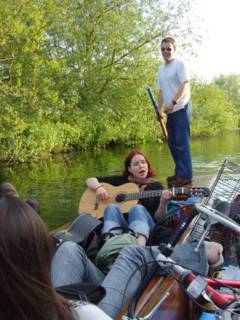
So there we were, two punts full of champagne and strawberry fuelled chaos, me, another early finishing Australian LLM mate, a batch of her college friends and one of the college friends’ assorted Canadian cousins.
“Grantchester or death!” was our watchword, as we steered away from the St John’s punt moorings out into the green, viscous mass of the Cam.
The women were reduced to goo-ing at the sight of what we first took to be ducklings.
“Don’t their parents look rather like geese?” I asked.
“Canadian geese,” a Canadian suggested.
“So,” some random punter asked, “what does that make the babies?”
The answer evaporated into air like a champagne bubble from a cheap plastic cup: “Goose- kittens?”
“Goslings?” I hazarded.
“Why not goose-puppies, huh, huh?”
We were soon debating, as only international lawyers could, whether one could commit piracy on the Cam and what our pirate names should be. Somehow, all the men wound up as “Uncle Boat” – except for Captain Forceps, who explained that prosthetics had come a long way since hooks.
We weren’t exactly rushing. True, it was after two by the time we got the punts unmoored, but by three-ish we’d only just made it under all the college bridges to the landings at The Anchor – and it was already time to send a party out for more champagne before we faced the challenge of “The Rollers”.
I had presumed, idly, that where the Cam rushes down a concrete canal and pours out by Darwin college, there would be a lock.
Instead there’s a 45 degree concrete ramp set with a series of steel rollers. You get out, try and pull/run the punt up it, topple it onto a set of planks embedded in the tow path, shunt it across, and then down a smaller set of rollers on the other side.
Not as easy as it sounds. Still, amidst the mayhem no accidental dunkings.
I had to zip off on my bike (a leisurely ten minute walk away for all our time on the river) to the costume fitting, but then afterwards cycled Grantchester-wards to catch up the crew for the picnic. People were prepared to risk death, apparently, having stopped part way.
Rejoining the party, I was warned to avoid the couple shagging in the undergrowth while stowing my bike (the quaint Spring fertility rites of the British) and was soon drinking, debating, and listening to Newfoundland folk songs with guitar accompaniment.
When it came time to set off home, I volunteered to have a crack at doing some of the standing and pole-pushing, which raised the awkward question of what to do with the bike.
“Just put it in one of the punts!” came the tipsy reply. The chorus rapidly took up the suggestion and we were sailing merrily down the Cam, with a bicycle on board.
I’m not sure that the speeding kayakers knew what to make of us.
“Okay, you though going up the rollers was tough, going back can be scary. Especially if you sit in the punt. It’s white-water punting.”
“White water punting?” I countered. “As an adventure sport that sounds about as scary as extreme fine dining.”
"Well, the only risk is that you sink the punt."
"Ah."
"Ooh, look at the goose-kittens," someone coo-ed.
Someone did sit in the punt going down the rollers: water broke over the bows like a themed movie-park ride (“Brideshead Unlimited II”).
Punting back towards the mathematics bridge we passed a puntful of PhD friends from college.
“That’s some terribly poor punting technique there, man!” taunted the captain of the cricket team.
True, I could make it go forward, or steer, but not both. But I thought my principle achievement was not falling in.
I am going to have to spend more time this Spring messing about in punts.
Sunday, May 23, 2004

Saturday, May 22, 2004
Possibly the worst metaphor in legal history
When is “alcohol” not alcohol? When is a “car” not a car?
Put another way, when is one apple not like another?
No this is not a Sesame Street song, this is actually a critical issue in world trade.
Let’s start on the ground floor. The WTO exists to promote more liberal trade (not so much free trade, as freer trade). One of its most basic rules is that you do not treat imported products that are “like” your domestic products differently from your domestic products.
So if I have an apple tax of 5% on local apples, I can’t slap an extra 10% tax on imported French apples.
(Note, you can still tax nasty foreign apples at the border with a tariff, we’re only talking about not cheating on your tariff promises by whacking on an extra charge on them behind your trading buddies backs once their apples are off the wharf.)
Still awake? Cool.
So, when am I allowed to treat apples differently? The answer is, if they’re different from each other – ie if they’re not actually “like” one another.
So when is an apple not like an apple?
Let’s try an easier one: insulation materials. Is asbestos sheeting “like” fibreglass batts for insulation? No, one is a major carcinogen and risk to health, the other is not. Is a heavily petrol consuming car not “like” a low fuel consuming car? Mmm … maybe not.
See what’s happening here? The test begins to slide from whether things are physically identical (a bit of a philosophical paradox anyway) to taking a peek at whether the government regulation is aimed at protectionism or some legitimate regulatory purpose: health in the case of asbestos, the environment (clean air and preserving fossil fuels) in the case of cars.
The conclusion in WTO law? The meaning of “like” and “like products” is a slippery beast that changes its colour and stripes according to the exact Article of the General Agreement on Tariffs and Trade 1994 in which you find it.
This lead in the “famous” Japan – Alcohol case to what I would argue is the worst literary image ever unleashed on an unsuspecting world in the course of legal reasoning. I give you the words of the World Trade Organisation Appellate Body:
I just have this vision of the Chair of the panel in the middle of submissions whipping out his accordion of likeness for a rousing chorus of the protectionist polka.
Maybe a nice bit of square dance calling: “Take your trade partner by the hand, now do-cee-do and ain’t it grand! Woo hoo!”
My WTO exam is on Monday. Excuse the madness.
PS this just in (via Aileen at wuyuetian) the latest in reality TV: "The Partner" - the legal profession just got scarier ...
When is “alcohol” not alcohol? When is a “car” not a car?
Put another way, when is one apple not like another?
No this is not a Sesame Street song, this is actually a critical issue in world trade.
Let’s start on the ground floor. The WTO exists to promote more liberal trade (not so much free trade, as freer trade). One of its most basic rules is that you do not treat imported products that are “like” your domestic products differently from your domestic products.
So if I have an apple tax of 5% on local apples, I can’t slap an extra 10% tax on imported French apples.
(Note, you can still tax nasty foreign apples at the border with a tariff, we’re only talking about not cheating on your tariff promises by whacking on an extra charge on them behind your trading buddies backs once their apples are off the wharf.)
Still awake? Cool.
So, when am I allowed to treat apples differently? The answer is, if they’re different from each other – ie if they’re not actually “like” one another.
So when is an apple not like an apple?
Let’s try an easier one: insulation materials. Is asbestos sheeting “like” fibreglass batts for insulation? No, one is a major carcinogen and risk to health, the other is not. Is a heavily petrol consuming car not “like” a low fuel consuming car? Mmm … maybe not.
See what’s happening here? The test begins to slide from whether things are physically identical (a bit of a philosophical paradox anyway) to taking a peek at whether the government regulation is aimed at protectionism or some legitimate regulatory purpose: health in the case of asbestos, the environment (clean air and preserving fossil fuels) in the case of cars.
The conclusion in WTO law? The meaning of “like” and “like products” is a slippery beast that changes its colour and stripes according to the exact Article of the General Agreement on Tariffs and Trade 1994 in which you find it.
This lead in the “famous” Japan – Alcohol case to what I would argue is the worst literary image ever unleashed on an unsuspecting world in the course of legal reasoning. I give you the words of the World Trade Organisation Appellate Body:
”The concept of “likeness” is a relative one that evokes the image of an accordion. The accordion of “likeness” stretches and squeezes in different places as different provisions of the WTO agreement are applied. The width of the accordion in any one of those places must be determined by the particular … context … in any given case …”
I just have this vision of the Chair of the panel in the middle of submissions whipping out his accordion of likeness for a rousing chorus of the protectionist polka.
Maybe a nice bit of square dance calling: “Take your trade partner by the hand, now do-cee-do and ain’t it grand! Woo hoo!”
My WTO exam is on Monday. Excuse the madness.
PS this just in (via Aileen at wuyuetian) the latest in reality TV: "The Partner" - the legal profession just got scarier ...
Thursday, May 20, 2004
George Dubyah, John, Tony and Ozymandius
Even the extreme American “legal realists” who pinned the legitimacy of ousting Saddam Hussein on the success of the subsequent nation building must have a feeling of the sand slipping out from their feet about now.
While I have posted comments on those torture photos at other peoples’ blogs, I’ve not blogged on the issue yet myself (I blame the exams that start tomorrow).
But this astonishes me. They let a General who believes Hussein and Bin Laden are the direct tools of Satan (and are waging war on the US on behalf of said anti-Christ), implement the Guantanamo-isation of the Abu Ghraib prison system.
Is it any wonder people under his command treated detainees as sub-human?
Is it any wonder the coalition has been demonised as a “new Crusade”?
This on top of a White House where a lawyer produced a memo (which admittedly sent Powell through the roof) that described the Geneva Conventions as “quaint”.
The imposition of democracy is beginning to look a lot like the imposition of the law of God, which I for one find rather disturbing.
(I had the impression God had left the day to day administration of law up to humanity about the time Moses came down from the mountain. Less flippantly, I though Christian philosophy since Aquinas had been fairly clear that while God may grant the ability to distinguish good and evil, the detail of law was up to us.)
I may have history and theory tomorrow, and maybe that’s why it comes to mind but dear old John Locke (Considerations on Representative Government, 1861) said some time ago:
In other words, if the majority aren’t behind them: “representative institutions are of little value, and may be a mere instrument for tyranny …”
Welcome to western, liberal democracy Iraq. Whether you like it or not.
For lighter fare, with equal rantage, read on ...
Even the extreme American “legal realists” who pinned the legitimacy of ousting Saddam Hussein on the success of the subsequent nation building must have a feeling of the sand slipping out from their feet about now.
While I have posted comments on those torture photos at other peoples’ blogs, I’ve not blogged on the issue yet myself (I blame the exams that start tomorrow).
But this astonishes me. They let a General who believes Hussein and Bin Laden are the direct tools of Satan (and are waging war on the US on behalf of said anti-Christ), implement the Guantanamo-isation of the Abu Ghraib prison system.
Is it any wonder people under his command treated detainees as sub-human?
Is it any wonder the coalition has been demonised as a “new Crusade”?
This on top of a White House where a lawyer produced a memo (which admittedly sent Powell through the roof) that described the Geneva Conventions as “quaint”.
The imposition of democracy is beginning to look a lot like the imposition of the law of God, which I for one find rather disturbing.
(I had the impression God had left the day to day administration of law up to humanity about the time Moses came down from the mountain. Less flippantly, I though Christian philosophy since Aquinas had been fairly clear that while God may grant the ability to distinguish good and evil, the detail of law was up to us.)
I may have history and theory tomorrow, and maybe that’s why it comes to mind but dear old John Locke (Considerations on Representative Government, 1861) said some time ago:
“When … a set of institutions, has the way prepared for it by the opinions, tastes and habits of the people, they are not only more easily inclined to accept it, but will … be … better disposed, to do what is required of them both for the preservation of the institutions, and for bringing them into such action as enables them to produce the best results.”
In other words, if the majority aren’t behind them: “representative institutions are of little value, and may be a mere instrument for tyranny …”
Welcome to western, liberal democracy Iraq. Whether you like it or not.
For lighter fare, with equal rantage, read on ...
Home is where you hang your heart

I’ve had a great time in UK, an amazing time in Cambridge - love the place, lucky to be here – but there should be at immigration, Heathrow terminal 4, a neat little sign “abandon all hope of administrative efficiency all ye who enter here.”
You think Australian banks are bad?
Well, they are.
But they’re burning beacons of dynamic efficiency and customer service than their ole blighty brethren. But if it were only banks, it'd be fine.
Early on, during induction at the Law Faculty, it was declared that the Cambridge system was “You appoint the best people, and the rest sorts itself out.” This accounts, in a nutshell, for the best of the institution (the academic faculty) and its worst (how they run it).
I sometimes wonder if the left hand has even been introduced to the right. Y’know, in passing, at a cocktail function.
I know people who've started referring to this general malaise either as "the new world expectation of efficiency" or just by the simpler "Welcome to England".
All a long winded way of saying you don’t realise what you love about a place until you leave. The reason that Australians are seen in the UK as breezy, cheerful, can-do types who work hard is because – well, we are and we do. (Despite seeing ourselves as laid back, un-entrepreneurial slackers.)
On leaving Australia I have realised I took the following things for granted:
Of course having racked up four cities in as many years, I’ve left a number of other places. So here’s a quick best and worst on each.
Still, I’ve found a community here, and I may yet be around for longer.
Me: “The British couldn’t organise their way out of a damp paper bag. Actually, they’d just sit there and complain about the damp. How did these people run an Empire?”
The Swiss Historian: “They had guns, the natives didn’t.”
I’ve had a great time in UK, an amazing time in Cambridge - love the place, lucky to be here – but there should be at immigration, Heathrow terminal 4, a neat little sign “abandon all hope of administrative efficiency all ye who enter here.”
You think Australian banks are bad?
Well, they are.
But they’re burning beacons of dynamic efficiency and customer service than their ole blighty brethren. But if it were only banks, it'd be fine.
Early on, during induction at the Law Faculty, it was declared that the Cambridge system was “You appoint the best people, and the rest sorts itself out.” This accounts, in a nutshell, for the best of the institution (the academic faculty) and its worst (how they run it).
I sometimes wonder if the left hand has even been introduced to the right. Y’know, in passing, at a cocktail function.
I know people who've started referring to this general malaise either as "the new world expectation of efficiency" or just by the simpler "Welcome to England".
All a long winded way of saying you don’t realise what you love about a place until you leave. The reason that Australians are seen in the UK as breezy, cheerful, can-do types who work hard is because – well, we are and we do. (Despite seeing ourselves as laid back, un-entrepreneurial slackers.)
On leaving Australia I have realised I took the following things for granted:
A bright, sunny winter is not a contradiction in terms, or necessarily a bad thing.
Our grass is different: clumpier, tougher, knottier and needs watering.
We really do have trouble with authority (most Aussies I know have had a run-in with college bursars, porters, manciples or senior tutors over something, even I – who never even got a detention in high-school – have been fined for a smoke-detector violation).
Australian beer has a smoother, more kinda summer-drinking consistency. English ales have a lot of flavour, but sit pretty heavy. (The recent taste-test comparison: a party with a rare six pack of Coopers Green Label. Manna, I tell you, manna.)
Vegemite.
Of course having racked up four cities in as many years, I’ve left a number of other places. So here’s a quick best and worst on each.
Canberra’s best: the guys. The Thursday night gang of red wine and pizza who indulged my weird imaginings. The Sunday brunch crew who were my local community. The Tuesday night dinner party in Yarralumla while it lasted. Ultimate Frisbee. You know who you are, don't believe I don't miss you all.
Proximity to the New South Wales south coast.
Canberra’s worst: Summer and Winter I could both do without. But the nightlife has improved leaps and bounds while I’ve been away, it seems.
Sydney’s worst: my first job. No, I am not a corporate lawyer, nor was meant to be. My first flat and the Worst. Flatmate. Ever.
Sydney’s best: The colleagues who’s cynicism made life bearable. The irreplaceable Mad Rob. (Dude, you’re a legend. Shibby!)
And Balmain, Sunday night jazz, the harbour at night, the ferry trip to work.
Melbourne’s best: my job (working for a judge rocks), my colleagues (other associates, who basically rocked), my bosses PA (who was like an adoptive new age auntie), my lifestyle (reasonable hours, pay, travel time to work and cocktail prices), and the blogger community, which was astonishingly welcoming (thanks Beth!)
Melbourne’s worst: Those summer nights in a house without air conditioning. Winter nights in a house without insulation …
Cambridge’s best: my deranged, dysfunctional, soon-to-disband, international household of madness – my very own family away from family (I came home at lunchtime to discover a water-fight in progress in the kitchen); formal hall in college (it’s wearing the bat-gown with a suit to dinner, I tells ya); having the doors of my legal mind blown wide open by Phillip Allott.
Oh, and central heating. Damn but they can keep winter out in this country.
Cambridge’s worst: Michaelmas Term (rapid descent into winter, freshers from all over the globe bearing exotic flu strains); Lent Term (more winter); the East Anglia wind; and that efficiency thing.
Still, I’ve found a community here, and I may yet be around for longer.
Monday, May 17, 2004
Dammit, now that’s what I call study
Yesterday, I sat in gorgeous spring weather and twenty degree weather, on a picnic rug in the Queen’s college backs, by the Cam.
We observed croquet and punts, I squeaked excitedly about ducks, an acappella group rehearsed nearby (I lost it completely during the “Can you feel the love tonight?” number from the Lion King).
We flopped and lolled and debated the theory of international law.
“I like Kelsen’s reasoning, but he just won’t show you the grundnorm.”
“Can governments have a subjective intent? Or is opinion juris simply speech-act state practice?”
“I like it when Hart calls that idea a meaningless anthropomorphism hiding an empty tautology. It makes me laugh.”
“Can you have two contradictory legal norms that are valid in the same space at the same time?”
“What’s the difference between constutionalism and constitutionalisation?”
We bantered, we debated. I observed, in fine egalitarian style, a punt full of beer-swilling lads float by – a mate running along the tow path, shooting down the bank, using a punt full of tourists as a stepping stone, and leaping in among them.
“You know,” I said, “the rumour is if you fall in the Cam in Trinity Hall’s backs, they have to send you to the nurse. A few years ago a porter’s dog fell in. Died two days later.”
“It does look rather algal.”
We got back to the nature of international society, customary law and the international constitution (we’re confident there is one, really) and reflected that it would have been fabulous if we could have had champagne, strawberries and that amazing professor in a deckchair just giving us a grade for the course based on our conversation.
Best study-group meeting of my life. It even beat revising international criminal law and debating whether universal jurisdiction and state immunity are contradictory concepts over a cooked brunch.
T-minus 10 and counting
In exactly nine days from now, I will be staggering from a grad hall dinner in search of after-dinner drinks, my last ever law exam having been over by that point some five hours.
I do not intend to be sober.
Back here in the present, I think I’ve hit the eye of the storm. I’m tense, but it’s a low background hum. I think I’m working efficiently and methodically. I’m sleeping reasonably well.
Hatches are battened, the wheel house in order, what’s not vital has gone overboard. Maps are out, course plotted; though I know I'll just have to react to what's thrown at me.
Now let’s see how we come through this.
Friday, May 14, 2004
An unusual request
Rather alarmingly, there's been a spate of recent attacks by a knife-weilding cyclist at night out on Jesus Green.
Quite a few warnings have gone round about not walking across poorly lit parks at night, even, it would seem, in company.
It was nonetheless a bit of a surprise to get an e-mail (through a list) today from another international student, a rather muscularly ethical and community-spirited chap it would seem.
I thought about it, and then bit. After all, he's a great guy, very sincere and a keen cricketer. The consequences of him being injured in any altercation would be awful.
He's the only member of the college team who can bowl.
Or bat.
Indeed, he's generally our only hope in the grudge-match against Jesus (the college, not the son of good, prophet or nice chap in sandals depending on your views). Jesus notoriously beat the Hall in a graduate cricket game when they showed up drunk last year.
And continued drinking, throughout the game.
Our team was, rather awfully, sober, trying to the best of their ability and - in the event - soundly thrashed.
Anyway, this was my reply:
He's since told me: "thanks, that's helpful."
Glad my skills could be of use ...
Rather alarmingly, there's been a spate of recent attacks by a knife-weilding cyclist at night out on Jesus Green.
Quite a few warnings have gone round about not walking across poorly lit parks at night, even, it would seem, in company.
It was nonetheless a bit of a surprise to get an e-mail (through a list) today from another international student, a rather muscularly ethical and community-spirited chap it would seem.
I was wondering if any one would be able to enligten me about what laws here say about knocking out/down the attacker (such as the man-on-little-bike) if (1) i see him attacking other people (2) when i am certain that he is the bad guy and he is going to attack me, but before he has actually attacked me (which would mean it won't YET be a self defence)
I thought about it, and then bit. After all, he's a great guy, very sincere and a keen cricketer. The consequences of him being injured in any altercation would be awful.
He's the only member of the college team who can bowl.
Or bat.
Indeed, he's generally our only hope in the grudge-match against Jesus (the college, not the son of good, prophet or nice chap in sandals depending on your views). Jesus notoriously beat the Hall in a graduate cricket game when they showed up drunk last year.
And continued drinking, throughout the game.
Our team was, rather awfully, sober, trying to the best of their ability and - in the event - soundly thrashed.
Anyway, this was my reply:
I'm not a UK lawyer, but from my undergraduate criminal law classes I suspect:
(1) if you see him actually attacking other people, you could step in "in defence of others" - hitting him would be no problem.
(2) if you are certain it's the bad guy (he's cycling towards you, acting threatening and waving a knife) punching him should be fine in self-defence.
The law is usually that you may use "reasonable" force in self-defence (or defence of others), and that's why no-one could give you 100% water-tight legal advice in advance.
If he comes at you with a knife, using your fists (lesser force) is reasonable.
If he is only standing there, yelling, making threats, but not actually doing anything - then attacking with fists (even if he has a knife) is not reasonable.
I have no idea whether the law would think striking back with a cricket bat against a knife-weilder was reasonable, but as this is England it could well be OK.
In the end police take a common-sense approach, and this cyclist is not very popular.
Again, this is only a rough outline to the law, not legal advice.
He's since told me: "thanks, that's helpful."
Glad my skills could be of use ...
Thursday, May 13, 2004
Ch-ch-changes ...
So, I should be studying for my WTO exam.
But last night was the annual dinner at college, with a "Great Gatsby" theme and both "serious" (colour) and "humorous" (costume, sepia) photos.
My three-pound costume consisted of a fake monocle on a ribbon - and shaving my head again. It took a truly evil grin to scrunch up my face muscles enough to keep the monocle in place.
Just call me "the mad baron". (No, do, the photos are here. Yes, I did spend my evening hugging people. That kind of night.)
Anyway, after drinking industrial-strength after-dinner cocktails in the common room until the wee-small hours and walking home with the Italian Sociologist (and near-neighbours the Californian Archaeologist and the Canadian Criminologist) at two this morning I have felt a Gatsby-esque lethargy about work.
The kind accompanied by a sense of fatigue and dehydration.
And euphamisms.
The result has been that rather than study, I've found a new template and tinkered it into what you see before you. It should fix any problems people were having reading the far right hand of the page in some browsers (I hope).
I like it, clap hands and comment if you do to.
Lines from a recent graduate hall dinner
Doug sits down to dine with three people studying international relations (Irish, Russian, and English). A discussion of the appropriate yardstick to judge a government's international action ensues.
Doug: “Don’t give any of this European proportionality, give me a good common law standard of reasonableness.”
Russian guest: “Is that a law joke, or are you flirting?”
Doug: “Can’t I be both?”
Tuesday, May 11, 2004
International law: the law of a half-built international society
(A nutty, utopian vision, complete with leaps of logic)
French Declaration of the Rights of Man: “A society in which the observance of the law is not assured, nor the separation of powers defined, has no constitution at all.”
International law can seem like a mug’s game. It has great promise, but often seems short on real world effects and enforcement. The UN is easily criticised for having realised it has no chance of producing world peace and instead producing endless reports and a rather tedious document numbering system.
But these are cheap shots. One only has to look at the World Bank, IMF or World Trade Organisation to see that international legal structures can have real world effects. One only has to look at refugee law to see international law having a direct affect on individual lives.
Enforcement of every law in society isn’t needed before we say we live under the rule of law. Nor does the fact the law is broken prove it useless or non-existent (that murder still occurs does not invalidate criminal law). A functioning society relies mostly on people having internalised the rules and following them voluntarily or out of a sense of obligation.
States comply with WTO rulings voluntarily for the much the same reason most corporations comply immediately with court orders. States can no more be sent to jail than companies and both could fight off “enforcement” action for some time (economic sanctions or winding-up and deregistration), but both realise they are better off in the long-term with stable rules-based system, even if sometimes it means accepting results against their short-term interests. (This is “regime theory”: the idea that the benefit of a rules-based system in itself can encourage cooperative behaviour out of pure self-interest.)
The problem complicating international law is simple. Law and society are inextricably interlinked. Once people organise into a society, there will be a “legal” dimension to their social system – however unsophisticated or customary.
You cannot have a society without it beginning to generate law, and you cannot have law without a society. International law, the law of the international community, is the law of a society that refuses to see itself as a community.
It is a society that admits its interdependence, but refuses to admit it has any social contract, that in fact sees “social contract” as an oxymoron. It will accept social but unenforceable aspirations (the Universal Declaration of Human Rights) or contractual relations (WTO trade regimes) but remains wedded to the supposedly total freedom of “state sovereignty”.
It’s a society that refuses to see itself (despite the UN Charter) as having a constitution or separation of powers (the International Court of Justice having basically held that it cannot review decisions of the Security Council to establish whether or not they are legal.)
Here’s a simple, old idea. A true society aims at the good of all its members (Aristotle). If all states really were equal in resources, state sovereignty might be an efficient way of aiming at the common good: states are manageable units that might sensibly look after their local people. Letting such equals contract among each other might bring about a civilised and balanced world.
However, to treat as equal that which is not is a form of injustice. As states are not equal, state sovereignty (as a theory upon which to base a society), therefore, promotes injustice.
The only just form of international society would have to start from the premise of a universal society of mankind, and assume that the underlying principles of international law were its unwritten constitution. (To some extent Kant's cosmopolitanism might back this, but you really need to look to early international lawyers like Suarez and Wolff.)
On such a view, states would be holding delegated power from universal society to govern individual countries on trust for all mankind.
If people actually believed this, it would be an interesting world.
Monday, May 10, 2004
Using humour to make your point
This has to be one of the funniest cases I've read for legal equality in a while ...
This has to be one of the funniest cases I've read for legal equality in a while ...
Saturday, May 8, 2004
Heading for hell in a nice multinational handbasket? (Inspiring teachers 2)
Why do big players in international relations get to act like bullies in the playground? Why are important international institutions criticised as remote and imposing developed nation economic and governmental structures on the developing world?
Allott argues with breathtaking clarity that international law has adopted some of the ideology of nineteenth century liberalism, without any of its “constitutional principles”. That is, international law believes in:
However, this has been achieved without any implementation of substantive representative democracy or accountable and transparent government.
Executive governments run international agencies basically free from the constraints of domestic politics, legislation and judicial review. (Governments can sign treaties and vote on policy in the World Bank without media scrutiny, enabling legislation or administrative law challenge.)
International law thus risks becoming a fairly un- or anti-democratic preserve, the domain of unelected bureaucrats, where virtually unaccountable government appointees can re-make world law which they can then “helplessly” take back to national parliaments and say, “Well, we have to pass this into domestic law, the WTO/World Bank/IMF/International Telecommunications Union technical standards committee has told us to and we’ll lose the benefits of membership if we don’t.”
It risks being an unaccountable squeeze by the powerful over the powerless, without any democratic controls.
Allott puts it this way (in “State Responsibility and the unmaking of international law” 29 Harvard ILJ (1988) 1):
Whether you think his point is overblown or not … oh, sod it, it’s plain inspiring. Just point me to the barricades and pass me a tricolore.
Why do big players in international relations get to act like bullies in the playground? Why are important international institutions criticised as remote and imposing developed nation economic and governmental structures on the developing world?
Allott argues with breathtaking clarity that international law has adopted some of the ideology of nineteenth century liberalism, without any of its “constitutional principles”. That is, international law believes in:
a domestic sphere free from legal regulation (state sovereignty); and
a laissez-faire approach to the public sphere (international free trade).
However, this has been achieved without any implementation of substantive representative democracy or accountable and transparent government.
Executive governments run international agencies basically free from the constraints of domestic politics, legislation and judicial review. (Governments can sign treaties and vote on policy in the World Bank without media scrutiny, enabling legislation or administrative law challenge.)
International law thus risks becoming a fairly un- or anti-democratic preserve, the domain of unelected bureaucrats, where virtually unaccountable government appointees can re-make world law which they can then “helplessly” take back to national parliaments and say, “Well, we have to pass this into domestic law, the WTO/World Bank/IMF/International Telecommunications Union technical standards committee has told us to and we’ll lose the benefits of membership if we don’t.”
It risks being an unaccountable squeeze by the powerful over the powerless, without any democratic controls.
Allott puts it this way (in “State Responsibility and the unmaking of international law” 29 Harvard ILJ (1988) 1):
“International law is trapped in the pre-Revolutionary world of the eighteenth century, the world made by Vattel, the world before the American and French Revolutions, before Rousseau and Marx. The international law of the old regime is preventing the emergence of the new international society. As governments further extend their Faustian ambitions into international society and international society becomes the main arena for the human struggle to survive and progress, the highest professional duty now rests on international lawyers to exert eternal vigilance on behalf of the people, because lawyers have power over the law, the only thing which can have power over the government. The task of the contemporary international lawyer is to redeem governments in the name of justice, which is a sort of love, and in the name of humanity, whose interests transcend the interests of states and governments.”
Whether you think his point is overblown or not … oh, sod it, it’s plain inspiring. Just point me to the barricades and pass me a tricolore.
Friday, May 7, 2004
Thursday, May 6, 2004
Procrastination and insomnia
It has set it in. The Fear. I am not studying harder, but sleeping less.
So what better time to not study, and not even make an effort to finish Naylor, but to start new ramblings.
The "Insomulin" (a neologism stolen from Dean Motter) series is now up to three parts.
But the latest one is too long and embarassing to post here, so I've moved the whole set of surreal/baroque little stories (all set in the same world, incidentally) over here, where I hope they'll be happy.
If you like sci-fi or fantasy sort of stuff, you may like these. I may make something more of them once the crime novel is done.
And once the exams are over. Oh, the exams.
Hurm, had not quite counted on that ...
When beginning to lay plans to stay on the UK until Christmas to "wait and see" what might happen with the PhD application, I should perhaps have checked my return air ticket terms and conditions.
The kinda sorta plan was that I'd start a job in London in August and then fly home at Christmas regardless of whether I was going to be working in London or studying Cambridge as of October this year.
Except my return journey expires in September.
Yes, yes, dear reader. I knew this when I left: return tickets are only good for a year. I just mislaid that fact along the way.
So, unless I find something really worth staying for, looks like I'm home in September.
Home and unemployed.
Of course, if I get into the PhD and get funding, I'll have to be back here by October.
Confused yet? I am. And I'd better start applying seriously for jobs in Australia, too, by the look of things ...
Tuesday, May 4, 2004
Teachers who change your world
It was the last ever History and Theory seminar today. The last class Prof. Allott will ever teach before retiring. I don’t think any of the seven of us wanted it to end.
I cannot overstate the impact of this course on my thinking about my professional discipline, public international law. There was no grand final revelation today, thought the entire course is really an explanation of his view of the world, leading up to a final point where (agree with it or not) you’re in a position to get his point.
His aim is to equip you to argue for or against (broadly) all current interpretations of international law and pick your own (though he would obviously be happy if it were his). Extraordinarily ambitious.
When the dust settles, I might try to explain my reaction better. His view of international society and order (and the role of law within it) is commonly dismissed as Utopian, but … well, it demands that you think, engage and not just constrain yourself to the hideous view that international law is a useless Lilliputian effort to restrain the Gulliver of state power with a thousand legal threads (to steal a metaphor from Krauthammer whose view of international law is that negative).
Anyway, this small, dry-witted, modest, Cambridge don with his deliberate enunciation and watery blue-grey eyes has had us dizzy and spellbound since October. Even those convinced they’ll fail the exam rave about him down the pub.
It’s like waking up as a character in Donna Tartt’s “Secret History” – a small, possibly deluded, group of idealists overwhelmed by the intellectual charisma of an unashamed classicist.
But, y’know, without the murder and unhappy endings … so far at least.
Regardless of what happens, this course alone will have been worth the year. It is the one class here that I feel has been an actual education, not just a chance to extend existing knowledge and skills.
It is simply appalling that numbers in this subject at Cambridge have been dropping because it is “too hard”; and worse that this kind of intellectual challenge is slipping out of the education system in general in the face of “commercial reality”, “profit centres” and “relevance” and probably more so because students see it as a luxury than because Law Faculties are not prepared to support them.
That said, I just can’t imagine anyone else teaching this particular course. On the other hand, it’s been one of those experiences that restores your faith in the inestimable value (at any level) of being a teacher.
Life-changing teachers, anyone? I know I can’t be alone here …
Sunday, May 2, 2004
My rapidly diminishing stockpile of rationality
It is now fairly obviously May.
Which deprives me of the slender shield to my sanity of being able to claim my exams start next month. They now start this month. A much scarier prospect.
Indeed, after three years away from full-time study I’d kind of forgotten how one enters the twilight of one’s sanity in an exam period.
The colleges are hushed and closed to visitors. The libraries are full of pale, serious people and piles of undergraduates’ folders and notes. (My favourite so far, three cheerfully gift-wrapping covered binders marked “Culture Wars”). Punting is done elsewhere, in a sun that shines not on us, by tourists.
My moods are up and down, my body clock – with the slightest application of exam pressure – has magically shed its Cambridge conditioning (waking as late as 10.30) to return to my office slave settings (awake by 7.30, but possibly as early as 5.45).
People are going out less, but partying harder it seems when they do.
I am trying with various degrees of willpower and success to prune my social life, fun levels and intake from within the Beer vitamin group.
I oscillate between a confident sense that I am in a good position, and a certain dread that I’ve not really been working hard enough to get the results I need if I want to carry on into the PhD program.
I over-react to some things (finding utterly hysterical the “Sex and Cycling” article in the free local magazine “Cambridge Agenda”), and disregard others with cavalier bravado (the requirement that my committee minutes be a rational and unbiased record of proceedings).
I have sudden surges of energy and productivity, or lethargy and napping.
I am thus the model of a perfectly normal student whose exams start within three weeks and finish within four.
On the upside, today is a good mood day and while I appear to have lost the power of rational conversation with flatmates, I am churning out model essays on the theory of customary international law and global society.
I am also realising that perhaps one of the greatest privileges of my education has been taking Professor Phillip Allott’s history and theory course, which I think has changed me as a lawyer.
I also had a friendly neighbourhood physicist ask if I’d like to share a house with him and some other grads next year, if should I get to stay on.
And as far as non-Cambridge options go, a recruitment agency finally called me back last week, so the plan B of working in London after graduating and some travel may yet come to pass.
Anyway, over soon one way or another, if I can just keep the pace and my sanity.
Strike that. If I can just keep the pace.
Subscribe to:
Posts (Atom)
