Only sleeping ... (and books as "the new snobbery")
May as well make it official: I am taking a little break from my increasingly erratic updates of Courting Disaster. There will probably not be much posted next week either, but I'm hoping for a rested return to form thereafter.
Meanwhile, perhaps I shouldn't feel quite so intimidated at the thought of how many people seem to be taking the Booker Short-List assault course: unlike Beth, many apparently buy prize-listed books just to look more intelligent on the tube, or when their bookshelves are being inspected by friends.
Monday, October 17, 2005
I lost my balloon!
So yesterday was a very Christopher Robin evening. Matters started ordinarily enough: after a Sunday morning's lazing about, I marked an undergraduate essay and went to a housewarming BBQ. So far, so pleasant and autumnal.
But then I had to help set up for a club squash. No, not a lemon drink.
A "squash" in Cambridge is generally a drinks function where the jaded old committee of a club or society meet the newly-minted enthusiastic first years and attempt to fill them with enthusiasm for the society and its good works, and with alcohol, in about equal measure.
Normally: many people, small room, hence squash.
Not so our almost venerable (but hip) little organization. We managed to put on a fairly civilized spread in a pleasant room, with jazz playing on someone's iPod speakers in the background (I wonder whose?) and weren't too crowded at all.
There were also blue balloons.
Now, a point to note is that I am one of only two grads on the committee and the only boy on the committee at all. The average committee member age is probably 21 and only because I and the other grad are both turning 30 this year.
So, while packing up, one of my fellow organizers asked: "Do you like being the only boy on this committee? What's it like?"
"It's like have a nine or ten younger sisters. Terrifying."
"We always feel reassured when you turn up to things. Like there'll be someone sensible around to look after us."
"You know, I'm sure that's said about Christopher Robin in the Pooh books: '... and everyone felt much better now that Christopher Robin was there.'"
To compound the image, I then got to take home a blue balloon tied to my backpack as I cycled through the night. But, as I can now warn you from bitter experience, knot that little sucker tightly if you expect it to be there when you get home.
So yesterday was a very Christopher Robin evening. Matters started ordinarily enough: after a Sunday morning's lazing about, I marked an undergraduate essay and went to a housewarming BBQ. So far, so pleasant and autumnal.
But then I had to help set up for a club squash. No, not a lemon drink.
A "squash" in Cambridge is generally a drinks function where the jaded old committee of a club or society meet the newly-minted enthusiastic first years and attempt to fill them with enthusiasm for the society and its good works, and with alcohol, in about equal measure.
Normally: many people, small room, hence squash.
Not so our almost venerable (but hip) little organization. We managed to put on a fairly civilized spread in a pleasant room, with jazz playing on someone's iPod speakers in the background (I wonder whose?) and weren't too crowded at all.
There were also blue balloons.
Now, a point to note is that I am one of only two grads on the committee and the only boy on the committee at all. The average committee member age is probably 21 and only because I and the other grad are both turning 30 this year.
So, while packing up, one of my fellow organizers asked: "Do you like being the only boy on this committee? What's it like?"
"It's like have a nine or ten younger sisters. Terrifying."
"We always feel reassured when you turn up to things. Like there'll be someone sensible around to look after us."
"You know, I'm sure that's said about Christopher Robin in the Pooh books: '... and everyone felt much better now that Christopher Robin was there.'"
To compound the image, I then got to take home a blue balloon tied to my backpack as I cycled through the night. But, as I can now warn you from bitter experience, knot that little sucker tightly if you expect it to be there when you get home.
Thursday, October 13, 2005
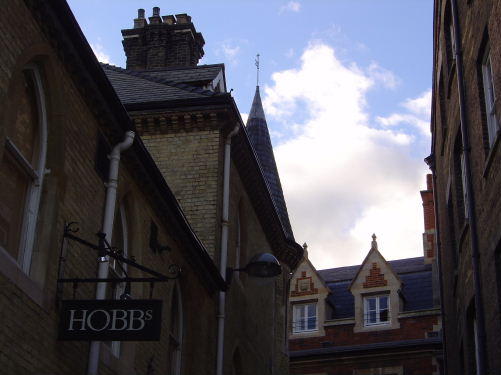
The hep jazzcats of Cambridge
On Tuesday I was walking just round the corner from where this photo was taken, when I was stopped in my tracks by the sudden familiar tones of a muffled trumpet in seven short bursts from above: "whah-wha-whah-wa-wah-whah", like a happy duck quacking through molasses.
Then, crump, a heavy set of piano notes fell down behind it, then picked themselves up into swiftly developing riff that went loping off around the trumpet quack before the drums and bass kicked in.
Clark Terry and the Oscar Peterson Trio, one of my favourite jazz records was being played at death-metal volume over Trinity Street. (Listen to the opening over here.)
I really, really hope it was some undergrad new to the joys of Oscar showing off to a friend, or just lounging back and murmuring: "Like, yeah ..."
Tuesday, October 11, 2005
Trying new things
So, as I mentioned below, I repaired my bike yesterday. An operation that would have taken a competent bike mechanic 20 minutes I pulled off in a mere two hours with the aid of eHow.com, which claims to provide “Clear Instructions on How To Do (just about) Everything” (I want to search it for instructions on creating WMD but something tells me this could look bad later).
When Malcolm sold me the bike (hi Malcolm!) I’d recalled he’d left me some spare inner tubes, and presumed he’d also left me some tyre levers. Tyre levers, may I say, rock. It is surprisingly damn difficult to prise a bike tyre off its rim, or get it back on for that matter, without leverage.
Further, it was the rear wheel I had to change: meaning I did all this without destroying the gear assembly or getting the chain hopelessly tangled. (Both of these would take talent, but I’m not ruling out my powers of destruction).
Anyway, the new inner tube is in, despite my worst fears I got the tyre back on the wheel, and the wheel back on the bike. What’s even better: I don’t seem to have caught the inner tube between the tyre and rim anywhere – which would insure a tear in the tube and, hey presto, back to square one.
All up, I am feeling like a man who could be bike-mechanic sexy. (See the entry for March 23, 2004 over here somewhere. Just don’t blame me for my stupid archives … )
Oh, and today I taught undergrads for the first time as well. They didn’t complain, throw things, or set fire to me – even a little bit!
So, as I mentioned below, I repaired my bike yesterday. An operation that would have taken a competent bike mechanic 20 minutes I pulled off in a mere two hours with the aid of eHow.com, which claims to provide “Clear Instructions on How To Do (just about) Everything” (I want to search it for instructions on creating WMD but something tells me this could look bad later).
When Malcolm sold me the bike (hi Malcolm!) I’d recalled he’d left me some spare inner tubes, and presumed he’d also left me some tyre levers. Tyre levers, may I say, rock. It is surprisingly damn difficult to prise a bike tyre off its rim, or get it back on for that matter, without leverage.
Further, it was the rear wheel I had to change: meaning I did all this without destroying the gear assembly or getting the chain hopelessly tangled. (Both of these would take talent, but I’m not ruling out my powers of destruction).
Anyway, the new inner tube is in, despite my worst fears I got the tyre back on the wheel, and the wheel back on the bike. What’s even better: I don’t seem to have caught the inner tube between the tyre and rim anywhere – which would insure a tear in the tube and, hey presto, back to square one.
All up, I am feeling like a man who could be bike-mechanic sexy. (See the entry for March 23, 2004 over here somewhere. Just don’t blame me for my stupid archives … )
Oh, and today I taught undergrads for the first time as well. They didn’t complain, throw things, or set fire to me – even a little bit!
Sunday, October 9, 2005
Self-determination and all that jazz
While attempting to fix my bicycle today I bumped into a visiting college friend who’s working for the UN Mission in Kosovo.
Odd to be discussing the exercise of treaty-making powers by the UN over a territory which may or may not ultimately be able to control its own foreign affairs while smeared in bicycle grease.
It was also an odd time to bump into him as Kofi Annan has just received a report from a special envoy on Kosovo, examining the options for its “final status” when the effective rule of the UN Interim Administration Mission in Kosovo (UNMIK) ends.
It’s outright reintegration into Serbia following the 1998-9 conflict would seem highly unlikely, but the deliberate creation under UN auspices of a tiny fully independent State or a lesser “autonomous region” raises interesting questions.
By the end of term I’ll be explaining the law of self-determination to second-year law students. Which means I need to come to an understanding of it myself. Dammit.
Anyway, the political principle of self-determination is both a powerful tool for those living in territories subject to foreign rule and also a genie that’s rather hard to put back in the bottle - in that it seems to imply any ethnic group can claim its own country.
As a legal concept, the boundaries of self-determination a bit hard to establish. Basically, it meant former colonies – particularly in Africa – could claim self-determination within existing colonial boundaries (latin tag for this idea: “uti possidetis”). That is, if you accept the arbitrary territorial divisions of colonialism for the sake of future peace (a bargain ultimately backed by the Organisation for African Unity) the inhabitants of the territory can chose how they want to be governed.
In practice this always meant become a sovereign State. In this sense, self-determination was a right exercisable by the people who arbitrarily found themselves lumped into an ascertainable territory: it was not a right belonging to ethnic groups.
International law does not per se recognise the rights of ethnic/national groups to “self-determination”, but it does protect the rights of individuals to associate in cultural, linguistic or religious groups.
The reason for this is obvious: international law is made by States who are not keen to allow themselves to be dissolved into infinitely fracturing self-governing sub-groups. Individual rights to associate in groups within existing State structures they can cope with.
The collapse of the former Yugoslavia challenged all this to some extent. Here was an arbitrarily assembled federal State collapsing into its internal administrative regions, which did have strong ethnic majorities. “It’s self-determination Jim, but not as we know it.” The people of Quebec, Scotland or Western Australia have no right to unilaterally succeed from their Federal governments, so how did Yugoslavia succeed in ripping itself into smaller legal pieces?
Frankly, at present, I think what occurred was quite simply an exceptional case. As a matter of effectiveness (an important idea in international law), the Socialist Federal Republic of Yugoslavia had ceased to function. The initial problem wasn’t civil war, it was a fundamental change in the underlying ideology of the State. Without a strong communism at the helm, old tensions could re-emerge, allowing central government to disintegrate.
In terms of controlling the impending chaos, the EC turned by analogy to the principle of “uti possidetis”, because it drew some lines on the ground that seemed to promise (rather illusorily as things turned out) stability and an alternative to conflict.
It’s still not a full answer, but it’s a start …
While attempting to fix my bicycle today I bumped into a visiting college friend who’s working for the UN Mission in Kosovo.
Odd to be discussing the exercise of treaty-making powers by the UN over a territory which may or may not ultimately be able to control its own foreign affairs while smeared in bicycle grease.
It was also an odd time to bump into him as Kofi Annan has just received a report from a special envoy on Kosovo, examining the options for its “final status” when the effective rule of the UN Interim Administration Mission in Kosovo (UNMIK) ends.
It’s outright reintegration into Serbia following the 1998-9 conflict would seem highly unlikely, but the deliberate creation under UN auspices of a tiny fully independent State or a lesser “autonomous region” raises interesting questions.
By the end of term I’ll be explaining the law of self-determination to second-year law students. Which means I need to come to an understanding of it myself. Dammit.
Anyway, the political principle of self-determination is both a powerful tool for those living in territories subject to foreign rule and also a genie that’s rather hard to put back in the bottle - in that it seems to imply any ethnic group can claim its own country.
As a legal concept, the boundaries of self-determination a bit hard to establish. Basically, it meant former colonies – particularly in Africa – could claim self-determination within existing colonial boundaries (latin tag for this idea: “uti possidetis”). That is, if you accept the arbitrary territorial divisions of colonialism for the sake of future peace (a bargain ultimately backed by the Organisation for African Unity) the inhabitants of the territory can chose how they want to be governed.
In practice this always meant become a sovereign State. In this sense, self-determination was a right exercisable by the people who arbitrarily found themselves lumped into an ascertainable territory: it was not a right belonging to ethnic groups.
International law does not per se recognise the rights of ethnic/national groups to “self-determination”, but it does protect the rights of individuals to associate in cultural, linguistic or religious groups.
The reason for this is obvious: international law is made by States who are not keen to allow themselves to be dissolved into infinitely fracturing self-governing sub-groups. Individual rights to associate in groups within existing State structures they can cope with.
The collapse of the former Yugoslavia challenged all this to some extent. Here was an arbitrarily assembled federal State collapsing into its internal administrative regions, which did have strong ethnic majorities. “It’s self-determination Jim, but not as we know it.” The people of Quebec, Scotland or Western Australia have no right to unilaterally succeed from their Federal governments, so how did Yugoslavia succeed in ripping itself into smaller legal pieces?
Frankly, at present, I think what occurred was quite simply an exceptional case. As a matter of effectiveness (an important idea in international law), the Socialist Federal Republic of Yugoslavia had ceased to function. The initial problem wasn’t civil war, it was a fundamental change in the underlying ideology of the State. Without a strong communism at the helm, old tensions could re-emerge, allowing central government to disintegrate.
In terms of controlling the impending chaos, the EC turned by analogy to the principle of “uti possidetis”, because it drew some lines on the ground that seemed to promise (rather illusorily as things turned out) stability and an alternative to conflict.
It’s still not a full answer, but it’s a start …
Wednesday, October 5, 2005
Fresher's flu
Michaelmas is once more upon us: denoted by wide-eyed new arrivals in Cambridge, the turning of the leaves, the first autumnal mists and - inevitably - my first cold of the year.
This year I managed to catch it before Fresher's week, while sojourning in the peaks district. In some ways, a good week to be sick as there's little prospect of getting any work done in any event.
In some ways, bad: as it's the week to get to know the newbies and make 'em feel welcome.
I'm opting for the inhospitable strategy of a DVD ("Kill Bill, vol. 1") and early to bed ...
Michaelmas is once more upon us: denoted by wide-eyed new arrivals in Cambridge, the turning of the leaves, the first autumnal mists and - inevitably - my first cold of the year.
This year I managed to catch it before Fresher's week, while sojourning in the peaks district. In some ways, a good week to be sick as there's little prospect of getting any work done in any event.
In some ways, bad: as it's the week to get to know the newbies and make 'em feel welcome.
I'm opting for the inhospitable strategy of a DVD ("Kill Bill, vol. 1") and early to bed ...
Saturday, October 1, 2005
So, where the hell have I been? (If you even noticed I was away … )
I’ve been remiss, certainly: but the last two weeks has been a non-stop travel extravaganza. I’ve been in Switzerland, Oxford, London and the Peaks District in just under two weeks.
Executive summary (it's a long post)
Switzerland was cold, wet and less full of Swiss people than one might expect (admittedly, I was in Geneva, which is 50% foreigners).
I was in Oxford for a Friday afternoon, and found it pleasant enough that I may have to go back for a weekend, despite it being “The Other Place” and having backed the King in the Civil War.
Then a quick weekend in London with Peter and Jasmine, my tirelessly hospitable hosts in the metropolis, before heading off for three days of hostelling in the hilly bit of England.
Geneva
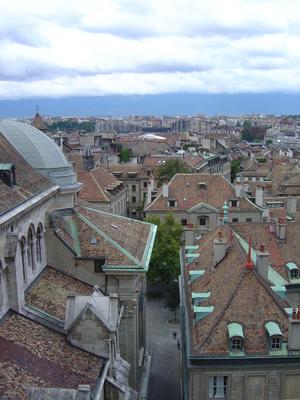 Friday 16 September I set off for a weekend in Geneva, pretty much straight from presenting a paper at a conference in Cambridge. I was greeted at the airport by my host (an Australian buddy from the LLM who works in – wait for it – international law), and was swept off to drink wine in a funky little bar.
Not sure what I was expecting of Geneva. It felt like most of the place was erected out of concrete in the 1970s. Or maybe it was just that my host lived in the student quarter. Saturday we tootled round the Romanesque/Gothic confection of the Cathédral Saint Pierre, had lunch at a café and in the face of flaying wind went shopping. (Yes, I found bargains in Geneva). I then went to a fun party of ex-pat Anglophones in what would have seemed a big flat, had it not contained about 40 people.
Geneva is apparently dead on a Sunday, so we headed up to a wine festival in the little village of Roussin with some of my host’s Red Cross buddies. We drank wine, ate sausage and watched a gloriously amateurish parade of oompah-bands from villages in the district, followed by little floats principally stocked with sombre-faced Swiss kids in costume.
In a very me moment, I got lost on the way to the train station on Monday, and so wound up jumping in a cab (“l’aeroport, s’il vous plait!”) to prevent a repeat of my Edinburgh easyjet non-departure.
Oxford and London
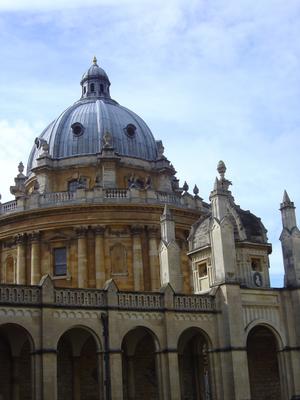 Friday 23rd I had a chance to have a discussion with a senior law of the sea academic in Oxford.
Bizarrely, there is no train from Cambridge to Oxford (though there is, apparently, a line that was last used in the war). The options are to spend a freak-load of cash and make a two-hour train trip going into London transferring from Kings Cross to Paddington and heading out again; to spend even more and fly "Don Air"; or spending a fiver and getting an epic three-hour, stopping all villages, bus.
Poverty won over common sense, but at least it was a chance to catch up on some reading.
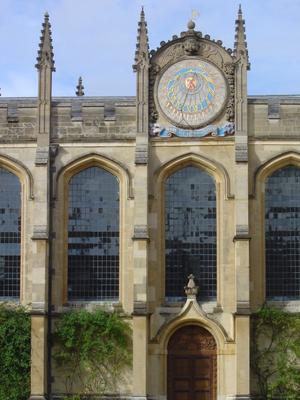
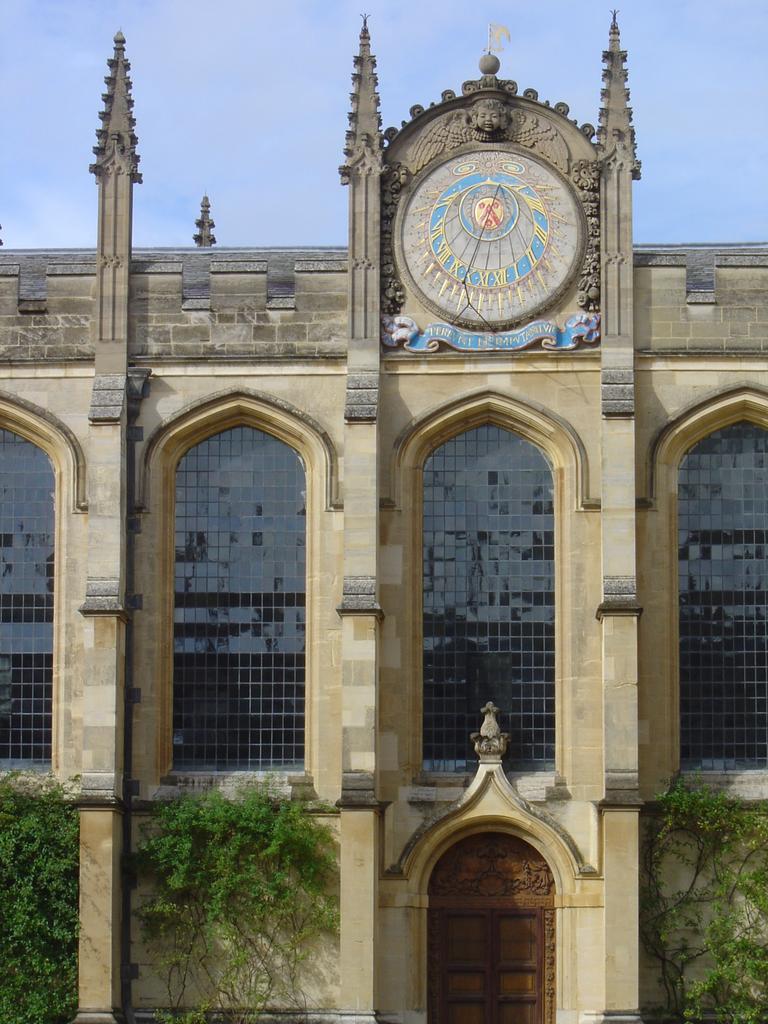
The interview went well, Oxford was pretty (when it stopped raining on me) and has some amazing vintage clothing stores, and I had an agreeable time drinking with friends of my sister’s.
 Then off on a bus to London Friday night. Saturday was a whirlwind social round catching up with my Australian lawyer friends for lunch or drinks, before a late train home to Cambridge so I could catch a visiting former flatmate for breakfast on Sunday.
Peaks District
Then, earlier this week, I was away Monday through Wednesday at a youth hostel in Edale, in the peaks district, for outdoor activities with 100 new scholars from my funding body.
Predictably, I managed to take a seat on the bus leaving Cambridge directly in front of an Australian lawyer, who’d been to the same law school, worked at the same firm and was at the Sydney Federal Court while I was at the Fed in Melbourne.
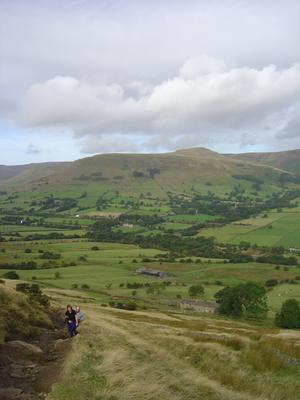 Unlike the uber-adventure-activity mistress Marissa, I opted for the soft (if occasionally damp) elective activities such as raft-building, canoeing and hill-walking over high ropes and caving. My height of adventure was a 40 minute walk through darkened cow fields to the pub (not without its risks!) and badly bruising one finger near the tip when I got it caught in a three-strand chain bridge and then fell off arse-backwards into the woodchips during a “team-building” exercise.
Now I’m back in the ‘Bridge, panicking about my state of readiness for supervising undergraduates, and reflecting on the alarming fact that half the new Masters students in college appear to be 12.
Scariest recent moment ...
I held the gate at Wychfield open for a newly arriving couple. After some pleasantries, I introduced myself.
“I’m Doug,” I said, honestly enough.
“Do you have a blog called courting disaster?” asked he.
Ye gods.
I’ve been remiss, certainly: but the last two weeks has been a non-stop travel extravaganza. I’ve been in Switzerland, Oxford, London and the Peaks District in just under two weeks.
Executive summary (it's a long post)
Switzerland was cold, wet and less full of Swiss people than one might expect (admittedly, I was in Geneva, which is 50% foreigners).
I was in Oxford for a Friday afternoon, and found it pleasant enough that I may have to go back for a weekend, despite it being “The Other Place” and having backed the King in the Civil War.
Then a quick weekend in London with Peter and Jasmine, my tirelessly hospitable hosts in the metropolis, before heading off for three days of hostelling in the hilly bit of England.
Geneva
 Friday 16 September I set off for a weekend in Geneva, pretty much straight from presenting a paper at a conference in Cambridge. I was greeted at the airport by my host (an Australian buddy from the LLM who works in – wait for it – international law), and was swept off to drink wine in a funky little bar.
Not sure what I was expecting of Geneva. It felt like most of the place was erected out of concrete in the 1970s. Or maybe it was just that my host lived in the student quarter. Saturday we tootled round the Romanesque/Gothic confection of the Cathédral Saint Pierre, had lunch at a café and in the face of flaying wind went shopping. (Yes, I found bargains in Geneva). I then went to a fun party of ex-pat Anglophones in what would have seemed a big flat, had it not contained about 40 people.
Geneva is apparently dead on a Sunday, so we headed up to a wine festival in the little village of Roussin with some of my host’s Red Cross buddies. We drank wine, ate sausage and watched a gloriously amateurish parade of oompah-bands from villages in the district, followed by little floats principally stocked with sombre-faced Swiss kids in costume.
In a very me moment, I got lost on the way to the train station on Monday, and so wound up jumping in a cab (“l’aeroport, s’il vous plait!”) to prevent a repeat of my Edinburgh easyjet non-departure.
Oxford and London
 Friday 23rd I had a chance to have a discussion with a senior law of the sea academic in Oxford.
 Bizarrely, there is no train from Cambridge to Oxford (though there is, apparently, a line that was last used in the war). The options are to spend a freak-load of cash and make a two-hour train trip going into London transferring from Kings Cross to Paddington and heading out again; to spend even more and fly "Don Air"; or spending a fiver and getting an epic three-hour, stopping all villages, bus.
Poverty won over common sense, but at least it was a chance to catch up on some reading.
The interview went well, Oxford was pretty (when it stopped raining on me) and has some amazing vintage clothing stores, and I had an agreeable time drinking with friends of my sister’s.
 Then off on a bus to London Friday night. Saturday was a whirlwind social round catching up with my Australian lawyer friends for lunch or drinks, before a late train home to Cambridge so I could catch a visiting former flatmate for breakfast on Sunday.
Peaks District
Then, earlier this week, I was away Monday through Wednesday at a youth hostel in Edale, in the peaks district, for outdoor activities with 100 new scholars from my funding body.
Predictably, I managed to take a seat on the bus leaving Cambridge directly in front of an Australian lawyer, who’d been to the same law school, worked at the same firm and was at the Sydney Federal Court while I was at the Fed in Melbourne.
 Unlike the uber-adventure-activity mistress Marissa, I opted for the soft (if occasionally damp) elective activities such as raft-building, canoeing and hill-walking over high ropes and caving. My height of adventure was a 40 minute walk through darkened cow fields to the pub (not without its risks!) and badly bruising one finger near the tip when I got it caught in a three-strand chain bridge and then fell off arse-backwards into the woodchips during a “team-building” exercise.
Now I’m back in the ‘Bridge, panicking about my state of readiness for supervising undergraduates, and reflecting on the alarming fact that half the new Masters students in college appear to be 12.
Scariest recent moment ...
I held the gate at Wychfield open for a newly arriving couple. After some pleasantries, I introduced myself.
“I’m Doug,” I said, honestly enough.
“Do you have a blog called courting disaster?” asked he.
Ye gods.
Monday, September 12, 2005
Now this cannot be good news ...
25% alchohol beer, anyone? Unleashing such a product on Australians or Brits would seem to be a recipe for disaster.
Fortunately it tastes like a "quirky mixture of beer and sherry", according to its creator.
Even in Cambridge, possibly the world's last significant population centre for under-60 sherry drinkers (an 60 really should be the minimum legal age for sherry-drinking), that doesn't sound like a taste sensation likely to catch on ...
25% alchohol beer, anyone? Unleashing such a product on Australians or Brits would seem to be a recipe for disaster.
Fortunately it tastes like a "quirky mixture of beer and sherry", according to its creator.
Even in Cambridge, possibly the world's last significant population centre for under-60 sherry drinkers (an 60 really should be the minimum legal age for sherry-drinking), that doesn't sound like a taste sensation likely to catch on ...
Saturday, September 10, 2005
 Classic viewing: "Edge of Darkness" (BBC DVD)
Undoubtedly one of the best BBC TV dramas ever made, “Edge of Darkness” first screened in 1985 and reflects the dark mood and preoccupations of the time.
Starting with a simple tale of human tragedy, the plot slowly widens to encompass national and international concerns. Bob Peck delivers an extraordinarily controlled and nuanced performance as Yorkshire detective Ron Craven whose young daughter, Emma, is gunned down outside their home. Still grief-stricken, Craven discovers a handgun and a Geiger counter in Emma’s room. Was the gunman after him, or his daughter?
As Craven makes his own investigation of her death, several strands slowly come together: his own past in counter-terrorism in Northern Island, his daughter’s environmental activism and the current inquiry he is meant to be conducting into a rigged election at a Yorkshire mine refitted as a low-grade nuclear waste containment centre. These threads come to form one line of inquiry, taking him inexorably into the heart of a trans-national nuclear state.
What unfolds is, in effect, an extremely intelligent five-and-half hour action film mixing espionage, conspiracy theories, environmentalism and a touch of science-fiction. Quietly compelling, it is made with astonishing attention to detail. It uses both silence, and a terrific score by Michael Kamen and Eric Clapton, to great effect.
It has a gorgeous sense of surrealism as well: two frighteningly, clinically British spies (one all army charm, the other a glumly FT-reading lawyer) are funded by the Endowment for the Arts as “strolling players”; while larger-than-life Texan CIA man Darius Jedburg (Joe Don Baker) is obsessed with golf and British ballroom dancing.
But, as one review brilliantly puts it:
“The moment that most lingers in the mind is the sequence where Baker and Peck find a [disused] bomb shelter buried deep in [a] nuclear plant. Fine wine, the best books, and, of course, a classic motor car. The two settle down for a gourmet dinner.
“It's hypnotic enough for its oddity alone, but what is even more striking is that this relaxation occurs in the middle of a fraught chase sequence. Character development amid the action? Doesn't happen these days.”
Watching it again, I was amazed how much I recalled from seeing it as a kid in Australia. It holds up amazingly well, and its commentary on the links between industry, energy and the military and the way a society deals with terrorism and ecological concerns are also still more than relevant. Really excellent viewing, even if the parts of the final episode (“Fusion”) are a little melodramatic.
Further reading: Wikipedia, DVD Times, imdb, BBC Cult TV.
Thursday, September 8, 2005
Notes from the Edinburgh Fringe: overlong and overdue, part 2
What I seemed to spend most of my four days in Edinburgh doing was buzzing between plays. I only caught six shows in the end, but that seemed more than enough. I know enough thespy Cambridge types that I could only see about half my friends’ shows – and I kept bumping into student theatre friends on the street … mostly while they were passing out promotional flyers to tourists.
So, highlights. Best Cambridge shows would have been a marvellous production of Brecht’s “Threepenny Opera” in the sweltering sauna that is the C Too venue; and an astonishingly physical production of “Macbeth”, cut to a bare one-hour script.
“Macbeth – The Hour” was competing in a fierce field of Scottish play productions: it’s something people seem compelled to stage at the Fringe. Still, this was different. It had a junk yard staging, with all walls, fences, tables, beds, etc being provided by a series of planks held with handles by cast members allowing lightning-fast scene changes.
To give one small sample of the physical staging: I’ve always found the witch’s cauldron scene pretty camp. Not here. Three half-naked men, kneeling, hands joined behind their backs represented the cauldron. As the witches recited their foul list of ingredients they mimed (very effectively) force-feeding the human cauldron’s three mouths, the actors gagging and choking all the while. Nasty, but surprisingly creative in a play where it’s easy to think you’ve seen it all before.
Of the new theatre I saw, “The Guardians” and “Angry Young Man” were easily the best. “The Guardians” is a dark comedy about the Abu Ghraib torture scandal; and the faked photos run in British tabloids of similar atrocities supposedly perpetrated by UK soldiers. Two talking heads, a female US soldier (clearly based on Private Lynndie England) and a sleazy, erudite, sadomasochistic, Oxford-educated tabloid journalist. The England character came off relatively sympathetically, and despite the nameless journalist being a bit of a stereotype, the American writer’s ear for English idiom was flawless. Worth seeing if it tours other places.
“Angry young man” was a straightforward farce about a dodgy doctor from an ex-Soviet republic fleeing to England to avoid being struck off. Following a misunderstanding with a minicab driver, he loses his identity documents and is mistaken for a people-smuggled refugee by a clueless upper-class would-be do-gooder. Following adventures with ducks, skinheads, predatory girlfriends and the English countryside a happy ending ensues. The clever bit was that the entire thing was acted by four men in identical suits, taking turns to play various roles (each has a go at the central character) and narrate the action.
Best line? Approaching the bar in an illegal club occupying a disused air-raid shelter, we have the following exchange:
Doctor: “It was, how you say? A typical English pub.”
Barman: “G’day, mate.”
The Fringe is simply an unconquerable cliff-face of theatre. But with a little research and some local advice I was pretty pleased with what I saw.
What I seemed to spend most of my four days in Edinburgh doing was buzzing between plays. I only caught six shows in the end, but that seemed more than enough. I know enough thespy Cambridge types that I could only see about half my friends’ shows – and I kept bumping into student theatre friends on the street … mostly while they were passing out promotional flyers to tourists.
So, highlights. Best Cambridge shows would have been a marvellous production of Brecht’s “Threepenny Opera” in the sweltering sauna that is the C Too venue; and an astonishingly physical production of “Macbeth”, cut to a bare one-hour script.
“Macbeth – The Hour” was competing in a fierce field of Scottish play productions: it’s something people seem compelled to stage at the Fringe. Still, this was different. It had a junk yard staging, with all walls, fences, tables, beds, etc being provided by a series of planks held with handles by cast members allowing lightning-fast scene changes.
To give one small sample of the physical staging: I’ve always found the witch’s cauldron scene pretty camp. Not here. Three half-naked men, kneeling, hands joined behind their backs represented the cauldron. As the witches recited their foul list of ingredients they mimed (very effectively) force-feeding the human cauldron’s three mouths, the actors gagging and choking all the while. Nasty, but surprisingly creative in a play where it’s easy to think you’ve seen it all before.
Of the new theatre I saw, “The Guardians” and “Angry Young Man” were easily the best. “The Guardians” is a dark comedy about the Abu Ghraib torture scandal; and the faked photos run in British tabloids of similar atrocities supposedly perpetrated by UK soldiers. Two talking heads, a female US soldier (clearly based on Private Lynndie England) and a sleazy, erudite, sadomasochistic, Oxford-educated tabloid journalist. The England character came off relatively sympathetically, and despite the nameless journalist being a bit of a stereotype, the American writer’s ear for English idiom was flawless. Worth seeing if it tours other places.
“Angry young man” was a straightforward farce about a dodgy doctor from an ex-Soviet republic fleeing to England to avoid being struck off. Following a misunderstanding with a minicab driver, he loses his identity documents and is mistaken for a people-smuggled refugee by a clueless upper-class would-be do-gooder. Following adventures with ducks, skinheads, predatory girlfriends and the English countryside a happy ending ensues. The clever bit was that the entire thing was acted by four men in identical suits, taking turns to play various roles (each has a go at the central character) and narrate the action.
Best line? Approaching the bar in an illegal club occupying a disused air-raid shelter, we have the following exchange:
Doctor: “It was, how you say? A typical English pub.”
Barman: “G’day, mate.”
The Fringe is simply an unconquerable cliff-face of theatre. But with a little research and some local advice I was pretty pleased with what I saw.
Wednesday, September 7, 2005
Notes from the Fringe: overlong and overdue, part 1
So a few weekends ago now, I was in Edinburgh during the Festival season.
I went to the ‘Burgh ostensibly to visit some delightful Cambridge friends in their new terrace house (home ownership among people younger than me really freaks me out), catch up with another Cambridge mate who’s doing some research up there and to have a discussion with an academic at Edinburgh Uni about my PhD research. I did, though, spend a good deal of time at the Festival.
Edinburgh’s a town of about half-a-million, which apparently more than doubles during the Festival season. It’s easy to believe: almost every down-town cash machine is perpetually out of service. At first I thought it was just bad luck or poor maintenance: then I realised they were all out of money. I had to ask for cash back when buying a sandwich in Marks and Spencers.
The Royal Mile becomes something like a crowd scene from a medieval movie. Hordes of people thronging below the castle while people in bizarre costume pass out flyers for their shows, and street performers increase congestion by simultaneously clearing an area and drawing a thick crowd. Madness best held at bay with an iPod.
When you can find some elbow-room and a beer, the people-watching is fabulous. Every third person is speaking a language other than English, or is carting props, costumes or fellow-performers to and from a show.
I had a number of Cambridge drama friends in shows, and have seldom been more glad to have politely refused to go to auditions. Most of ‘em didn’t look like they’d slept since arriving two weeks prior. “It’s so good to speak to someone who looks relaxed, alert and normal!” one all but yelled at me in a frenzy over coffee. (For the record, I was travel-stained and spaced out.)
It’s always potentially a bit embarrassing bumping into people who you didn’t know were in Edinburgh for a show.
“What are you doing in Edinburgh?” I asked one, meaning “what show”?
“Oh,” she replied in her light Edinburgh accent, smiling. “Waitressing. I’m just indigenous.”
Ground, swallow me now.
I also enjoyed an inadvertent return to childhood during my stay. I was informed on arrival that my host and her boyfriend in a fine bit of mutual consultation had double-booked the single bed in the spare room (which had belonged to my host as a child). I was welcome either to the futon in the lounge, or I could haul the component out from under the spare bed required to turn it into a bunk and share with the other guest “Ant”.
“Ant said he’s totally up for it,” I was told. So, never being one to act the killjoy I returned on my first night a little shy of 11 pm and started assembling a bunk. It swayed a little when I got in.
“Comfy?” asked my hosts.
“Fine,” I said, gently rocking our two-man berth, “I really like its slightly nautical air.”
So a few weekends ago now, I was in Edinburgh during the Festival season.
I went to the ‘Burgh ostensibly to visit some delightful Cambridge friends in their new terrace house (home ownership among people younger than me really freaks me out), catch up with another Cambridge mate who’s doing some research up there and to have a discussion with an academic at Edinburgh Uni about my PhD research. I did, though, spend a good deal of time at the Festival.
Edinburgh’s a town of about half-a-million, which apparently more than doubles during the Festival season. It’s easy to believe: almost every down-town cash machine is perpetually out of service. At first I thought it was just bad luck or poor maintenance: then I realised they were all out of money. I had to ask for cash back when buying a sandwich in Marks and Spencers.
The Royal Mile becomes something like a crowd scene from a medieval movie. Hordes of people thronging below the castle while people in bizarre costume pass out flyers for their shows, and street performers increase congestion by simultaneously clearing an area and drawing a thick crowd. Madness best held at bay with an iPod.
When you can find some elbow-room and a beer, the people-watching is fabulous. Every third person is speaking a language other than English, or is carting props, costumes or fellow-performers to and from a show.
I had a number of Cambridge drama friends in shows, and have seldom been more glad to have politely refused to go to auditions. Most of ‘em didn’t look like they’d slept since arriving two weeks prior. “It’s so good to speak to someone who looks relaxed, alert and normal!” one all but yelled at me in a frenzy over coffee. (For the record, I was travel-stained and spaced out.)
It’s always potentially a bit embarrassing bumping into people who you didn’t know were in Edinburgh for a show.
“What are you doing in Edinburgh?” I asked one, meaning “what show”?
“Oh,” she replied in her light Edinburgh accent, smiling. “Waitressing. I’m just indigenous.”
Ground, swallow me now.
I also enjoyed an inadvertent return to childhood during my stay. I was informed on arrival that my host and her boyfriend in a fine bit of mutual consultation had double-booked the single bed in the spare room (which had belonged to my host as a child). I was welcome either to the futon in the lounge, or I could haul the component out from under the spare bed required to turn it into a bunk and share with the other guest “Ant”.
“Ant said he’s totally up for it,” I was told. So, never being one to act the killjoy I returned on my first night a little shy of 11 pm and started assembling a bunk. It swayed a little when I got in.
“Comfy?” asked my hosts.
“Fine,” I said, gently rocking our two-man berth, “I really like its slightly nautical air.”
Monday, September 5, 2005
Songs that are speaking to me at present
Having been tagged with this five-tracks meme by Daniel, I thought I’d comply (“Resistance is useless!”).
So, here’s five songs I’m enjoying at present:
Barenaked Ladies, “If I Had A Million Dollars”: “If I had a million dollars / I’d build a treefort in our yard … / You could help it wouldn’t be that hard … / Maybe we could put a refrigerator in there”.
A couple of guys and their string guitars mucking around with off-the-wall lyrics and a tune that just forces you just to grab a friend and dance in the kitchen (100% proven fact). It sounds like a parody C&W song, but is about a zillion times funnier.
Ani DiFranco, “The Arrivals Gate”: “Gonna go out to the arrivals gate at the airport / And sit there all day / Watch people reuniting / Public affection so exciting / It even makes airports OK”.
Other than the echo of the sappy Hugh Grant speech at the beginning of “Love Actually” this is a touching little tune, especially for someone who flies home at Christmas. The faintly on-edge feel of the sampling and techno-pop nicely match the dislocation of airports.
The Waifs, “The Waitress”: “I thought I’d move to Sydney to get a little piece / Of the city life they talk about in the 90’s / Where everyone I meet don’t want to know my name / They want to know what I do for a living.”
Apart from a damn catchy tune, this song summarises – despite the handful of good friends I made there – everything I disliked about Sydney.
The Cruel Sea (no website at present), “You’ll Do”: “The only reason that you can forgive me / Is cause you can't remember what I said / Your always sayin’ that you wanna leave me / But first you gotta get out bed”.
As Tex Perkins said introducing this song at a Canberra gig I once went to, “This is a song about the quest to find your one true mate, it’s called … You’ll Do.” The concept that this could be a love song embodies the laconic Australian humour and understated sincerity I sometimes miss over here.
The Cat Empire, “Hello”: “she stopped me in my tracks / and I said ‘mmm hchello hchello...’”.
So OK, the lyrics could have been written by girl-crazy fifteen year olds: but this song is just plain raucous fun, funk in a head-on collision with big band which manages to side-swipe a scratching DJ as well. A tune that’s always capable of getting me up to face the day.
Having been tagged with this five-tracks meme by Daniel, I thought I’d comply (“Resistance is useless!”).
So, here’s five songs I’m enjoying at present:
Barenaked Ladies, “If I Had A Million Dollars”: “If I had a million dollars / I’d build a treefort in our yard … / You could help it wouldn’t be that hard … / Maybe we could put a refrigerator in there”.
A couple of guys and their string guitars mucking around with off-the-wall lyrics and a tune that just forces you just to grab a friend and dance in the kitchen (100% proven fact). It sounds like a parody C&W song, but is about a zillion times funnier.
Ani DiFranco, “The Arrivals Gate”: “Gonna go out to the arrivals gate at the airport / And sit there all day / Watch people reuniting / Public affection so exciting / It even makes airports OK”.
Other than the echo of the sappy Hugh Grant speech at the beginning of “Love Actually” this is a touching little tune, especially for someone who flies home at Christmas. The faintly on-edge feel of the sampling and techno-pop nicely match the dislocation of airports.
The Waifs, “The Waitress”: “I thought I’d move to Sydney to get a little piece / Of the city life they talk about in the 90’s / Where everyone I meet don’t want to know my name / They want to know what I do for a living.”
Apart from a damn catchy tune, this song summarises – despite the handful of good friends I made there – everything I disliked about Sydney.
The Cruel Sea (no website at present), “You’ll Do”: “The only reason that you can forgive me / Is cause you can't remember what I said / Your always sayin’ that you wanna leave me / But first you gotta get out bed”.
As Tex Perkins said introducing this song at a Canberra gig I once went to, “This is a song about the quest to find your one true mate, it’s called … You’ll Do.” The concept that this could be a love song embodies the laconic Australian humour and understated sincerity I sometimes miss over here.
The Cat Empire, “Hello”: “she stopped me in my tracks / and I said ‘mmm hchello hchello...’”.
So OK, the lyrics could have been written by girl-crazy fifteen year olds: but this song is just plain raucous fun, funk in a head-on collision with big band which manages to side-swipe a scratching DJ as well. A tune that’s always capable of getting me up to face the day.
Saturday, September 3, 2005

Pirate punt-tacular
So, I took Thursday afternoon off to enjoy the weather and spend time with friends heading off for September. (Let's ignore for the moment the fact that I only ever blog about taking time off - the PhD is advancing.)
So, how did neighbour K want to celebrate her birthday, and how did the American Archeologist want to relax after turning her dissertation in?
A pirate punt trip, is how!
I was press-ganged to write the e-mail advertisement for the event:
Perhaps the most disturbing feature of the outing was my ability to costume myself almost entirely out of my own wardrobe (the fetching paisley headscarf set me back £1.99 at Oxfam).
Passers by on the Cam seemed to get into it as well, answering our hail of "Ar me hearties" or crying back "Shiver me timbers!" or enquiring as to what grog we be drinkin'. Fun afternoon. And there are photos.
Oh, and check out international talk like a pirate day.
So, I took Thursday afternoon off to enjoy the weather and spend time with friends heading off for September. (Let's ignore for the moment the fact that I only ever blog about taking time off - the PhD is advancing.)
So, how did neighbour K want to celebrate her birthday, and how did the American Archeologist want to relax after turning her dissertation in?
A pirate punt trip, is how!
I was press-ganged to write the e-mail advertisement for the event:
Ar me hearties!
Ye is warmly invited, and firmly (ar!) commanded, to attend K's birthday-and-the American archaeologist's-handin'-in-day afternoon of pirate puntin', grog swillin', ale quaffing and parrot husbandry.
Eye patches optional. Ar.
"Avast!" I hear you cry, and: "But where and when can I set sail on this debauched and larcenous extravaganza of outlawry?"
"Thursday!" be the word.
2 pm in the MCR to don make-up and costumes, 3 pm at Trinity Punts to set sail with the jolly roger hoisted high and unleash terror upon the high seas - or as much of Old Father Cam as we can subjugate to our nefarious plans.
Be thar, or walk the plank!
... and for those who don't speak pirate: Thursday 2nd at 2 pm in the MCR for an afternoon of pirate punting. Do bring costumes, swords, beverages, edibles (chocolate gold coins a must).
Perhaps the most disturbing feature of the outing was my ability to costume myself almost entirely out of my own wardrobe (the fetching paisley headscarf set me back £1.99 at Oxfam).
Passers by on the Cam seemed to get into it as well, answering our hail of "Ar me hearties" or crying back "Shiver me timbers!" or enquiring as to what grog we be drinkin'. Fun afternoon. And there are photos.
Oh, and check out international talk like a pirate day.
Tuesday, August 30, 2005
Japan would be well advised to stop going reckless
A fantastic headline don’t you think? It introduced this little gem of North Korean journalism: “Its moves to escalate the tensions under the pretext of ‘threat’ from the DPRK would only invite stronger rebuff at the debate on the regional issues. The Japanese reactionaries would be gravely mistaken if they think their sanctions could frighten the DPRK or bring it to its knees.”
Finally these gems are properly available on line. This wondrous little item came to my attention via Reuters recently:
Davis has also created the endlessly entertaining KCNA insult generator, capable of churning out such gems as:
Marvellous, just marvellous.
A fantastic headline don’t you think? It introduced this little gem of North Korean journalism: “Its moves to escalate the tensions under the pretext of ‘threat’ from the DPRK would only invite stronger rebuff at the debate on the regional issues. The Japanese reactionaries would be gravely mistaken if they think their sanctions could frighten the DPRK or bring it to its knees.”
Finally these gems are properly available on line. This wondrous little item came to my attention via Reuters recently:
Few can denounce the "imperialist ogre" or "kingpin of evil" as well as the writers at North Korea's official news agency, and a California graphic artist is now cataloging their rhetorical masterpieces on a Web site.
Pyongyang's official Korean Central News Agency, or KCNA, is the only regular source of the views of the secretive government of Kim Jong-il available to diplomats, journalists and scholars.
But there was no way for them to search the archives of KCNA until Geoff Davis, fighting boredom during a rainy San Francisco spring, decided to hone his Web design skills on a topic he had followed in news reports on the North Korean nuclear crisis.
"Their propaganda is often unintentionally hilarious and I couldn't find an existing searchable database of the KCNA on the Web. Thus, NK News was born," Davis told Reuters.
Davis has also created the endlessly entertaining KCNA insult generator, capable of churning out such gems as:
“You black-hearted gangster, you are sadly mistaken you think you can browbeat the DPRK!”
Marvellous, just marvellous.
Monday, August 29, 2005

A fine visit
Marissa, the Ruminator, old friend and first-ever flatmate visited Cambridge for the weekend.
We punted, we looked at colleges, we bought lunch from the cheese shop and ate it on the college lawn, we looked at colleges, we had a beer from the Mill in plastic cups by the Mill pond. And that was just the first four hours after she got off the bus from the train station.
Our first day was mostly walking. Including walking up to my balcony to prove that the slim resistance offered by a bottle of Marsanne was, indeed, useless. Followed by a stroll to two of my favourite pubs (the Castle and the Pickerel).
Yesterday was mostly cycling in gloriously atypical sunshine, having discovered a spare bicycle left in the care of neighbours by a departing Masters student, which wasn't widly too big for Marissa - though posed its own unique mounting/dismounting challenges on occassion.
We cycled round Jesus Green, darted irresponsibly up pedestrian-only streets, got into Kings Chapel (having parked the bike), and cycled over to a compulsory stop in the Doug tour: a pub lunch at the Free Press.
I felt happy to dispatch Marissa on her travels confident she'd been well fed, watered, and exercised. What more can you do for a visiting friend?
Her report of things is over here. All I'll say is, just in case you got a false impression, the jacket in question was brown velvet, not brown pinstripe. Ahem.
Marissa, the Ruminator, old friend and first-ever flatmate visited Cambridge for the weekend.
We punted, we looked at colleges, we bought lunch from the cheese shop and ate it on the college lawn, we looked at colleges, we had a beer from the Mill in plastic cups by the Mill pond. And that was just the first four hours after she got off the bus from the train station.
Our first day was mostly walking. Including walking up to my balcony to prove that the slim resistance offered by a bottle of Marsanne was, indeed, useless. Followed by a stroll to two of my favourite pubs (the Castle and the Pickerel).
Yesterday was mostly cycling in gloriously atypical sunshine, having discovered a spare bicycle left in the care of neighbours by a departing Masters student, which wasn't widly too big for Marissa - though posed its own unique mounting/dismounting challenges on occassion.
We cycled round Jesus Green, darted irresponsibly up pedestrian-only streets, got into Kings Chapel (having parked the bike), and cycled over to a compulsory stop in the Doug tour: a pub lunch at the Free Press.
I felt happy to dispatch Marissa on her travels confident she'd been well fed, watered, and exercised. What more can you do for a visiting friend?
Her report of things is over here. All I'll say is, just in case you got a false impression, the jacket in question was brown velvet, not brown pinstripe. Ahem.
Thursday, August 25, 2005

A view from my balcony

A summer day to live in memory
In April I boasted about getting into a habit of going for a run most mornings, which I slid out of around May Week and the following rush of family visitors. Recently, with the aid of friendly neighbour K, I’ve been running again. Usually about 2 km.
Most mornings we aim to head out at 8.30, if we’re going, and check if the other wants to come. Rigorous experimentation has now proved we run further and faster with a buddy: not in any competitive spirit, just coz it’s more fun.
This has usually been followed with breakfast at the kitchen-across-the-way. I’m the only resident left in the kitchen in my four-room corner, while the “flat” opposite mine is more inhabited. The habit of breakfast with the neighbours resulted from my fondness for stovetop-made coffee and microwave porridge. My kitchen lacks a microwave, and for a while the stove stopped working. So what commenced as necessity has become a pleasant ritual.
Last Wednesday morning, though, was a little more solitary. I headed out for a run with only the solace of the iPod. A neighbour passed through at breakfast but lacked time to linger.
I got in a couple of decent hours work, and decided to go read articles on my balcony. Shortly before noon the Ruminator called to catch up and discuss details of her impending visit. Lovely. Another call or two back home seemed in order while I was at the phone.
Then, with two hours work under my belt, my resolve cracked. It was 27c outside. The sky was cloudless blue. It was one of those rare days in England worthy of the name “Summer”, one of those moments when the sunlight goes straight to your head, erases the trauma of a grey five-month Winter, and makes you think maybe Ol’ Blighty ain’t so bad after all.
Fortunately, an excuse to abandon work was at hand. Neighbour K and I had an appointment with the Jesus Green outdoor pool. Jesus Green is a devastatingly pretty park, especially when cycling to the pool you pass over the lock.
We swam briefly in bitingly cold water until the blood began to stir and it wasn’t so bad. After a brief bout of exercise, we flopped in the sun and chatted, dipped again and after a pleasant couple of hours headed home for a snack.
For “snack” read “gin and tonic on the balcony”. Another neighbour brought us corn and avocado salad for dinner.
Graduate student life, it’s a tough game.
Monday, August 15, 2005
Talking Danish Westerns with Lyn: "Dear Wendy"
Doug: Heya Lyn.
Lyn: Hi Doug. Um, don’t you feel uncomfortable appropriating my voice like this?
Doug: Not especially.
Lyn: Just checking.
Doug: I mean, especially since you’ve done it to me in the past …
Lyn: I said, ‘just checking’, OK?
Doug: and since you’re not updating Lynscreens at present …
Lyn: Yeah, a change of subject anytime now would be fine.
Doug: And especially since we’re going to be talking about movies.
Lyn: So, what’ve you been seeing?
Doug: Ooh, astounding conversational flanking manoeuvre there.
Lyn: But you’ll fall for it, won’t you? C’mon, recent viewing. I want opinions, dammit!
Doug: Right, well I’ve seen “Charlie and the Chocolate Factory”. I take it back, Depp does outdo Wilder; I like the new material, and the tone is much more suitably dark for Dahl. I went to see “Fantastic Four” – trash, but good, amiable clean-cut trash. And I, despite myself, loved “Wedding Crashers”: I did not expect to be laughing at cringe comedy for two solid hours.
Lyn: You never bother saying anything that concisely. So, what’re you saving the words for?
Doug: “Dear Wendy.” Man, that is an amazing, but really pretty damn disturbing film.
Lyn: I’ve heard it called a Danish Western. The script’s by Lars von Trier, right?
Doug: Yeah, but it’s not really a Western. And it’s not terribly Danish – other than the director, crew, funding and the locations. It’s an American small-town tragedy, and it’s about how the fear of violence gives rise to violence.
Lyn: Gimme a narrative hook here.
Doug: Jamie “Billy Elliot” Bell is a loner/loser in a small mining town until he stumbles across an old gun, which despite his pacifist convictions he can’t throw away. Forging bonds with other outcasts, he soon has a small club of “armed pacifists”, who carry their “partners” for “moral support”. They develop their own code of “Dandyism” (with nods to Oscar Wilde and Brideshead Revisited), grow as people and swear never to use their guns to kill. In fact, they don’t even use the word “killing”, they refer to it as “loving”.
Lyn: That, right there, does not sound especially healthy.
Doug: Hell, wait ‘til you hear how their private language interacts with the retro-cool Zombies soundtrack.
All the action takes place in a tiny town square, or one of two mines nearby. Yet without the Fight-Club-esque device of framing of much of the movie as an extended flashback, making it perfectly clear things are going to go badly wrong, the little fragment of a town would really not have any oppressive sense of claustrophobia.
People talk about their fear of gangs with guns, and about being beaten up at school. But we never see these things. Their square is a strangely innocent oasis. The characters also have some of the misfit innocence of Depp in “Edward Scissorhands”, which I saw last night on a big screen, too.
Lyn: Stick to the point here. So, it has an innocence. I think you’re circling the word “Romanticism”.
Doug: Yes, it definitely explores Romanticism, and its obsession with death and mortality and also the connection between fear and violence. A town that imagines gangs of armed youths summons one into being. Also, for all their preternatural skill with their weapons, it is painfully apparent that this is not a Western where the heroes will be able to take on vastly superior numbers of black-hats and win.
Dandyist armed pacifism has been seen as a satire of Western foreign policy, but I think it’s a far more disturbing exploration of the empty heroism of symbolic acts.
Lyn: You use the word “exploring” a lot. You don’t think von Trier’s moralising, then?
Doug: No. This is a tragedy, in the true sense of not being about unhappiness, but in the remorseless working out of events.
Lyn: So, is it realistic, then?
Doug: No, but it’s compelling. It is has a sense of heightened unreality, a deliberateness that gives the characters depth despite occasionally too-smooth dialogue. It’s a great film. Disturbing, yes. But well worth seeing.
Doug: Heya Lyn.
Lyn: Hi Doug. Um, don’t you feel uncomfortable appropriating my voice like this?
Doug: Not especially.
Lyn: Just checking.
Doug: I mean, especially since you’ve done it to me in the past …
Lyn: I said, ‘just checking’, OK?
Doug: and since you’re not updating Lynscreens at present …
Lyn: Yeah, a change of subject anytime now would be fine.
Doug: And especially since we’re going to be talking about movies.
Lyn: So, what’ve you been seeing?
Doug: Ooh, astounding conversational flanking manoeuvre there.
Lyn: But you’ll fall for it, won’t you? C’mon, recent viewing. I want opinions, dammit!
Doug: Right, well I’ve seen “Charlie and the Chocolate Factory”. I take it back, Depp does outdo Wilder; I like the new material, and the tone is much more suitably dark for Dahl. I went to see “Fantastic Four” – trash, but good, amiable clean-cut trash. And I, despite myself, loved “Wedding Crashers”: I did not expect to be laughing at cringe comedy for two solid hours.
Lyn: You never bother saying anything that concisely. So, what’re you saving the words for?
Doug: “Dear Wendy.” Man, that is an amazing, but really pretty damn disturbing film.
Lyn: I’ve heard it called a Danish Western. The script’s by Lars von Trier, right?
Doug: Yeah, but it’s not really a Western. And it’s not terribly Danish – other than the director, crew, funding and the locations. It’s an American small-town tragedy, and it’s about how the fear of violence gives rise to violence.
Lyn: Gimme a narrative hook here.
Doug: Jamie “Billy Elliot” Bell is a loner/loser in a small mining town until he stumbles across an old gun, which despite his pacifist convictions he can’t throw away. Forging bonds with other outcasts, he soon has a small club of “armed pacifists”, who carry their “partners” for “moral support”. They develop their own code of “Dandyism” (with nods to Oscar Wilde and Brideshead Revisited), grow as people and swear never to use their guns to kill. In fact, they don’t even use the word “killing”, they refer to it as “loving”.
Lyn: That, right there, does not sound especially healthy.
Doug: Hell, wait ‘til you hear how their private language interacts with the retro-cool Zombies soundtrack.
All the action takes place in a tiny town square, or one of two mines nearby. Yet without the Fight-Club-esque device of framing of much of the movie as an extended flashback, making it perfectly clear things are going to go badly wrong, the little fragment of a town would really not have any oppressive sense of claustrophobia.
People talk about their fear of gangs with guns, and about being beaten up at school. But we never see these things. Their square is a strangely innocent oasis. The characters also have some of the misfit innocence of Depp in “Edward Scissorhands”, which I saw last night on a big screen, too.
Lyn: Stick to the point here. So, it has an innocence. I think you’re circling the word “Romanticism”.
Doug: Yes, it definitely explores Romanticism, and its obsession with death and mortality and also the connection between fear and violence. A town that imagines gangs of armed youths summons one into being. Also, for all their preternatural skill with their weapons, it is painfully apparent that this is not a Western where the heroes will be able to take on vastly superior numbers of black-hats and win.
Dandyist armed pacifism has been seen as a satire of Western foreign policy, but I think it’s a far more disturbing exploration of the empty heroism of symbolic acts.
Lyn: You use the word “exploring” a lot. You don’t think von Trier’s moralising, then?
Doug: No. This is a tragedy, in the true sense of not being about unhappiness, but in the remorseless working out of events.
Lyn: So, is it realistic, then?
Doug: No, but it’s compelling. It is has a sense of heightened unreality, a deliberateness that gives the characters depth despite occasionally too-smooth dialogue. It’s a great film. Disturbing, yes. But well worth seeing.
Saturday, August 13, 2005
Understanding suicide bombers
With similar incomprehension British society has been asking of the 7 July tube bombers “How could young men, born in England, personally unaffected by events in the Middle East, seemingly functional members of society, commit these acts?” Or more simply, “How could people who enjoyed cricket do this?” Obviously, in Britain and elsewhere, it has lead to a certain amount of soul-searching about whether multiculturalism has worked.
This misses the point.
The migrant experience has always involved initial ghetto-isation. The problem has never been the first generation’s coping with a new country, it has been the experience of their children.
The only place I’ve seen the point made was in a short literary essay (which shamefully, I failed to make a note of and have not been able to find on-line) on novels dealing with the alienation and anger of some children of migrants and their distinctively different experience to the generations before and after them. It was an idea I kicked around with a few friends recently, and this is a summary of my tentative conclusions.
Most migrants move for a better life. They don’t expect it to be easy and expect to work hard. Often migrants are prepared to take a step down the social ladder. Think of the archetypal foreign-trained professional who, with locally unrecognised qualifications, takes up unskilled work. Why? So their children have a shot at a better future.
Which can put a lot of pressure on the kids. One of my friends provided an example of a girl in her high-school with two African parents who had decided their first-born would be a doctor and their second-born a lawyer. Of course, the first had the gift for languages and the second for maths, but they were pressured to stick to the plan regardless. I can think of a uni friend from a migrant family (her father a successful developer), and she and all her siblings are now either doctors or lawyers.
This isn’t limited to migrant families, obviously. Many families who’ve recently “made it”, typically self-made entrepreneurs, will want to see their kids with “safe” qualifications in law, medicine, accountancy and so on.
However, second generation migrants are brought face-to-face with the hypocrisies in any society. Most western democracies are built on an egalitarian vision that “anyone can make it”. And while anyone can make it in Britain, Australia, Canada or the US – not everyone does, and there are fewer barriers for some than others. Children told by their parents they’ve come to a land of opportunity and pressured to succeed will have a more negative experience of the usual levels of incidental discrimination and suspicion of “new” migrant communities.
They may be able to make it, but will have to work harder for it than many, particularly in a post-industrial society with a shortage of blue-collar and entry-level positions.
On top of this, of course, is the potential dislocation of being caught between “home” and “national” culture. The second generation, as native speakers of the local language, are often the interpreters and intermediaries between the family and the outside world. A fine example of this, of course, is the popularity in some quarters of radical Imams who preach in English.
Caught between two cultures, the appeal of a pan-ethnic, supra-national religious identity must be strong. If already angry and alienated from your “local” culture, identifying with the suffering of Muslims elsewhere in the world can’t be particularly difficult.
None of this is to suggest that every second-generation member of a migrant community is a fiery, disaffected potential terrorist. Just that the pressures upon them are distinct and possibly unique.
A fact of the Australian experience is that by a third and certainly a fourth generation most migrant communities have lost any ability to speak fluently their “home” language. Indeed, many would regard it as pretty poor taste to suggest everyone who looks kinda Chinese, Greek or Italian should be able to speak Chinese, Greek or Italian.
Put simply, in the long run, local culture wins out.
Thinking of which, it’s not as if disaffected, violent masculinity organised on tribal lines is anything foreign to Britain. But football hooligans are no more representative of blue-collar former steel and coal towns, than the tube bombers are of their communities.
If you have a sufficiently large number of disaffected young men in a population, anger and violence is more or less inevitable. The “root causes” may lie in a lack of justice in the Middle East, but they may equally lie in social inequalities much closer to home.
If we’re going to tackle potential home-grown terrorists in multicultural societies, we need to stop thinking of them as somehow fundamentally alien and the special responsibility of “their” communities to weed out.
With similar incomprehension British society has been asking of the 7 July tube bombers “How could young men, born in England, personally unaffected by events in the Middle East, seemingly functional members of society, commit these acts?” Or more simply, “How could people who enjoyed cricket do this?” Obviously, in Britain and elsewhere, it has lead to a certain amount of soul-searching about whether multiculturalism has worked.
This misses the point.
The migrant experience has always involved initial ghetto-isation. The problem has never been the first generation’s coping with a new country, it has been the experience of their children.
The only place I’ve seen the point made was in a short literary essay (which shamefully, I failed to make a note of and have not been able to find on-line) on novels dealing with the alienation and anger of some children of migrants and their distinctively different experience to the generations before and after them. It was an idea I kicked around with a few friends recently, and this is a summary of my tentative conclusions.
Most migrants move for a better life. They don’t expect it to be easy and expect to work hard. Often migrants are prepared to take a step down the social ladder. Think of the archetypal foreign-trained professional who, with locally unrecognised qualifications, takes up unskilled work. Why? So their children have a shot at a better future.
Which can put a lot of pressure on the kids. One of my friends provided an example of a girl in her high-school with two African parents who had decided their first-born would be a doctor and their second-born a lawyer. Of course, the first had the gift for languages and the second for maths, but they were pressured to stick to the plan regardless. I can think of a uni friend from a migrant family (her father a successful developer), and she and all her siblings are now either doctors or lawyers.
This isn’t limited to migrant families, obviously. Many families who’ve recently “made it”, typically self-made entrepreneurs, will want to see their kids with “safe” qualifications in law, medicine, accountancy and so on.
However, second generation migrants are brought face-to-face with the hypocrisies in any society. Most western democracies are built on an egalitarian vision that “anyone can make it”. And while anyone can make it in Britain, Australia, Canada or the US – not everyone does, and there are fewer barriers for some than others. Children told by their parents they’ve come to a land of opportunity and pressured to succeed will have a more negative experience of the usual levels of incidental discrimination and suspicion of “new” migrant communities.
They may be able to make it, but will have to work harder for it than many, particularly in a post-industrial society with a shortage of blue-collar and entry-level positions.
On top of this, of course, is the potential dislocation of being caught between “home” and “national” culture. The second generation, as native speakers of the local language, are often the interpreters and intermediaries between the family and the outside world. A fine example of this, of course, is the popularity in some quarters of radical Imams who preach in English.
Caught between two cultures, the appeal of a pan-ethnic, supra-national religious identity must be strong. If already angry and alienated from your “local” culture, identifying with the suffering of Muslims elsewhere in the world can’t be particularly difficult.
None of this is to suggest that every second-generation member of a migrant community is a fiery, disaffected potential terrorist. Just that the pressures upon them are distinct and possibly unique.
A fact of the Australian experience is that by a third and certainly a fourth generation most migrant communities have lost any ability to speak fluently their “home” language. Indeed, many would regard it as pretty poor taste to suggest everyone who looks kinda Chinese, Greek or Italian should be able to speak Chinese, Greek or Italian.
Put simply, in the long run, local culture wins out.
Thinking of which, it’s not as if disaffected, violent masculinity organised on tribal lines is anything foreign to Britain. But football hooligans are no more representative of blue-collar former steel and coal towns, than the tube bombers are of their communities.
If you have a sufficiently large number of disaffected young men in a population, anger and violence is more or less inevitable. The “root causes” may lie in a lack of justice in the Middle East, but they may equally lie in social inequalities much closer to home.
If we’re going to tackle potential home-grown terrorists in multicultural societies, we need to stop thinking of them as somehow fundamentally alien and the special responsibility of “their” communities to weed out.
Subscribe to:
Posts (Atom)
