Sunday, June 29, 2008

Dog poo, school districts and terrorism

Despite equivocal evidence as to their effectiveness, the UK has more CCTV cameras than any other country in Europe. A fairly high tolerance of surveillance has thus become part of British life.

Against this backdrop comes a bizarre, but not entirely unexpected example of the normalisation and extension of counter-terrorism laws: a law initially justified as a terror prevention measure is now being used by local councils to spy on residents for matters falling a long way short of serious organised crime.

The UK government said that the Regulation of Investigatory Powers Act 2000 was intended to provide:
"a statutory basis for the authorisation and use by the security and intelligence agencies, law enforcement and other public authorities of covert surveillance, agents, informants and undercover officers. It will regulate the use of these techniques and safeguard the public from unnecessary invasions of their privacy."

To this end surveillance was only to be authorised when "necessary", meaning on grounds that it was needed:
  • in the interests of national security;
  • for the purpose of preventing or detecting crime or preventing disorder;
  • in the interests of the economic well-being of the UK;
  • in the interests of public safety;
  • for the purpose of protecting public health;
  • for the purpose of assessing or collecting any tax, duty, levy or other imposition,
  • contribution or charge payable to a government department; or
  • for other purposes which may be specified by order of the Secretary of State.
The trick is that these powers extended to local authorities, some of whom have had a very interesting idea of what constitutes "crime" or "disorder".

We have so far seen examples where:
"a family in Poole in Dorset were tracked covertly for nearly three weeks to check they lived in a school catchment area"

(which, in fact, they did) and one council has admitted
that its officers were in the middle of an undercover operation using digital cameras and binoculars to catch those failing to scoop up their dogs' poo.

What is most worrying to my mind, though, is not the use of powers introduced to fight serious crime being delegated to local councils so they can snoop on poorly-behaved neighbours. Nor is it the blatant waste of resources. It's that this is proving popular in some quarters.

If those who will trade liberty for a little brief security deserve neither and will lose both, what is the fate of those who will trade liberty for slightly cleaner pavements?

Update: ICC Lubanga Trial

Mr Lubanga did not walk free on Tuesday. The International Criminal Court found his release would be premature while the Prosecutor goes on to appeal the ruling requiring disclosure of information initially gathered on terms of confidentiality.

As noted below, much of that information was provided by the UN and it is the UN which must waive confidentiality.

The Prosecutor has said of his appeal:

“The Foundations of the ICC have to be based on high standards and efficiency ... We will harmonise fair trials with respect for the institutions that provide information to us. The basic framework to solve this particular problem is settled with the UN and we will explain this clearly to the judges”.

I am ambivalent about this. If "the basic framework to solve this particular problem is settled" means that the UN will now allow the defence and the Court to see this material in a full and proper way, then that's fine.

If, however, the words "the basic framework ... is settled" and the worrying references to "efficiency" and "respect for the institutions that provide information" all add up to an assertion that existing practices are fine and all that judges require is a clearer explanation on appeal, then we have a real problem.

The right to a fair trial cannot and should not be balanced against "efficiency" of the value of the ICC's working relationship with the UN. If the ICC cannot proceed with a trial fairly (a different thing from "perfectly"), it should simply not proceed at all.

Whatever the outcome of the Lubanga appeal, it looks set to have consequences for the new ICC cases opening against Congolese militia leaders Germain Katanga and Mathieu Ngudjolo Chui.

Monday, June 23, 2008

The quiet, procedural death of the International Criminal Court?

Tomorrow, the first man expected to stand trial before the ICC – Thomas Lubanga - may simply walk away to board the first plane out of the Hague, following three years in prison and without his trial having ever officially commenced.

This staggering outcome follows from a practice of the Prosecutor’s office that the Trial Chamber described in a decision on 13 June as a “wholesale and serious abuse”. Without accusing the Prosecutor’s office of bad faith, it seems clear that a procedural device for collecting evidence under conditions of anonymity in exceptional and limited circumstances became the Prosecutor’s tool of first resort. As a result, the possibility of running a fair trial was fatally compromised.

Basically, in order to gather evidence, the Prosecutor’s office promised suppliers of information that the evidence they turned over would be kept confidential – even from ICC judges. The intention seems to have been that if any information was identified as needed to run the trial, the prosecution would go back to the suppliers and negotiate for waiver of confidentiality.

The flaws in this approach were:
  1. this is not what Article 54 of ICC Statute, on a plain reading, allows the prosecutor to do (they are limited to using confidentiality only to gather leads which might point to evidence for use in the trial);
  2. it meant the prosecution was not in control of the evidence, the witnesses were (and for “the witnesses” read “the United Nations”); and
  3. it left the prosecution wide open to a defence allegation that they were withholding potentially exculpatory evidence that they were obliged to disclose, thus preventing a fair trial.
Inevitably, the defence did make that argument and it had some justification. The Prosecution claimed, as a result of confidentiality agreements concluded largely with the UN, that it was beyond its power to put some 207 potentially relevant documents into evidence. Of these 153 were UN documents.

The prosecution’s argument boiled down to “well, in fact, nothing we’re withholding would materially aid the defence or alternative evidence is available, so it doesn’t matter.” The Trial Chamber, quite properly, asserted that it was for the Court, not the Prosecutor, to weigh the evidence and the defendant was entitled to all potentially relevant prosecution material, not a selection of it.

I have more sympathy for the prosecution argument that UN and NGO witnesses in the field work under difficult conditions and confidentiality was needed to secure their cooperation (para 26). However, the Prosecutor’s office made a damaging concession (para 72), saying in its own evidence:

Of course, there was never any intention ... that these materials were received only for lead [finding] purposes. The point was to obtain these materials as quickly as possible for the sake of the ongoing investigation and then to allow the Office of the Prosecutor to identify the materials it wishes to use as evidence and then seek permission.

That is, the Prosecutor took the view that he could grant confidentiality first, and ask hard questions later. The result was not only a clear breach of the Statute but he also lost the practical power to control evidence, effectively putting UN legal counsel in charge of deciding what would go before the ICC.

As a result the Trial Chamber found that “the trial process has been ruptured to such a degree that it is now impossible to piece together the constituent elements of a fair trial.” This is utterly scathing judicial language.

The Chamber stayed the trial indefinitely and will hear an application for Lubanga’s release tomorrow. Unless the Prosecutor secures a wholesale about-face from the UN on the confidentiality of 200 odd documents, procedural justice seems to demand the defendant be released.

The Office of the Prosecutor must be a very unhappy workplace at present. If these are the realities of gathering evidence in the ICC, the prospects of any cases ever commencing seem pretty slim.

Saturday, June 21, 2008

Curse you rain!


I'm going to my first May Ball in two years, and its Coelacanth's first May Ball ever. Ah, May Balls and May Week.

... And of course it's raining. That typically English rain that if you stood out in it long enough would never be heavy enough to soak you through, but you would start to grow moss. How very familiar.

I have by now perfected the British obsession with the weather and so cross-referenced the hour-by-hour predictions on Weather.com and BBC Weather. The consensus is, it looks as though clouds will scatter and there will be hints of sun from 7-ish until sunset around 11 pm - when it will commence to bucket down heavily until dawn.

Black tie, sturdy boots and a good umbrella are called for.


Sunday afternoon postscript:

So the weather was nowhere near as bad as forecast and much warmer than a lot of May Balls I've been to.

We were able to head in early and up to a friend's rooms in college for some drinks and snacks (and a little of the football) beforehand, and when the ball itself commenced there were only two or three light bouts of misting rain.

For one of those, we didn't need to put up umbrellas as we were safely queuing for black-tie laser tag in an inflatable grid of tunnels - probably a highlight of the evening. (Along with ceidhle dancing, some decent - and indecent - stand up comedy and money-less gambling that taught me I should never be allowed to bet the farm on blackjack.)

Of nine who set out, six made the survivors' photo at 5.30 am after which Coelacanth and I got to wander 10 minutes back home through the dawn-lit streets of Cambridge and sleep until lunchtime.

It was a beautiful morning, a low English summer sun streaming over everything through the rain-cleared air. I'd forgotten how much fun it is, sometimes, to be awake before the rest of the world.

Tuesday, June 17, 2008

Working hard, eating hard

(Above, Coelacanth's* allotment: further proof of creeping Englishness.)


"Can't blog, eating" would just about summarise the last few days.

On Saturday one of my favourite teachers from the LLM was kind enough to invite a few of us to lunch at his cottage outside Cambridge. It was great to get out into the countryside out of town. Highlights of the day (other than the conversation) included, "How many degrees does it take to get an iron bench from a shed to a corner of the garden?"; "Kissinger? Well, not all of us had breakfast with him earlier this year"; Coelacanth enthusiastically weeding a garden bed while an emeritus professor of Trinity College took photographs and finishing the sparkling wine before lunch. All very civilised.

Last night, however, was dinner at our favourite Cambridge restaurant, Alimentum. I love it if only for the fact its incredibly classy interior looks out over a busy road onto a pine furniture warehouse.

The food as, always, was really very good indeed. But the discovery of the evening was wine no.44 on their list: a French-style cabernet blend from, of all places, Lebanon. Big flavours, amazingly well-balanced and a surprisingly light body. Quite a find.

Yes, Coelacanth and I have become wine snobs. But we're self-parodying wine snobs. So that's OK.

(*If "Coelacanth" seems confusing, see comments to the last post.)

Thursday, June 12, 2008

End of the teaching term

“So, what do you do when you’re not teaching?”

There have been a couple of signs my first teaching year has gone well. Not all the course assessment forms have been processed yet, but I’ve scored well on the survey numbers I’ve seen so far. I’ve also had a lot of requests for reference writing, and I suppose students must think you’re OK – or somehow impressive – to ask for a reference. And, most pleasingly, some of my International Criminal Law students invited me for a drink, where the question above was asked.

In theory, I’m meant to be turning the PhD into a book. However, before I even get back to work on the book, by the end of this week I am meant to:
  • settle the marks on my exam with the second marker (done);
  • meet with my faculty-appointed mentor to check on my progress (done);
  • help draft an advice for a colleague (fun, but lots of work);
  • write a book review;
  • peer-review an article for a journal a colleague edits;
  • respond to queries from an author on the last article I peer-reviewed for a journal;
  • chat with a friend about a line of argument in their PhD;
  • speak with someone the faculty may be recruiting as a consultant/external teacher on a pilot project I seem to be taking the lead on; and
  • write a 3,000 word journal note on Somalian piracy (present draft over 5,000 words).

Still, I’m not complaining. It’s good to be busy doing things you enjoy, and the real upside of academic life is the variety and freedom to manage your own time.

Oh, and I’ve just discovered I may have committed myself to too much classroom teaching next year as I didn’t realise you get teaching credit for supervising new research students. Seems obvious that that should count as teaching once pointed out, though, doesn’t it?

Sunday, June 8, 2008

First time for everything

So, a month ago I was late for my first ever exam, the one I had set for my masters course.

As the course convenor I was obliged to be there at the start of the paper to make sure no students had problems along the lines of: “My exam paper appears to be missing/written in Chinese/the paper for another course/on fire, etc”. I also had to flip through the materials my students were allowed to bring in and check they hadn’t smuggled any forbidden knowledge in through notes in the margin.

It should be a reasonably easy thing to turn up to your own exam on time. Except, of course, the law school does not have its own exam hall and the central exam timetablers can send you pretty much anywhere. We also have a pretty spread out “campus”, which includes many anonymous-looking or poorly signposted buildings that could easily be just another office block.

Leaving - I thought - plenty of time, I set off in search of my exam. Despite the heat of the day (a rare full sun and 25 degrees centigrade in humid London), I’d worn a suit and tie. I think my idea was that students shouldn’t see me looking too relaxed while they had to face a masters’ exam. Whatever I had in mind, it didn’t work out well.

The street my exam was on was easy enough to find. No problem there. But as I wandered around the top of it, I noticed few building had numbers on display, and none of those numbers was high enough. I began to get edgy. I still had a few minutes up my sleeve, but not really enough to go back to my office, check details, and set out again.

I crossed a major road. The other side was a new street. I had a missing building on my hands.
Beginning to breath faster and perspire slightly, I pulled out my mobile to call my secretary. I say “my”, but she works for eight other people as well – mostly more senior than me. She has been around for a while though, and is a gold mine of practical information. Calling her would have certainly answered my problems.

If I’d had her number.

At this point, I did what any calm, collected young academic in a suit and hard-soled shoes would do in a crisis. I ran.

Three or four blocks later, dripping on the front desk at the graduate office, I panted out my problem and they pulled out the map of exam locations. I mentioned the street name.

“You do know that on that street the numbers run up one side to the main cross-road and then back down the other?”

Well, I did now. I’d showed up at the wrong end of the street. Good thing it was only another three or four blocks to run back.

I’ll say one thing about exam panic. At least it prevents LLM students noticing that their examiner, who’s seven minutes late, has just dried his shirt out by standing in front of the hand-drier in the men’s room.

Monday, June 2, 2008

Blogging revisited

Courting Disaster has been off-line for nearly 18 months – and let’s face it, it was hardly updating regularly towards the end of that time.

So, here we are: rebooted and hopefully updating two or three times a week.

In brief, the last eighteen months have consisted of:

  • moving house (yes, again!) in December 2006, to the most adorable part of Cambridge, Newnham;
  • interviewing for three or four teaching positions and being offered a lectureship at a London university;
  • submitting the PhD thesis in May 2007;
  • marrying the love of my life in Canberra in June 2007;
  • being examined on the PhD in August 2007;
  • starting the new job in September 2007;
  • crawling elated, scared and knackered by turns through a first term of teaching (while commuting from Cambridge);
  • graduating from the PhD and having a second wedding ceremony (well, a blessing) for UK friends and visiting Australian family in November 2007;
  • having a quiet Christmas in Dahab, Egypt;
  • crawling elated, scared and knackered – but generally more confident - through a second term of teaching;
  • writing questions for and administering exams (and there’s a blog in that!);
  • marking, marking and bloody marking exams (only 84 undergraduate essays, three dissertations, 92 exam scripts and double marking the same again);
  • proposing a couple of new courses;
  • getting the PhD turned into a book proposal, peer-reviewed, committee-approved and a contract issued with a publisher; and
  • oh, look it’s just about our first wedding anniversary.

Busy? Just a bit.

Thursday, November 30, 2006

A fourth Christmas dinner in Cambridge


Where has the time gone? I cannot believe I've not blogged in two months. Oh, wait, that would simply be yet another hectic Michaelmas term.

I have spent, it seems, the whole term churning out job interviews, teaching and trying to finish a first draft of the final PhD chapter (slow, slow, progress).

Of course, there's also been a trip to Paris with Zoe's parents, a trip to Cardiff for a job interview and being treasurer of two student clubs (one theatre, one wine tasting).

Anyway, I was grateful to have made it to Christmas dinner with sanity more or less intact. It was another brilliantly English four-and-a-half course affair, with drinks in the master's lodge beforehand, and raucous conversation in the MCR over the last of the wine afterwards.

Some of the new grad students seemed a little startled by the tradition of tables just randomly commencing Christmas carols, and the fact that it's compulsory to stand and toast the line "five gold rings" when singing Twelve Days of Christmas.

Anyway, there is much else to report from the term, including my first ever surprise birthday party and the fact I am looking at moving for the 10th time since 2000, but that will have to wait.

I have tickets for a Christmas carol service, you see ...

Thursday, September 21, 2006

Sudan and the International Criminal Court

It now seems that the 7,000 strong African Union force in Darfur will remain in the Sudan with additional UN support and equipment until the end of the year.

However, it remains a "central plank of Sudan's foreign and domestic policy" to reject an expanded UN presence. Partially, this may be to allow the Sudanese government to pursue a military solution in the Sudan, unhindered by a larger, better-funded UN force with more robust rules of engagement.

In a particularly cheap ploy Sudanese President Omar al-Bashir has suggested that the UN has a colonial agenda, when it is quite clear from the text of the UN Security Council Resolution that any peace-keeping force will only be deployed with Sudan's consent.

The disingenuous nature of the claim is further belied by the fact that Sudan has already admitted 10,000 UN peacekeepers in the South.

Are Sudan's leaders just making political capital from the UN and stalling for time to finish what they've started? Doubtless, but there may be other considerations at play.

As international lawyers, we are often reluctant - as David Kennedy has pointed out - to face up to the idea that our high ideals may have unintended consequences.

The International Criminal Court has been requested by the UN Security Council to investigate whether to lay charges for crimes against humanity against persons involved in the Sudanese civil wars.

The Sudanese government has taken this development seriously enough to establish its own war crimes court, presumably in an effort to block ICC jurisdiction.

The ICC has jurisdiction over crimes of individual responsibility at international law (where the territorial State is unwilling or unable to prosecute them, unless the UN Security Council grants it broader powers).

Critically, the UN Secretary General has warned the Sudanese leadership "may be held collectively and individually responsible for what happens to the people of Darfur if they allow the African Union (AU) mission there to leave and then refuse access to United Nations peacekeepers".

It's not much of a leap to conclude that the Sudanese President is not entirely off-base in:
... liken[ing] the prospect [of U.N. force deployment] to an invasion force whose goal is regime change. Analysts say the government in Khartoum fears U.N. forces would arrest suspects likely to be named in any war crimes warrants issued by the International Criminal Court.

I want to be very clear: I am a supporter of the ICC. I believe it has a potentially important role to play in ensuring that there is individual accountability for crimes against humanity. However, when referring an investigation to the ICC is used a substitute for taking real and effective action, we risk making things worse, not better.

Anyone who though an ICC investigation was necessary to establish crimes against international law are being committed in the Sudan clearly did not have a newspaper to hand. The referral was clearly a political act. (I am not, however, suggesting the ICC's investigations are anything less than rigorous and impartial.)

International law will not prevent violence and death in Darfur any more than criminal law prevents murder within our own countries. Only policing will. The only way to get a policing force into the Sudan is negotiation (especially as western powers seem to lack the stomach for a hard-line military deployment that really would be tantamount to an invasion force bent on regime change).

It's very difficult to negotiate with someone once you've initiated an independent prosecution against them and theirs. Legal prosecution makes a poor political bargaining chip because once initiated, it's hard to call off.

Referring the Sudanese "situation" to the ICC was a poor substitute for action that may now make what was always going to be a very difficult negotiated settlement next to impossible.

At best, the Security Council should have sent the ICC in after a peace-keeping force, not ahead of it.

Wednesday, September 13, 2006

A non-Roman holiday


Photos from an amazing trip are over here.

I also have tales of random madness involving bicycle maintenance and more serious thoughts on international law I might get round to blogging soon.

In the meantime, here's a photo from Cinque Terre ...


Tuesday, August 22, 2006

Not sleeping, working real hard ...


Okay, I know the blog has stalled (once again).

My excuse it that I apparently have most of a PhD. I had a terrifically encouraging meeting with my supervisor last Wednesday, in advance of which I thought, "Hang on, what have I got written?"

So I prepared a little table of potential chapter titles, research papers/drafts I'd already written that would fit, and a total word count.

It appears I have a rough draft that lacks an introduction, conclusion and has only half a final chapter. I still have 129,000 words towards a 100,000 word thesis.

"I'm glad it's only 129,000 words," my supervisor said. "You've been writing at a rate of knots and I'd expected more."

He glanced at my list of issues for a final, wrapping-up chapter and said: "I think you should focus on what's necessary to complete, not everything that will eventually go into the book."

That was the first mention of the B-Word in a supervision meeting. (Eeek.)

Anyway, the push is on to finish the stuff I'm working on, so I can then survey the sprawling meandering mass of my draft and identify what to ditch. (Hopefully, a lot of fisheries law.)

I'm on track to finish early; which is exciting enough that I want to press on.

Especially given that I'm going to Italy Thursday of next week for a thoroughly undeserved break.

Thursday, August 3, 2006

Prison ships for illegal fisherman

I've just posted over at Ozelaw on the Australian Federal Government's plan to detain Indonesian fisherman caught in Australian waters at sea.

The distressing part about the present practice of detaining fishermen aboard their boats in Darwin harbour is that it has resulted in two deaths through lack of supervision of the detainees. Illegal fishing is certainly a crime, but it doesn't deserve the death penalty. There has been little focus in the initial media coverage on how this innovation might actually improve detainee conditions.

Saturday, July 15, 2006

Movin’, movin’, movin’


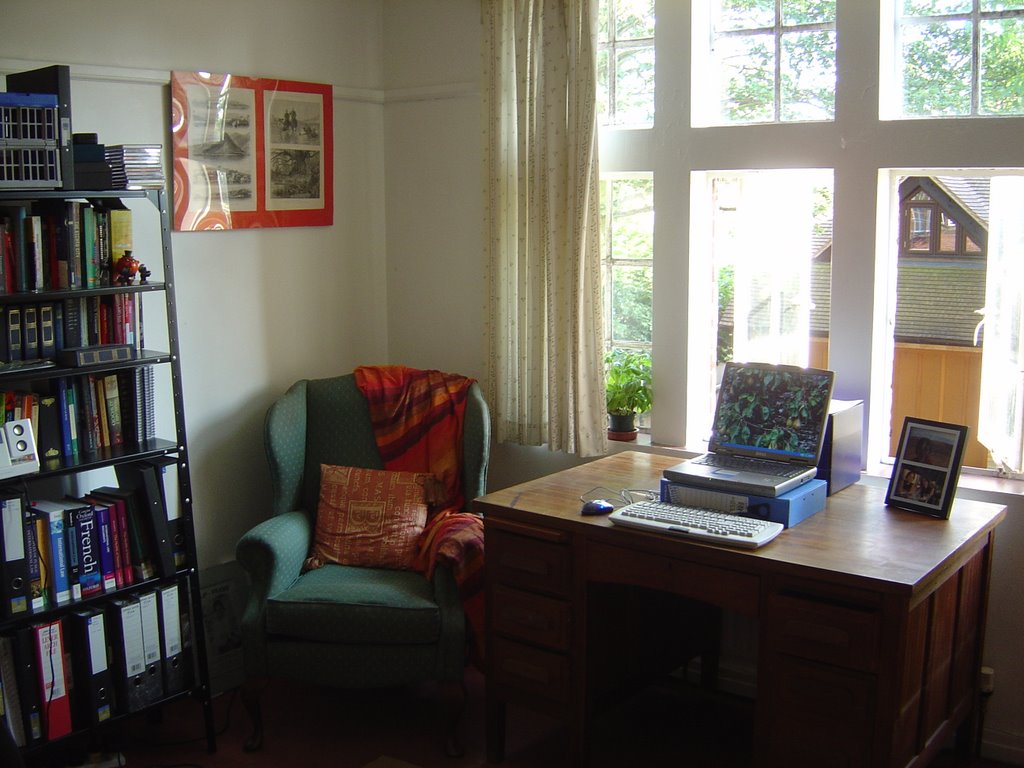
(New desk, click for bigger image)


I’ve often blogged about how often I move. However, the last two years in Cambridge I managed to stay in the same building and just upgrade rooms. Easiest move ever: just prop two doors open and carry everything up a flight of stairs.

Now, though, I’ve finally done it. Private accommodation, outside the sheltering womb of college and onto the UK rental market. After looking at some total dives, I got lucky. There’s a flat just behind the law faculty that’s been handed down through a few generations of Trinity Hall PhD students now. The location is ideal, the rent is very good and the carpets … well, let’s not talk about the carpets.

The flat is, a rarity for Britain, let without furniture. The system that’s evolved is incoming flatmates pay the out-goer for their room furnishing and the communal bits and bobs, then add and subtract as they see fit.

I immediately wanted to subtract a desk (huge, government issue, ugly with heavy metal filing drawers), a small wardrobe with vanity (less than 30 centimetres rail space) and a chest of drawers. The drawers were amusing. You could open three of four on any given day, but with few guarantees as to which. (“Right, I’m just about ready to go out … but it seems my socks and underwear are not. Hmm …”)

So I hit the local Salvation Army store where the finest in Cambridge’s veteran and slightly scarred furniture turns up. I found a big sturdy wardrobe, an impulse-buy armchair and a mock-Edwardian, seven-drawer writing desk. The nice people there even said they’d take away my old furniture as a donation (and, frankly, a kindness) when they delivered.

I paid up and turned to leave when I saw the fateful sign: “It is your responsibility to check furniture will fit through your doors.”

I measured the width of my new desk. About 80 centimetres and thought of the narrow front door to the new flat. “It’ll be fine,” I thought.

Getting home, I measured the back of the door, 81 cm, and sighed with relief.

Then realised the door has a thickness. Opened, the thickness of the door would have to be subtracted from the width of the frame. I measured the door's thickness, 4 cm.

“It’ll be fine!” I thought, not very convinced.

Next day the Salvo’s arrived and genially hauled my first piece up the stairs: the desk. Lining it up with door, it just wouldn’t go through. It couldn’t be angled around as the stairway was too tight, the door opened into a tiny vestibule and the desk’s sides were solid.

“Um,” I said in desperation, “if you lend me a screwdriver, I’ll take the front door off its hinges.”

So, they schlepped to and fro with furniture old and new(er), while I removed the front door and parked it inside.

The desk was heaved up again, rotated on its side and gently eased towards the door frame. And stopped.

“Just needs another quarter of an inch,” one of the deliverers said. “Tell you what. Take the screwdriver and see if you can get the top off.”

Fortunately, it looked like this had been done before: a variety of screws secured the writing surface on only three sides. With the top off, it slid through. Just.

“You like this because it had character, didn’t you?”

“Yes,” I answered sheepishly, “I guess I just didn’t realise how much.”

“Hmm. Do you want us to stay while you reassemble that, or are you going to buy a screwdriver?”

Sunday, June 25, 2006


May Week once more

Any week that ends with you having the champagne (well, Cava) stains dry-cleaned out of your pale linen suit has to be May Week.

For those who've not been lurking around this blog that long, or have but haven't paid much attention, May week is a week in June that celebrates the end of the academic year with Pimms-drenched garden parties and stay-til-dawn College balls.

This year I hit the garden party circuit harder, and kept myself to one college ball, going to the Caius (say "keys") Ball with a group of PhD mates.

That said, I may be getting old and jaded. I was feeling tired after just two days of steady-but-never-roaring-drunk drinking and pushinng on until dawn at the Caius ball felt particularly rough between about 2.30 and 4 am.

However, once dawn started to break around 4 (it hadn't been properly dark until 9.30 anyway) I perked up remarkably and went in search of a black coffee and steak sandwich. (As opposed to the mixture of voda and fruit juice that got me through the chill morning that followed the Jesus Ball last year.)

Caius is a gorgeous college and it was a good night (a photo of the college at dawn to the left).

Unfortunately, the weather wasn't 100% with us. A light misting rain was falling a lot of the night. It was that typically English rain that if you stood out in it long enough would never be heavy enough to soak you through, but you would start to grow moss. It was mostly only visible in the spotlights, but did put a dampner (no pun ...) on the outdoor activities.

Even the music venue tent wasn't totally spared: a gust of wind could send water crashing off its non-existent eaves onto anyone unfortunate enough to be at the fringes.

Still, good food, drink, company and some memorable comedy and music acts in a wonderful setting. Even if the dining room of the Senior Parlour looked mock Greco-Roman in a Las Vegas kind of a way ...

Tuesday, June 13, 2006


Fun in the sun in France

So Monday I got back from five glorious days in the South of France. I won’t bore you with too many details, just photos.

The basic day consisted of rising around 10 for a breakfast of fruit, yoghurt bread and honey. We'd then leave the house at the crack of noon, and zip off to stand in a ruined Cathar fortress on a mountain ridge for a bit, going “Oooh, pretty.”

This was usually followed shortly by, “Right. Where shall we go for lunch?”

This in turn lead to several hours of eating far too much and washing it down with litres of Rosé, before crawling home for a nap and a late cheese-platter dinner.

It was great to see Beth, Peter and Jasmine and Clay in particular was an absolute legend for doing all the driving. This really was the neglected Southeast of France where doing anything definitely required a car.

In fact, we were so far off the backpacker and American tourist trail that the village where we stayed wasn’t even listed in Wikipedia or google!

The low tourist population was probably just as well, as few of the ruins we went to seemed very strict about safety. You knew something had to be really dangerous if anyone had bothered to install a hand-rail, safety fence or warning sign.

My French even held up to a conversation with an old guy in the markets at Narbonne about what a nice hat I was wearing. There’s even a photo of me in it over here.

The only downside was I couldn’t find anywhere to check my bags for my last solo day in Perpignan before my Ryanair flight home, and lugging them around felt rather heavy – especially when I was also probably carrying some surplus food. I must’ve eaten eight days worth of food in five …

Tuesday, June 6, 2006


Washing my underwear for France

Well, okay, maybe I should rephrase that. I doubt France has a terribly keen interest in my underwear.

I, however, after a day of fun-filled excitement at the IMO library now am packing for a five-day jaunt to France.

(Don’t knock the IMO, by the way, their headquarters are right by the Thames and they have a cafeteria with a roof garden with a stunning view of Westminster.)

Predictably, like all last-minute packers everywhere, I was short of underwear.

Anyway, that small crisis of hand-washing dealt with, I am travelling light, light, light. Just me, a day-pack and my ambiguously hand-bag-like, yet-still-manly shoulder-bag. No checked luggage for me!

I’m headed to Perpignan to join the Beth travel extravaganza in Padern for a bit. Should be awesome.

See you in a week, if I remember I still sort of have a blog.

PS The photo was from my IMO day trip, taken on the Albert Embankment, where I also saw (but stupidly forgot to take a photo) Met Police officers on mountain bikes practicing cycling down stairs, to the bemusement and delight of passing Japanese tourists.

Saturday, June 3, 2006

Official charity plug: "Walk with a Rose"

The observant would have noticed the "official charity" bit I added to my sidebar last week. The curious might have asked "Walk with a Rose, what's all that about?"

"Walk with a Rose" was set up in my home town, Canberra.

It is an eight-week long walk from Brisbane to Canberra by Amy Banson to raise awareness of, and money for, acquired brain injury (ABI).

ABI refers to any brain injury acquired after birth, usually as a result of an accident.

It can result in symptoms such as memory and concentration problems, dependency, irritability, poor problem solving skills and depression. These may be mistaken for being lazy, childish or just hard to get along with.

What's important to realise is that people with a brain injury might exhibit no physical symptoms and still be unable to work or look after themselves.

The short of it is, over 340 000 Australians have an acquired brain injury, of these over 160 000 need daily assistance in living.

The majority of these, even the most profoundly disabled, will be cared for by loved ones at home.

Obviously, carers need a break, and there's a lot that could be done to expand respite care provision - especially at the best facilities that can offer Australians with brain injuries a genuine holiday themselves.

The aim of Walk with a Rose is to raise money to help pay for new facilities at existing respite care centres so more carers can get a break.

The walk's already attracted corporate support from ACTEW/AGL in Canberra and the endorsement of the National Brain Injury Foundation.

So if you were thinking of giving something to charity in the near future,
do consider the "Walk with a Rose" campaign.

More details and on-line donations at: www.walkwitharose.com.au.

Saturday, May 27, 2006


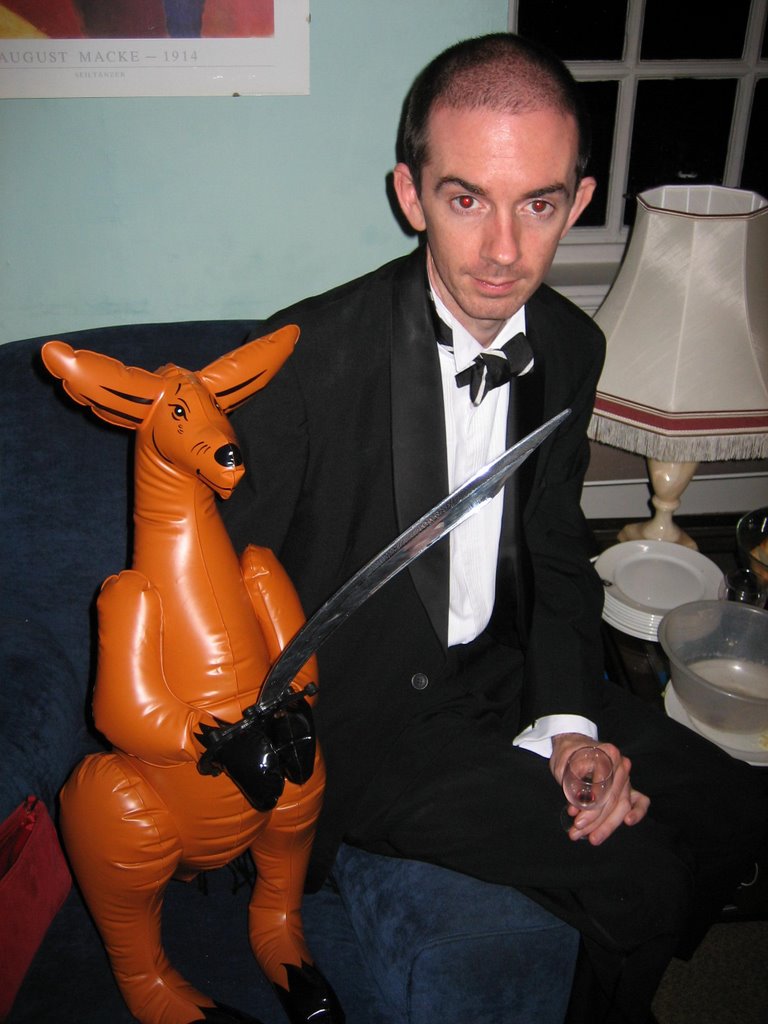
An international lawyer and his pirate kangaroo.

Monday, May 15, 2006

Stumped!

Something of an inglorious start to the cricket season.

There is an unfortunate assumption in England that all Australians know how to play cricket. Fortunately for me the standard for entry into the Trinity Hall graduate cricket team is: “Have you eve caught a moving object?”

In the sense that it is vital a team have an eleventh man to be allowed to play, I am vital.

In fairness, I’m not a bad fielder. Not a particularly good one either. I can’t bowl, and can generally just about block a ball with a bat. My best contributions are probably made in close proximity to the score-board, or zealously guarding the boundary line from balls that slip past the inner ring of fielders.

Still, I like the standing about out doors, the occasional running, the ebb and flow of the game and the really devastatingly excellent afternoon teas put on by our MCR stewards and treasurer and usually billed as “as big as the whole world!”

Which would be true, if the world were made entirely of cucumber sandwiches, strawberries and cream and Pimms mixed according to our treasurer’s secret recipe.

So you’ll imagine things are looking a bit grim if I’m sent in to bat. In our first game Sunday against Churchill college, we bowled first and were set a chaseable target of 122 from 20 overs.

Unfortunately, we suffered a bit of a mini-collapse, and while the run rate was on target, we were going through batsmen.

When I was one of the last three on the bench I headed out to the nets for a warm-up.

Ludicrously, my legs were too thin to do the pads up with the Velcro and I had to tie the straps in a knot. Still, I had fun in the nets, and by the final over was never expecting to hear the call.

Then, on the third ball of the final over we lost a batsman. The score was 121. One run to tie, two to win, three balls remaining as I trudged out to the pitch.

Our penultimate batsman was facing the bowler. With three balls left, I figured anything he hit might require running. So I edged forward from my crease, sort of forgetting it was his job to call the runs.

A nice straight block sent the ball back down the pitch towards me, where a quick-witted fielder took it, saw me out of my crease, and pegged it at the stumps.

A lunge with my bat was, lamentably, not enough to save my ignoble 45 seconds on the pitch.

Still, at least everyone on the team – and I do mean just about everyone – was courteous enough to think the result close enough that it was some decisive personal contribution of their own that had sealed the defeat.

A good game though, and a great result for Churchill who were so short of players last year that I was sent in to bat for them …