Tuesday, March 21, 2006

Lawyers, wildlife and metaphors

Funniest opening for a professional article I’ve read in a while:
“Most lawyers do not spend a lot of time camping in the wilderness, and probably very few have ever come face-to-face with a cougar. But confronted with that situation, any good lawyer would know in a flash that it is essential to escape without getting eaten. Risk management and goal assessment are among the profession's most indispensable skills.”

If you’ve ever gone on a hike in the States without memorising “16 different anticougar gambits” prior to departure you’re clearly not a litigator.

It’s all from piece by Steven Lubet in American Lawyer about lawyers and their excessively risk-averse and detail-obsessed behaviour, or as he puts it “cougar-spotting”.

How to tell the difference between obsessive time-wasting that pads a client’s bill, and catching the trick that’s going to cost your client a bundle?

Where a safety-first mentality has become redundant is clear in “over-lawyered” contractual clauses using every possible synonym for debt.

(“Hey Tony. This wise guy says because his contract wit’ us covers ‘arrears, bills, checks, chits, claims, commitments, damages, debentures, debits, dues, dues, incumbrances, invoices, liabilities, manifests, mortgages, notes, obligations, outstandings, receipts, tabs, tallies and vouchers’, his ‘gambling markers’ are excluded. Whaddya say?”)

The ordinarily useful attention to detail is demonstrated by a, for example “a ‘risk of loss’ provision [in real estate transactions], in case the property burns down between the contract signing and the closing date. That doesn't happen very often, but it's a cougar when it does.”

But then we have that fabulous anecdote, the one time payoff that justifies (or provokes) a lifetime of obsessive behaviour:
“A litigation partner at a large Chicago law firm told me that he always personally examines the handwriting on the significant documents in his cases, whether or not there is an allegation of fraud. That may seem pretty aggressive (and time-consuming), but he once noticed that two signatures-one on a letter and the other on a promissory note-seemed virtually identical, down to the last squiggle. Consulting a handwriting expert, he learned that no two signatures are ever exactly alike, unless one has been copied or traced. And sure enough, it turned out that a crucial letter had been forged. That successful bit of cougar hunting saved his client a couple of million dollars, and he has been diligently comparing signatures ever since.”

That’s why you’d hire a corporate lawyer, and why many sane people aren’t interested in being one. (Why didn’t the client notice the damn forgery?)

Still, it exemplifies nicely the trust no-one mentality of many law firm partners.

Monday, March 20, 2006

Why do women leave law firms?

A recent NY Times piece is asking the right questions, but is frustratingly slim on answers.
“People explain it simply as the fact that women have children, but so many other factors play into it … ”

Great, what are those factors? Well, they mostly seem to be poorly defined and explored intangibles.

The “roadblocks” seemingly include “errant mentoring, opaque networking opportunities, low-grade case assignments or arbitrary male control of key management committees”.

But then we’re back to discussing the:
“ ‘maternal wall’ on female lawyers … built on the unstated assumption among male partners that women who return to firms after having children will automatically be less willing to work hard …”
Okay, accounting firms apparently do better:
“Deloitte & Touche … has promoted and retained women by offering flexible working schedules, leadership development and career planning programs, and transparent and dedicated mentoring ... Deloitte also maintains generous sabbatical policies and outreach practices so that women who depart the firm to raise children have an easier time re-entering the work force — and rejoining Deloitte — when they are ready to do so.”
This sounds great, but is not explored in any more detail. So what’s the bottom line problem with law firms? Billable hours. Quelle surprise.
“Research … has also identified an inflexible, billable-hours regime as an obstacle to job satisfaction for both sexes, a trend that is more pronounced among the most recent crop of law school graduates.”

“… analysts says [billable hours are] increasingly cropping up as an issue for male lawyers as well ... Billing by the hour requires lawyers to work on a stopwatch so their productivity can be tracked minute by minute — and so clients can be charged accordingly. Over the last two decades, as law firms have devoted themselves more keenly to the bottom line, depression and dissatisfaction rates among both female and male lawyers has grown … many lawyers of both genders have found their schedules and the nature of their work to be dispiriting.”

Try downright depressing. One female colleague described her first two years in a law firm as “monkey work”: an intellectually unexciting hard slog a chimp could perform.

But wait, suddenly the key problem isn’t gendered? It’s just billable hours? At some levels this seems plausible, but only if you assume some men simply don’t notice not having a life beyond work, and hence more men stick around to make partner.

So, how did one successful two-partner marriage balance work and family, especially with one child with a learning disability?
“[They] engineered this by cutting back on their social calendar, sharing household chores and making sure that at least one parent was home for dinner most nights.”
Good on them for making it work, but forgive me if I think this vision of an absentee household staffed by help and family seems a bit grim. Yet this is the best life in a law firm can offer.

One quote that really rang true?
“Law firms like to talk about running the firm like a business … but they’re running on an institutional model that's about 200 years old … Most law firms do a horrible job of managing their personnel, in terms of training them and communicating with them.”
Indeed, their sink or swim mentality coupled with a business model that assumes a 30% staff churn rate has little need for retention or engagement with its “fee earners”. The day firms acknowledge they have an actively failing human resources model is the day any of this may change, for men or women.

Saturday, March 18, 2006

A hard week’s dining

Looking back over my blog, I’ve had surprisingly few entries about black tie dinners. Then again, even in the course of the usual end of term madness I’ve seldom been out to this many formal dinners.

The dining score-card for 8 to 15 March 2006 would read:

Total number of dinners out: 5, of which three were black tie dinners (one with academic gown), one with suit and tie, and the last a quite dinner with a mate.

Looking back, I came out of the gates too fast.

At the last “regular” grad hall of term on Wednesday the 8th, I had two friends come along from the Blind Wine Tasting Society. We rather lost sight (ha ha) of the fact that “blind tasting” is meant to be about sophisticated wine appreciation – not getting, well, blind.

Three people, four bottles, multiple car pile-up of hilarity ensues - lasting until 3 am that morning. My hangover, however, lasted much longer.

After a brief respite, on Friday it came time to dust the lapels of my tux, sponge the mud from the inner leg (didn’t I dry-clean this last time? no matter) and trot off to the undergraduate law society at St Catherine’s College annual dinner.

The observant will have noticed I am neither an undergraduate nor at Catz.

I was invited by my students as an external supervisor. I was touched to be asked, but flattered when I realised how few “externals” get invited to a lovely dinner for only about 30 people.

I could only suppose that to be invited you had to be regarded either as important or cool. As I’m not even remotely important, it seems my teaching style may have rendered me popular. A theory confirmed by being one of only two or so “oldies” encouraged to head over to the Catz bar afterwards – which mercifully had stopped serving alcohol.

Saturday saw me hand washing my one formal shirt and heading off to the feast of St Edward King and Martyr – yes, really – at Trinity Hall. This was my college’s thank-you dinner to those who’ve supervised (tutored) Hall students over the year. Three courses (including a fabulous saddle of Spring lamb) with wine, a cheese course, a digestive break where you stand and go into another room, then chocolates and fruit with claret, dessert wine port and coffee.

Afterwards the remainder of the wine, along with scotch and, oddly, beer was on offer in the Senior Combination Room – and it was good scotch.

Highlights of the evening included finding myself chatting with real enthusiasm about how my students were getting on, and the odd jibe about having been one of the elect invited to the Catz dinner.

Tuesday I headed out on the town with a friend who’s been to busy helping to write a UN report on top of her PhD to be seen much this term. After a decent dinner at the chain bar “Bar Ha Ha”, we repaired to the bar at Trinity Hall for our second bottle of vino and law chat.

Which kept me nicely in form for the black tie graduates end of term dinner at Trinity Hall on Wednesday, at which I neither drank excessively nor stayed out too late. No, really.

Anyway, so much to say that if I haven’t been blogging, it’s because I’ve been too busy eating.

Thursday, March 16, 2006

When the West Wing Fails You

Other than the odd burst of mindless flag waving, I love “The West Wing”. So, I was sitting down watching season four tonight, the episode where they decide – a little belatedly – to take legal advice on the consequences of assassinating a terrorist leader.

A terrorist leader who also happens to be an accredited diplomat to the US.

The discussion runs something like this.

President Martin Sheen: “Article 51 of the UN Charter allows a nation to wage war in self-defence.”

Lawyer: “The article is predicated on openly declared wars.”

Pres: “The world doesn’t work like that anymore.”

Lawyer: “The law does … this could be a war crime.”

No, no, no, no! Bad Aaron Sorkin, bad bad man!

Admittedly, I just supervised undergrads on this stuff, so maybe I have a bee in my bonnet.

Anyway: the UN Charter does not require declarations of war. Article 51 does not even mention war. It talks of an “inherent right of … self-defence if an armed attack occurs.”

Can you claim self-defence against terrorism? Well, it’s controversial. But I’d say after the Security Council in Resolutions 1368 and 1373 recognised the US’s right to act in self-defence following September 11, the answer has to be “yes”.

How far that right extends is a question for another blog.

The idea that law is graven is stone, anachronistically resistant to change and irrelevant to current concerns is also wrong. There is some scope for progressive re-interpretation of the Charter’s meaning in light of subsequent practice.

For example: there is, strictly speaking, no “veto” in the Security Council under the Charter. Certain votes require the “concurring vote” of all five permanent members. So there's at best a default veto: even an abstention by a P5 member should torpedo a motion requiring a “concurring vote”.

In practice, only express negative votes are counted under this rule and a blind eye is turned to abstentions. Despite the words plain meaning, their legal meaning has changed through their use in practice.

So, similarly, there’s nothing stopping the content of the words “self-defence” evolving over time.

So is such an assasination a war crime? Whether civilian leaders are legitimate military targets in a war is a debateable issue, as is the application of the law of armed conflict to a war on terror.

However, assassinating a diplomat returning to his own country is, one would think, rather against the spirit of the Vienna Convention on Diplomatic Relations.

For a usually relatively intelligent show, sloppy errors teenage delegates to a model UN should be able to pick up.

Sunday, March 12, 2006

Only in the UK ...

I am a big fan of BBC weather online. However, only the UK could need an icon for "sunny intervals with scattered snow."

Which was the weather Thursday before last: hence the photo below of my outside door.

Snow in March. Damned British weather.

Thursday, March 2, 2006

Great powers and legal subjects in the making of counter-proliferation law

It seems the nuclear club just got bigger. Certainly, India’s had nuclear weapons for years and has stood deliberately outside the NPT system. However, the Bush administration’s effort to accommodate its civilian power program in exchange for it being quarantined from military research and subject to IAEA safeguards is an interesting step towards containment and tacit acknowledgement of nuclear power status.

In part, the US is probably interested in seeing India (the world’s largest democracy, after all) become a counter-balance to China. What I’m interested in, though, is what the non-proliferation tells us about the structure of power in current international legal relations and law-making.

Gerry Simpson’s argument in his excellent Great Powers and Outlaw States is that the great powers adopt an approach to international law based on whether they think their power is waning or still growing. Those that are aware their era may be passing will favour a rules based system that attempts to cement their current position in place. This was the United Kingdom’s aim in negotiations over the UN Charter. The Security Council was a deal between a declining great power (the UK) and two still-rising great powers (Russia and the US). France and China were added essentially as afterthoughts: China in particular as a regional balance against Japan.

Thus, it is scarcely surprising in an era when the US feels its power to be in the ascendant it’s academics, politicians and policy-makers often seem impatient with current international law and want to push the envelope (far more so than their diplomats and generals). Meanwhile European powers cling to UN procedure as the touchstone of legitimacy. It was ever thus.

Simpson also puts the point that great powers politics usually results in several tiers of international rules. Roughly speaking, the great powers claim certain privileges or exemptions not available to others, the mass of law-abiding or “civilized” States live within the constraints and protections of the law, while demonized “outlaw” States are denied the protection of the law but are also subjected to an intensely discriminatory regulatory law (sanctions).

How does this play out in counter-proliferation? While there has been much talk of the US “hegemony” or a “unipolar” world, I do not think the US is claiming any special privileges as a sole super-power. Despite the rhetoric of the “war on terror” the US has not been prepared to claim unique rights only it may exercise, or declared a unilateral policy of great-power intervention (à la the Brezhnev Doctrine). Iraq looks increasingly exceptional: the final chapter of a previous era of intervention, not the herald of a new dawn of global regime change. It is an exception that proves no particular rule.

The US is acting, in fact, far more like a great power in a phase of consolidation rather than expansion. Like a consolidating great power it is interested in creating new, and discriminatory, legal structures that favour its position.

It does not openly disclaim that it is a subject of the law, but it is far more interested in being the first-among-equals within the club of law-makers. Legislators can make laws that apply equally to all, but will never realistically apply to them. “The law in its majesty forbids both rich man and poor man from sleeping under a bridge.”

It wants a system that preserves WMD among a club of “responsible” weapon holders and that prohibits others from obtaining them. Logically, this now dictates either sanctioning India, or brining it further into the fold. India, for its part, may finally have stepped closer to the seat at the law-making table it’s been after.

Next: the law-making club and the unequal international law of non-proliferation.

Monday, February 27, 2006


Only the finest in non-lethal weapons ...

Rabbits appear to have been troubling the gardeners where I live. The answer? These cute little (and, after one week, seemingly entirely ineffective) non-lethal rabbit traps.

The idea is that the rabbit is lured in by the tasty carrot, stands on the elevated ramp to get at it, the ramp then falls, in turn pulling the the pin holing the door open - and voila, caged bunny.

Shame the rabbits don't seem to like 'em and that the wind seems able to blow the doors shut ... I re-set one of them myself for this photo.

Saturday, February 25, 2006

Rap, rap, rapping the gavel of justice

Perhaps one of the finer moments of US Judicial humour in a footnote arrived in the my e-mail inbox in the form of the appeals judgment in US v Murphy (4 May 2005, 7th Circuit).

The case was about witness intimidation in – of course – a crack-smoking trailer park:
“On the evening of May 29, 2003, Hayden was smoking crack with three other folks at a trailer park home on Chain of Rocks Road in Granite City, Illinois. Murphy, Sr., who had sold drugs to Hayden several years earlier, showed up later that night. He was friendly at first, but he soon called Hayden a “snitch bitch hoe”(1) and hit her in the head with the back of his hand. He said he saw her name in discovery materials from his son’s criminal case and that she was responsible for putting him in jail. …”

The footnote at (1) reads:
The trial transcript quotes Ms. Hayden as saying Murphy called her a snitch bitch “hoe.” A “hoe,” of course, is a tool used for weeding and gardening. We think the court reporter, unfamiliar with rap music (perhaps thankfully so), misunderstood Hayden’s response. We have taken the liberty of changing “hoe” to “ho,” a staple of rap music vernacular as, for example, when Ludacris raps “You doin’ ho activities with ho tendencies.”

Delicious.

Friday, February 17, 2006

Iran’s nuclear programme: what’s going on?

Okay, so we’ve all heard the phrases: Iran has resumed uranium enrichment, it’s torn UN seals off research installations, the International Atomic Energy Agency (IAEA) might refer it to the Security Council.

Indeed, Iran’s chief hope of stalling UN action appeared to be negotiating with the E3 (France, the UK, Germany) and Russia. Now France’s foreign minister has said that as no civilian program could explain the Iranian nuclear program the situation is simple: it’s a clandestine military program.

What the hell is going on? Here’s my effort at an idiot’s guide. (My apologies that this has become a very long post).

(1) Isn’t Iran obliged not to pursue nuclear research under the Non-Proliferation Treaty?

No. Iran is a party to the NPT, but it only prohibits the non-nuclear weapons States (everyone but the US, UK, France, Russia and China) from having nuclear weapons. There is nothing wrong with a civilian nuclear power program, indeed Article 4 of the NPT preserves the right “to develop research, production and use of nuclear power for peaceful purposes.”

The other problem with the NPT is there’s really not anything much wrong with enriching uranium to weapons grade. There’s also no prohibition on a parallel weapon program that could be used to deliver a conventional explosive or nuclear bomb by missile. A State could do both legally, pull out of the NPT on three months notice, and then put them together.

It’s this lack of a safety margin that explains why everyone is so concerned about IAEA inspections, it’s the only guarantee of good faith that States are not moving to a weapons program (see below). It’s also a requirement under Article 3 of the NPT that all States sign up to an inspection program.

(2) What does it mean to “resume uranium enrichment”?

There’s a great diagram over at Le Monde. It’s pretty comprehensible even if you don’t read French.

The basics are these. Like most things dug out of the ground, unrefined uranium is not very useful. Refinement turns it into “yellowcake” powder, which is 75% uranium. Heated in the right conditions the yellowcake becomes uranium hexaflouride gas (or UF6). The UF6 can be refined into the seriously useful type of uranium (U-235) by spinning it in a centrifuge. As the Guardian puts it:
“Uranium is enriched by spinning it at supersonic speeds in centrifuges. Hundreds of the machines are needed to obtain enough material for a bomb.

Diplomats said in September that Iran could have serious technical difficulties in enriching uranium on an industrial scale, which requires getting the centrifuges to work in cascades.”
If you’ve got enough cascades of centrifuges to refine it, or “enrich it”, improving the concentration of U-235 to 3-5% you can run a power plant; refine it to a concentration of 90% you have weapons-grade material. The other possible problem is that a civilian nuclear power program may itself produce material useful in weapons.

(Scientists, correct me if I’m wrong, please.)

So, Iran is “resuming” this process because in 2002-3 it had its first go at it. When they were caught out by US spy satellites and agreed to let the IAEA in, the IAEA found uranium enriched to a level well beyond what was needed for a civilian program. In 2004 the IAEA accused Iran of being less than fully frank with it, and Iran agreed to a voluntary suspension of enrichment activity. This is where the talk of “UN seals” comes in: Iran let the IAEA secure the facilities.

There’s a useful timeline, again at Le Monde.

(3) What’s the fuss about IAEA inspections?

Put simply, the NPT requires parties to enter inspection arrangements with the IAEA but does not provide a lot of detail. In practice the IAEA has negotiated “safeguards” agreements, also called Additional Protocols, allowing strengthened inspection measures (such as visiting on short notice) with most parties to the NPT (there’s a table of them here).

The point of such inspections is to give the world confidence that nuclear material is not being diverted for military purposes. However, States commonly have concerns that IAEA inspections might allow commercially sensitive information to leak to other countries (essentially, a fear some inspectors might engage in industrial espionage). The tension between inspectors, hopefully acting for the global good, and State’s legitimate fears about sensitive information is reflected in Article 7 of the IAEA’s own Model Protocol on inspections, providing that the State and the IAEA:

“shall make arrangements for managed access under this Protocol in order to prevent the dissemination of proliferation sensitive information, to meet safety or physical protection requirements, or to protect proprietary or commercially sensitive information. Such arrangements shall not preclude the Agency from conducting activities necessary to provide credible assurance of the absence of undeclared nuclear material and activities at the location in question …”

Inspections in Iran have been carried out in accordance with such a Protocol.

The catch is Iran isn’t strictly bound by an Additional Protocol. One was negotiated between Iran and the IAEA in late 2003. It was signed, but it never entered into force.

It is quite common in international law for agreements not to be binding upon signature but only upon later “ratification”. This usually means taking the treaty back home and complying with any national law requirements before depositing an instrument of ratification, at which point the treaty may enter into force for the ratifying State.

Iran, however, has never taken the step of bringing it into force but rather has pledged to apply its Additional Protocol pending entry into force. So they can thus call their co-operation with the IAEA voluntary, and claim a right to stop it at any moment. It’s really a very clever legal strategy.

(4) So where to now?

The UN Security Council does not have to wait for the IAEA, legally speaking, before it declares that a State is pursuing a nuclear program that constitutes a threat to international peace and security. Once it has found such a threat, it can impose sanctions that UN members are obliged to implement.

The SC’s powers to protect international peace and security are sweeping. Even if Iran is doing nothing illegal under the NPT per se, or even if it withdraws from the NPT and is no longer legally bound by it – that’s irrelevant if the SC considers that it poses a threat to peace and security. So Iran's argument that it's not presently in legal or technical breach of NPT commitments may be - in a very narrow sense - correct; but that's hardly the point, especially given its history of trying to conceal part of its program from the IAEA.

What the IAEA process provides is a mechanism for diplomacy and a forum for Iran to build confidence that its nuclear program is intended only for civilian purposes. So why is it playing at diplomatic brinkmanship?

My guess is not that they necessarily want nuclear weapons, they want to pose a credible threat that they have the capacity to build nuclear weapons. When you’re sitting in a highly unstable region, and the US is busy redecorating in your next-door neighbours and has branded you part of an “axis of evil” – it’s not perhaps entirely unreasonable to want to possess your own nuclear deterrent.

It’s just a really high-risk strategy if what you’re after is security.

Update on Iran (20/02/06)

According to Reuters Iran now appears to have poured cold water on Russia's offer to enrich Iranian uranium within Russian territory (thus preventing Tehran from diverting it for weapons, but allowing a peaceful power program). While they may accept it, they will not abandon research into further enrichment.


Tuesday, February 14, 2006


(Image from BBC online)

Crossing the road safely with Dr Who: 70s style!

This is very odd, rather than "stop, look and listen!" we have Jon Pertwee explaining to ice-cream hungry youngsters how to "SPLINK!" - the most bizarre safety (non-)mnemonic imaginable.

Still, his suit and final facial expression are quite amusing.

Props to the BBC for digging out such archival treasures and putting them online. Shame about the picture quality, though.

Friday, February 10, 2006


Clearly not fearsome enough: students and food

A student back from Singapore gave me these tasty apricot filled baked treats after the Christmas break.

In addition, I've been invited to the annual law students' dinner at one of the colleges for which I supervise students (provide tutorials) in international law.

I'm guessing a college student law society is only going to ask you to attend one of these shin-digs if you're either: (a) important; or (b) regarded as alright/potentially fun to have around.

So, as I clearly wield no power at all, I'm guessing I'm doing OK on the whole fair-minded and dillgently prepared supervisor thing. Yay me.

I've also managed to lose my fear that my supervisees will find this blog (hi guys!).

Tuesday, February 7, 2006


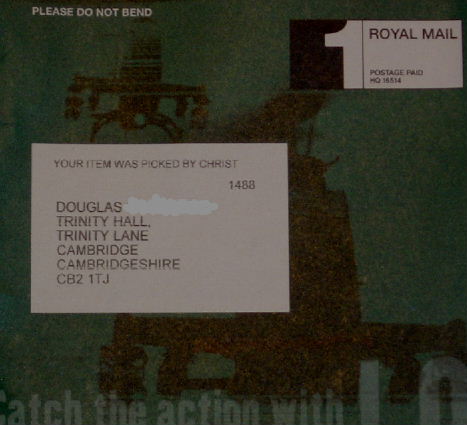
"Picked by" ... wow, He's working at the video store?

So, I subscribe to a DVD rent-by-mail service. It's a fantastic idea, I pay them 8 pounds a month and get four DVDs in the mail. No late fees, two at any one time, I post one back they post one out. I get to update my rental selections on line.

It's genius.

But there's still a human element. Someone, and I do mean Someone, has to pack the mail bag.

(Look closely at the "Your item was picked by line" above the address, if you haven't already.)

It does indeed look as though my increased attendance at evensong choral services in Cambridge has not gone un-noticed upstairs.

Yes, I know I should be blogging about Iran's nuclear program; or cartoons, free speech and religious respect - but this is too darn funny.

PS The DVD that arrived in this packet? "Monty Python: Quest for the Holy Grail." 100% fact.

Thursday, February 2, 2006


Big, ugly and very valuable: patagonian toothfish

People might remember the embarrassment for the Australian government, when the crew of the Viarsa 1 went free in November 2005 after being acquitted by a jury in Perth of illegal fishing in the Australian Exclusive Economic Zone off the Heard and MacDonald Islands north of Antarctica. It was the crew’s second trial, the first being abandoned when the jury failed to return a verdict. In the meantime they’d spent two years living in seaman’s hostel in Perth.

So, what’s all the fuss about fishing in Australian Antarctic waters?

Well, for a start the toothfish are supposed to be managed under the Convention for the Conservation of Antarctic Marine Living Resources 1980 (CCAMLR). While not being endangered, they do take 10 years to mature and over-fishing risks taking juveniles before they can breed.

Secondly, it’s big business. These are big fish (they can grow to over 2 metres) and the meat is worth a lot in US ( where it is sold as “Chilean sea bass”) and Japanese markets. The economics of their over-exploitation is remarkable.

Treves has succinctly describes the “common pattern” of IUU (illegal, unregulated and unreported) fishing for Patagonian toothfish in the CCAMLR area:
Fishing vessels flying various flags and most often involving Spanish interests … engage in long-term fishing cruises in the waters of the Southern Ocean. The wealth of the fish – especially Patagonian toothfish – in the vast expanses of the Southern Ocean, and the relatively remote chance of being caught while fishing in the economic zones of France (Kerguelen and Crozet Islands) and Australia (Heard and McDonald Islands), are the main attraction for such expeditions. The financial stakes are considerable, given that a full cargo of Patagonian toothfish can equal or exceed the value of the fishing vessel involved.

In two cases before ITLOS (the International Tribunal for the Law of the Sea) this proposition has been starkly demonstrated. When the Monte Confuco was seized by France the evidence before the Tribunal was that the vessel was worth $US 345,000 while its cargo of toothfish was worth approximately $US 1.5 million. When the Volga was seized by Australia the vessel was valued at $AU 1.8 million, and its cargo of toothfish was sold at tender for $AU 1.9 million. (See Tullio Treves, “Flags of Convenience before the Law of the Sea Tribunal”, 6 San Diego Int’l L.J. 181 (2004-2005), 181-2).

However, law enforcement in this part of the world is hard. It’s extremely remote and inhospitable environment with weather conditions often making boarding vessels dangerous, if not impossible. It’s no coincidence that most Australian boardings of vessels found fishing illegally have usually required military assistance and boarding by fast rope from Navy helicopters.

Some of these cases often involved lenthy hot pursuits in difficult and dangerous conditions: the South Tomi was pursued for 15 days across 3,300 nautical miles, while the Viarsa pursuit lasted 21 days and covered 3,900 nautical miles. Third States provided military assistance the eventual boarding of both the South Tomi (South Africa) and Viarsa (South Africa and the United Kingdom).

Thus, Australian experience suggests IUU fishing vessels are willing to go to significant and dangerous lengths to evade capture and are often under instruction not to surrender to law-enforcement vessels unless absolutely necessary. The risk-taking appears to be related to the potential economic gain.

It has been said that the profits to be made, given that only one or two voyages may be needed for a significant return on the cost of the vessel, make IUU fishing for toothfish potentially more profitable than drug or people smuggling (see Baird, “Coastal State Fisheries Management”, (2004) 9 Deakin Law Review 91).

This has driven Australia to described the practice before the CCAMLR annual meetings as “a highly organised form of transnational crime”.

Indeed, when Australia stopped the Lena and the Volga on the same day, it appeared that the two vessels were in communication and Australia led evidence before ITLOS that suggested these two Russian-flagged vessels were part of a larger IUU fishing fleet owned by one family through a company in Jakarta (see the Volga Case transcript, ITLOS/PV.02/02, p. 28 at ITLOS).

It just goes to show if there's enough money in it, there's nothing disorganised about crime.

Sunday, January 29, 2006

The Palestinian election

For what little my opinion is worth: I think the Hamas election victory could well become a step forward for peace in the Israel/Palestine dispute. I think Israel and the west will have no choice but to negotiate with the “Change and Reform” parliamentary party, and I think a new breed of Hamas politicians will have to distance themselves from terrorism and the core aim of the destruction of the Israeli state.

I am not about rewarding suicide bombers here, merely making a pragmatic prediction. Once Hamas has to govern, once it is responsible for tax collection, spending aid money and the day-to-day governmental grind of providing roads, water and schools – it is going to have a much harder job selling itself to its now (greatly enlarged) core constituency. Government involves compromise and the experience tends to soften radicals.

Hamas was not elected, it would seem, by a newly radicalised Palestine. It won as most oppositions do: because people were sick of the incumbents. These are not electors who will be impressed by renewing the insurgency against Israel: they want a functioning economy, basic services, and freedom of movement through Israeli managed checkpoints. Those will be the yardsticks of Hamas’ success or failure now: not its ability to cause bloodshed.

It will be in the new parliamentary Hamas members’ interests to clamp down on militarism or distance themselves from it. If they want international credibility and the aid money that goes with it, they’ll have to.

Further, Israel is still the occupying power throughout much Palestinian territory and is thus responsible for basic services. Getting the occupying power to fulfil its obligations means negotiating with Israel, which some Hamas leaders already do.

On the other side, if Israel wants security in its own borders, it has to solve the Palestinian question. And if it won’t negotiate with Hamas who will it negotiate with? Permanently closing the border and leaving the Palestinian economy to (further) stagnate and the Palestinians to starve isn’t a realistic option. Which means refusing to talk to terrorists isn’t an option: though it may be a tactic to try and wring concessions from Hamas about a strengthened cease-fire and modifying its charter goals.

A Hamas parliamentary wing, let alone a government, gives the international community significant leverage to hold the militants to account. The difficulty will, of course, be in how all players manage any splinters of Hamas who inevitably decide in coming months and years that the parliamentary wing are ‘sell-outs’ and go it alone.

Thursday, January 26, 2006

Cime of the day

An exercise of universal jurisdiction is where a State makes it a crime before their courts for anyone, anywhere to commit a certain act. With this in mind I found the following passage drily amusing:

"... in United Kingdom law universal jurisdiction is asserted in sections 47 and 51 of the Anti-Terrorism, Crime and Security Act 2001, in respect of the offence of knowingly causing a nuclear explosion without authorisation. The Rule of Law is a wonderous thing."


(See Vaughan Lowe's chapter on "Jurisdiction" in Evans (ed), International Law).

Tuesday, January 24, 2006

"Clearly an act of stupidity"

One of the more bizarre local crimes to have been committed recently in Cambridge involves posting a hamster.

A couple of undergraduates living not that far from me decided to post a hamster in a bizarre act of revenge to a man who they claimed had threatened one of them. Apparently, after there had been complaints about a man loitering about their college (on one report kerb-crawling and abusing students) the pair had tailed a suspect home and become embroiled in an argument.

The reason given for such an idiosyncratic revenge:

"to cause confusion - I suppose to make him look after it".

That and they claim to have been "plastered" at the time.

The hamster, subsequently called "First Class", was saved from death by mail-sorting machine through the attentive intervention of a postman. The pair were found guilty of, and fined heavily for abandoning an animal in circumstances likely to cause suffering.

In a statement reproduced in student papers but not the mainstream media, the pair apologized but also made a comment about the the diligence of the RSPCA in securing their prosecution compared to the local police's activity to find the loitering man they blamed for their woes.

They also made a rather ill-judged comment about "society's priorities" and the number of lives that could be saved by a donation to Oxfam equivalent to the public costs incurred in their prosecution. Well quite. But hardly the kind of half-hearted expression of contrition likely to endear them to the general public, though certainly not crass enough to justify the subsequent (and cowardly) hate mail to one of their families.

Monday, January 23, 2006

Being foreign

I'd be the first to admit that Australian universities don't often do their peachy-fresh best by international students (especially given the cash they bring in) in terms of creating a smooth application process.

Indeed, now being a foreign student myself and subject to the varying whims and idiosyncrasies of Cambridge bureaucracies, I have some sympathy for the confusion and terror that can be engendered through the process of applying to study abroad.

I can even believe that there exist in parts of the world "education agents" to recommend universities to those wishing to study in Australia and who will, for a fee, guide them through the application process.

What a shame they may prove no more use in the application process than a bootful of old cheese.

From a friend working in foreign student admissions, I present the e-mail she wish she'd sent to one such agent:

"Dear Ms X,

Thank you for your utterly unnecessary letter regarding your client, Mr Y.

As I am sure you can appreciate, there are a very large number of students who choose not to complete their enrolment until the last minute. Nor is your assumption - specifically, that you are entitled to special treatment on the basis that you can operate a fax machine - unusual.

Your efforts are, however, made more unique by your timing, and I am gladdened to see that you take your responsibilities so seriously as to require urgent completed enrolments within hours of making payment. Such a keen work ethic is to be admired.

As a professional courtesy, may I take this opportunity to remind you that in the majority of efforts to increase efficiency, underlining doesn't work. This is true irrespective of how many times it is used. The same can be said of the use of an "urgent stamp". There is a well-established inverse relationship between how many times the stamp is used and how effective it is.

May I also suggest that in future, you carefully analyze where the important information is found on any given letter, and avoid marking that section with a stamp of any kind.

I would also recommend that you request from your employer that you be allowed to undertake further training in the basic functions of a fax machine. This will allow you to send each page of your faxes once, as opposed to sending the same page one hundred and fifty times.

Warm regards, etc"


Oh dear. Anyone else had their own work held hostage by the incompetence of others lately?

Friday, January 20, 2006

Jet-lag-o-rama

Sorry to have been absent a while. January ran away with me, and then became a downhill run to returning to Cambridge.

Some statistics (believe them or not!):

Total time spent in transit, door-to-door, from my parents house to my room in Cambridge: 34 hours.

Time spent hanging about at airports (Canberra, Sydney, Singapore, Heathrow), as opposed to flying: 7 hours.

Sleep gained on flight: 2 hours.

Number of movies watched: 5 ½ (Everything is Illuminated, The Corpse Bride, Must Like Dogs, The Constant Gardener, The Brothers Grimm and bits of Deuce Bigalow: European Gigilo).

Pages of international law material read on the flight: nil.

Number of sudoku (easy and medium only) attempted: 10

Number of sudoku completed: 9

Bus trip, Heathrow to Cambridge: 2 hours, 45 minutes.

Time difference between Eastern Australia and the UK: 11 hours.

Average time spent in bed before waking up desperately confused: 2 hours.

Current half-time score: jet lag – 5; Doug – 2.

Fortunately I have a weekend to get myself together before I begin supervising undergrads again on Tuesday. Shame I need to read Pinochet (No 3) in that time as well …

Tuesday, December 27, 2005


Holiday Reads, Part 3: "On Beauty"

Headline: a great talent, a little burdened by the easy cliché


I’ve been struggling to write something on “On Beauty” for a while. I think Zadie Smith is a terribly talented writer, but my response to this novel is a little ambivalent.

Let’s start with the good. Smith’s prose is exceptional. Her ear for speech and dialogue is fabulous, and her ability to inhabit the skin of a character regardless of age or gender compelling.

The story gets off to an interesting start. The Belseys are a mixed race family: Howard is a British academic living in the US who has trouble with faculty politics and thus getting tenure; Kiki is a black American woman, political rather than intellectual, and a hospital administrator. The marriage thus embodies some neat tensions of class, politics, practice/theory, and culture: boundaries the children of the marriage need to negotiate.

It is a tribute to her sympathy for her characters that despite all the stupid, hurtful and wilfully self-obsessed things Howard Belsey does, I found it impossible to entirely dislike him. Indeed, I felt a certain sympathy for him, which Smith seems to feel herself. This is pulled off not through any especially redeeming features on Howard’s part, but because (as with all the characters) when we see the world through his eyes, it is drawn so compellingly in Smith’s lush observational prose.

Also, Howard finishes the novel humbled if not repentant. Ultimately, despite all the damage done to himself and others, Howard’s acts seem adolescent rather than mercenary. He profits little by them and does not really aim to; he stumbles into things out of a failure to appreciate consequences which a man should really have outgrown by his fifties.

However, by writing in the mode of affectionate academic satire, there are ideas the Smith excuses herself from pushing further. Howard’s refusal to engage with emotion or aesthetics (he claims to hate Mozart and has founded an academic career on the idea of Rembrandt as a merely competent tradesman) comes off as wilful affectation. Rather than portray him as one “clinging to his rhetoric of disenchantment as if it were a religion” (to quote an excellent Slate article), Smith leaves Howard apparently without strong beliefs - making many of his actions seem like parts of a childish game.

More to the point, Smith creates a bevvy of interesting characters some of whom dissapointingly lapse into jargon or ultimately conform to stereotype before simply evaporating by the end of the novel. The final moments of confrontation and resolution also seem rather, well, stage-managed.

Smith has the potential to be a writer of much wider scope, and I’d hate to see her lose her warmth and humour to write “serious social novels”; but somehow when her novels come to rest on comedy and satire for their resolution it feels a little like cheating.

Sunday, December 25, 2005

Holiday reads part 2:
Brett Easton Ellis, “Lunar Park”

Headline: Beth said it best


I was keen to check out Lunar Park after it made Beth’s top 5 for 2005 and was drawing praise from other friends as well.

I devoured it over two days, and Beth’s assessment of it being by turns “hilarious, clever, spooky, then sad” is spot on.

It’s actually the first Ellis I’ve read, and the (supposedly) autobiographical introduction is an enormously witty “imitation of himself”, a stylised and at least partially true account of his rise to prominence and the “American Psycho” controversy. I’ve never had the stomach to read “American Psycho”, but trust the reviews that the film captured much of the humour and ambiguity while omitting the baroque violence.

If “American Psycho” was fundamentally a parody of the emptiness of money-obsessed big city America, then “Lunar Park” is an excoriation of the emptiness of suburbia - and a pretty compelling post-modern horror novel. The “emptiness of suburbia”, you say, isn’t that a bit trite; a little twee and “Desperate Housewives“?

It’d be a fair criticism, if this weren’t a novel first and foremost about materialistic, status-obsessed parenting and how a generation of parents driven by personal freedom are as capable of screwing up their kids as their hidebound 1950s parents. The depiction of lethargic children on a cocktail of behavioural drugs at a “rehearsal party” supervised by a paediatrician is as funny as it is awful.

(The parent/teacher night gag about appropriate ways to draw a “normal” platypus is also a small gem.)

That and it’s a novel about being haunted by the memory of your father and a seriously nasty novel you once wrote, as well as … well, the forces of supernatural evil (maybe).

It is also wildly clever. The author-turning-himself-into-character shtick has seldom been done so well, deftly manipulating the conventions of both “I-never-knew-my-father” autobiographical fiction and the straightforward small-town horror genre. (His heavily ironic disclaimer about having done no research into the “true” events of the novel is also an overdue call for a return to imaginative, as opposed to footnote-driven, fiction.)

Despite the trappings of autobiography, one is left with the distinct impression you know little more about Ellis, other than the fact he’s a damn clever writer.